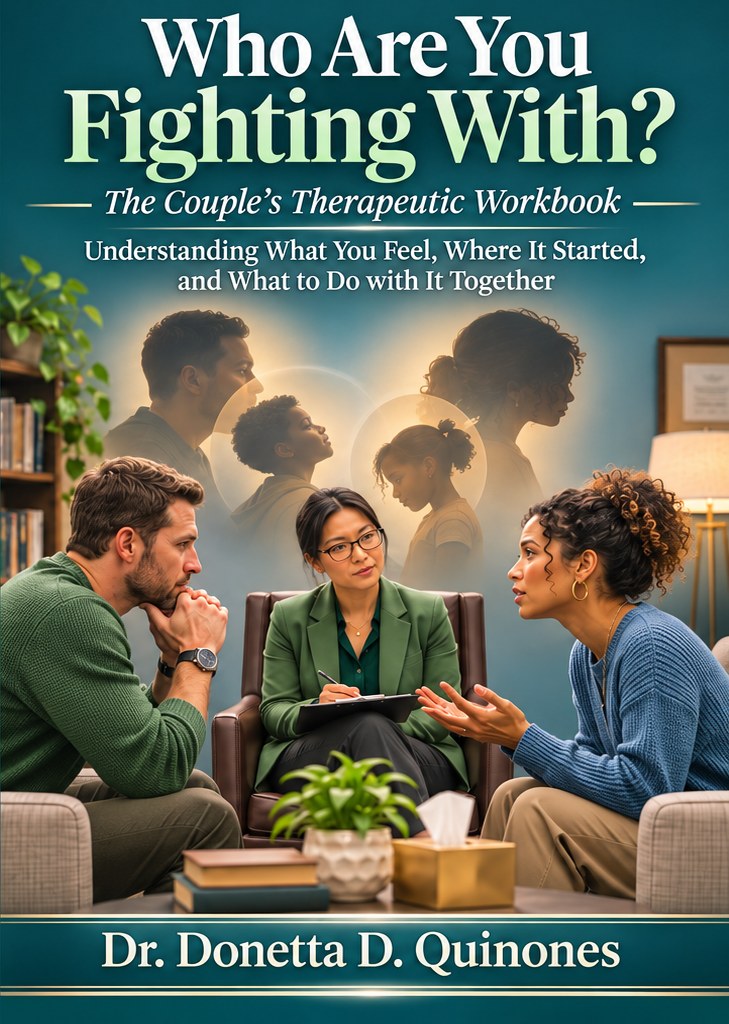
Who Are You Fighting With?
The Couple's Therapeutic Workbook
Understanding What You Feel, Where It Started, and What to Do with It Together
Dr. Donetta D. Quinones
GraceRoot Institute · Houston, Texas
Copyright
Who Are You Fighting With? The Couple's Therapeutic Workbook: Understanding What You Feel, Where It Started, and What to Do with It Together
© 2026 Donetta D. Quinones, PhD, LMHC, LPC. All rights reserved.
Published by GraceRoot Institute · Houston, Texas · graceroot.institute
Reproduction. The purchaser may copy pages for personal use. Clinicians may not copy the workbook for clients; the reproducible set is in the clinician manual, Who Are You Fighting With? Three or Four People in the Room. Otherwise, no part may be reproduced without the author's written permission, except brief quotations in reviews.
Educational use. This workbook is designed for use alongside counseling. It is not therapy by itself, and it does not create a counseling relationship with the author. If you are in danger, call 911; in a crisis, call or text 988.
Composite characters. The couples in this book are fictional composites; no real person, couple, or client is described.
Scripture. Unless otherwise indicated, all Scripture quotations are taken from the Christian Standard Bible®, Copyright © 2017 by Holman Bible Publishers. Used by permission. Christian Standard Bible® and CSB® are federally registered trademarks of Holman Bible Publishers.
Skills. The skills in this workbook are DBT-informed; this is not a DBT program. Skills adapted from Linehan (2015).
Trademarks. Relational Integrity™ and the Emotional Regulation & Relational Integrity™ materials are the author's own, © Academic Research Solutions, Inc. / GraceRoot Institute, used by permission. Films, songs, and characters mentioned are referenced for commentary and teaching; their trademarks belong to their owners, and this workbook is not affiliated with, sponsored by, or endorsed by any of them.
First edition, 2026.
A Note Before You Begin
This workbook is designed for use with your counselor.
That sentence comes first because it is the most practical one in the book. Your counselor knows your story and this book does not, so when the two seem to disagree, go with your counselor. A workbook without counseling is a gym bag without a membership: the right equipment, and nowhere to use it.
Who this book is for. It is for two people who keep having the same argument and would like to understand it rather than win it: the couple who loves each other and is worn out, the partner who agreed to come mainly because the other one asked, and the engaged couple who would rather learn this before the wedding than after. Every page assumes that both of you can raise a concern, badly, and still be all right afterward.
Who it is not yet for. It is not yet for a relationship in which one person is afraid of the other. That is not a verdict on anyone’s worth or future. It means the order changes: when there is fear in a house, the first job is safety, and exercises done together can make that job harder.
Here are eight questions. Answer them in your head; you do not need to write anything down or tell anyone what you answered.
- Are you afraid of your partner?
- Is there anything you don’t say because of what might happen afterward?
- Has anyone pushed, grabbed, held, hit, or choked you, blocked a door, or taken your phone or keys during an argument?
- Has anyone broken or thrown things, hurt a pet, or driven in a way that frightened you when they were angry?
- Does anyone check your phone, messages, location, or spending, or control money you earn or need?
- Has anyone kept you from seeing friends or family on your own?
- Has there been pressure around sex, where saying no had a cost?
- Has anyone threatened to hurt you, themselves, or the children, or to take the children, if you leave or say no?
How to Use This Workbook
Most couples who pick up this workbook already know their fight by heart: the opening line, the turn, the door, the long quiet afterward. What they do not know is who else has been in the room for it, and that is the “it” these pages will help you figure out, without either of you having to be the villain.
Every module follows the same pattern:
1. If You Have Ten Minutes. The heart of the module on one page. On a hard week, this page is the whole module, and that counts. 2. The Room. A scene with a couple who are not you but may sound like you. They are composites, blends of things many people say and do. 3. What Is Happening. The teaching, in plain words. 4. My Pages. Worksheets for you alone. 5. Our Pages. Exercises for the two of you, only after your counselor says so. 6. The Older Story. A reflection on God’s character, or on someone in Scripture who wrestled with the same thing. 7. This Week and Bring to Session. One practice to track, and one question for your next appointment.
My Pages and Our Pages are different on purpose. A My Page is yours and is never handed to your partner, so it can hold the honest version without anyone quoting it back to you on a Thursday night. An Our Page is done together, and only after your counselor has met with each of you separately and agreed that joint work is safe. Skipping one never needs a reason: “Our counselor wants us to wait on this one” is always enough.
Let your counselor choose the module. Your counselor is following your situation, not my table of contents, so work on two modules at a time at most. A couple who reads all twelve on Saturday will usually have a very well-informed argument on Sunday, and nothing else.
How sure anyone is. These pages offer ways of understanding what may be happening between you, not a diagnosis of either of you, and I use plain words to say how settled each idea is:
- When I write “research shows,” the finding is well established.
- When I write “studies suggest,” it is well supported, with limits.
- When I write “many counselors find,” “one way to understand this,” or “in my work, I use,” you are reading a clinical map or one of my own models. It is a way of looking at it, not a finding, and if it does not fit your life, set it down.
- When I write “you may have heard,” a correction is coming.
A word about faith. This book is Christ-centered, and each Older Story is an invitation to sit with God’s character, never an instruction for winning an argument. No verse here is meant to end a conversation, settle who is right, set a deadline for forgiveness, or keep anyone in danger. If one is ever used that way in your house, tell your counselor.
Where to Keep This Book
A workbook works only if its pages can tell the truth, and they tell the truth only when the person writing knows they are private. Keep this one somewhere that is yours: a bag you carry, a drawer nobody else opens, a shelf at work. If privacy at home is uncertain, keep a second copy elsewhere, or use this web edition on a personal device with its own passcode.
No one owes their partner what is written on their My Pages, and reading them, with or without asking, is not part of this work. If you want to share something you wrote, say it in your own words in your counselor’s office, a far better setting than the kitchen table at eleven at night.
If anyone in your home reads your things, uses what you write against you, or makes you afraid to keep a private book at all, do the My Pages in your head or with your counselor or an advocate, and tell your counselor at your individual session. That is no longer a storage question; it is what A Note Before You Begin is asking about.
Where We Are
For use with your counselor.
This page is a map, not a scoreboard. Check a module when you open it, write the date, and mark the last box when your counselor sent you there. Some modules take one week and some take five, and coming back to one is not failing it.
| Module | Title | Opened | Date started | My counselor assigned this |
|---|---|---|---|---|
| 1 | Before We Start | |||
| 2 | The Break That Comes Back | |||
| 3 | Three or Four People in the Room | |||
| 4 | Round and Round | |||
| 5 | The Emotional Chain | |||
| 6 | Present but Not There | |||
| 7 | What I Built to Survive | |||
| 8 | Three Columns and the Search Party | |||
| 9 | Check the Facts | |||
| 10 | Say It with Integrity | |||
| 11 | Repair That Holds | |||
| 12 | Wise Mind and the Long Run | |||
| Appendix | The Individual Track |
Using This in a Group
A note for counselors and ministry leaders
Many couples will meet this workbook in a church marriage ministry, a small group, or a class. It works there, within limits worth stating plainly at the first meeting.
What groups use. Groups use the teaching pages (If You Have Ten Minutes, The Room, What Is Happening, The Older Story, and This Week) and the My Pages; talking about Joaquin and Lorraine is much safer than talking about your own spouse. Practices that involve a partner, such as a timed break or a repair, can be taught and discussed in a group as information. Couples practice them with each other at home, and only after a counselor has met with each partner separately, because a break or a repair handed to a couple nobody has screened can be used as a weapon.
What stays inside counseling. The Our Pages, the safety questions in A Note Before You Begin, My Page 1D, and anything about a specific partner. No group leader can meet the Our Page condition by being kind and well-intentioned.
What facilitators do not do. Facilitators do not collect, read, or check the My Pages, or ask anyone what they wrote. Ask “what did you notice” instead, so sharing is always a choice, and partners do not compare My Pages, in the group or on the drive home.
Copies. Each participant needs their own workbook or web edition. Please do not copy My Pages for the group, even for someone who forgot their book; a borrowed page is not a private one.
When one spouse comes alone. A person whose spouse is not ready, or not coming, is welcome and loses nothing on the My Pages. Point them to the Individual Track at the back of the book, which was written for exactly that week.
A simple shape for a group night. One module fills sixty to ninety minutes. Read The Room aloud and ask what people noticed about each person in it and what each one might be protecting. Teach the main idea in your own words, then give ten quiet minutes for one My Page, with no sharing afterward. Read The Older Story together and ask what it shows about God’s character. Close with the This Week practice, reminding couples that anything involving a partner waits for their counselor. Four questions work in any module: What did you notice in The Room? Whose side did you find yourself on first, and why? What surprised you in The Older Story? What would make this week’s practice hard, and for whom?
When someone tells you something. I often say that the church is a hospital: hurting people are there, and hurting people can hurt others, so teach your group to choose wisely whom they share personal information with. If someone tells you they are afraid of their partner, thank them, speak with them privately, give them the Hotline number (1-800-799-7233, or text START to 88788) and 988, and help them find a counselor who will see them alone. Do not counsel the couple together, repeat what you heard to the other partner, or use Scripture to ask anyone to stay, submit, or forgive on a schedule. Here a well-meaning leader does the most good by doing less, privately.
A free group leader’s guide is available at graceroot.institute.
For Your Counselor
This workbook is the client companion to Who Are You Fighting With? Three or Four People in the Room. It follows the manual’s sequence and uses its wording for every shared tool, so a client hears one set of rules, not two. The skills in Modules 1, 2, 5, 9, 10, and 12 are DBT-informed and adapted from my worksheet Emotional Regulation & Relational Integrity™; skills adapted from Linehan (2015). This is not a DBT program, and it should not be described to clients as one.
Before any Our Page. Complete the Appendix D screen with each partner individually, and re-screen at week six and whenever circumstances change; the gate on every Our Page works only if you give the go-ahead deliberately. Where the screen finds fear, monitoring, or control, conjoint work stops, the Our Pages stay closed, and the client at risk can use the My Pages and the Individual Track with you. IPV screening is the condition of this whole book, not one of its modules.
Faith. For clients who do not want faith integrated, use the faith-neutral handouts in the manual’s Appendices C and E, which carry the same tools without The Older Story.
The order. Module 9 sits in Part Four but stands on its own, so you can assign it at Session 5, where the spine places its handout. Its Handout 12 section belongs to Session 13 in the spine and can be assigned with Module 11. Module 1 uses only the Handout 14 checklist; the rest of Handout 14 is in Module 11.
| Module | Manual chapters | Sessions (Appendix F) | Handouts |
|---|---|---|---|
| 1. Before We Start | 22–25; App. D | 0a, 0b, 1 | 14 (rules of engagement only); 10A (short form) |
| 2. The Break That Comes Back | 14, 18, 20, 29 | 3–4 | 3, 10 |
| 3. Three or Four People in the Room | 1, 18, 24 | 1 | 1 (neutrality) |
| 4. Round and Round | 10, 13, 18 | 2 | 1 |
| 5. The Emotional Chain | 11 | 4 | 4, 9 |
| Module | Manual chapters | Sessions (Appendix F) | Handouts |
|---|---|---|---|
| 6. Present but Not There | 2–5 | 7–8 | — |
| 7. What I Built to Survive | 6–9 | 9 | 6 |
| 8. Three Columns and the Search Party | 26–27 | 11–12 | 7 |
| 9. Check the Facts | 13, 15 | 5 (Handout 12: 13) | 11, 12 |
| 10. Say It with Integrity | 13, 18, 21 | 15 | 2, 13 |
| 11. Repair That Holds | 19, 28, 29 | 10, 13–14 | 5, 14 |
| 12. Wise Mind and the Long Run | 25, 29 | 16 | 15 |
| Individual Track | 12 | Individual work | 8 |
Reproduction. Purchasers may copy pages for their own personal use. Please do not copy the workbook for clients; the reproducible set is in the manual.
Part One: Safe Ground
There is an old piece of advice about roofs: fix them on a dry afternoon, because nobody can do it in the storm. Part One is about the ground underneath you before anyone climbs the ladder. Its two modules do not try to solve the argument you came in with. They give you a plan for the next hot moment, a break that comes back, and a set of rules you agree on while you are calm, so that the harder work in the rest of this book has somewhere safe to stand.
Module 1: Before We Start
If You Have Ten Minutes
Most couples come to counseling ready to fix the fight, and the first thing a counselor usually asks for instead is a plan for the next time a conversation gets hot, because a plan written on a calm Tuesday is the only kind that works on a loud Friday. Write your first draft below, four answers you could remember with your heart pounding; Module 2 builds the full version.
My Page 1A: If It Gets Hot This Week
This page is yours. You decide whether anyone else sees it.
(Safety first: if anyone reads your things, do this in your head or with a counselor or advocate.)
The first sign I will notice (in my body, my voice, or what I start doing):
The exact words I will use to call a break:
Where I will go:
When I will come back (a time, not “later”):
This Week: Keep one rule of engagement for seven days. Choose it yourself from the list on Our Page 1E; doing that page together waits for your counselor’s go-ahead.
The Room
Have you ever started a hard conversation already holding the receipts?
Joaquin Villarreal brought his in a folder. He is thirty-eight, broad through the shoulders from years of hauling condensers up attic ladders before his company moved him inside to dispatch its trucks, and he arrived ten minutes early in a pressed work polo. He had two typed pages, numbered, with dates, and item seven had a sub-point. Joaquin spends his workdays turning eighty phone calls about broken air conditioners into routes that get every truck where it needs to be by five o’clock, and he came to his marriage the same way. “I just want everything on the table so we can knock it out,” he said. “Tell me what to fix and I’ll fix it. I’m not trying to win. I’m trying to be done.”
Lorraine came straight from after-school sectionals, forty years old, with a pencil still behind one ear and a reed case in her cardigan pocket. She directs the band at a middle school, which means she spends seven hours a day inside the sound of a hundred and forty twelve-year-olds discovering the trumpet. Her paper was an index card with one word on it, underlined twice: Quiet.
“I wrote one word,” she said, “because if I write two, he’ll argue with the second one.”
Joaquin looked at the card and then at the counselor. “See, that’s what I mean. She wants me to stop talking.”
Lorraine did not answer, and her silence was not empty. By the time she gets home most evenings she has used every sentence she owns, and when Joaquin sets a list on the kitchen table, what she sees is a hearing. So she goes quiet. To her it is the most careful thing she can do, because it keeps her from saying the long version, and in eleven years the long version has never once gone well.
The counselor did not read either paper. “I’m going to ask you both to do something you may not like,” she said. “Fold those up and put them away for a month. Not in the trash. In a drawer.”
“A month?” Joaquin said. “We’ve been married eleven years. We don’t have a month.”
“That’s exactly why,” the counselor said. “Before we touch anything on either list, I want to know what happens in your house the next time it gets hot. Because it will.”
Lorraine almost smiled. Joaquin wrote that down, on the back of page two.
What Is Happening
Why the lists go in a drawer. Some of us walk into a hard conversation as if onto the set of Judge Judy, with dates, exhibits, and a closing statement rehearsed in the car. The receipts are usually accurate, which is the frustrating part, but most people answer an indictment by building a defense. In Joaquin’s trade, nobody recharges an air conditioner that still has a leak, because the refrigerant goes straight back out and the customer pays twice. Repair started before a relationship can hold it gets paid for twice, too.
Safety before closeness. The work in this book goes in an order, which my worksheet on emotional regulation puts in three phrases: regulation before reconciliation, safety before intimacy, and truth before trust. People have to be calm enough to think before they can repair anything, nobody opens up to someone they are bracing against, and trust is rebuilt out of things that actually happened. Many counselors steady a relationship before working through hard material, and this is the sequence I use: a way of looking at it, not a finding, with a practical payoff, because steady ground gives everything else somewhere to land.
Uncomfortable is not the same as unsafe. A conversation can be deeply uncomfortable and still be safe: one of you says something true, both of you squirm, and both of you are fine the next morning. A relationship is unsafe when saying something true reliably costs the person who said it, in punishment, a week of silence, a threat, or fear of what happens after the door closes. Can each of you say “that hurt me” and still be all right afterward? If not, bring that to your counselor before anything on the lists.
Why your counselor meets with each of you alone, and more than once. Many counselors do this with every couple, so it says nothing about either of you, and your counselor will explain what stays private there and the few things, such as someone being in danger, that cannot. It happens more than once because people tell more as trust grows, and because a pregnancy, a job loss, a deployment or a homecoming, or a decision to separate can change what is safe. If you did not want to come, this session is yours too, a place to say “I’m only here because I was asked,” which a counselor would much rather hear in week one than in week eight.
“What happens in this house stays in this house.” Many families, churches, and military households live by some version of that rule, and it has protected people: from gossip, from outsiders who did not understand them, and from systems that did not always treat families like theirs fairly. A counselor’s office is not the street. Your counselor protects your privacy for the same reason the rule exists, so that your business is not used against you. Where did you learn the rule, and what was it protecting then? If keeping it now means nobody outside the house knows what is happening inside it, the rule may be guarding the wrong thing.
Fear of a partner is information, not a communication problem. Teaching a frightened person and the person they fear the same skill treats a safety problem as a communication problem, and the one doing the frightening can learn the vocabulary of calm faster than the other can find safety. If any answer in A Note Before You Begin was yes for you, start with My Page 1D and a private conversation with your counselor. If your own behavior worries you, saying so is a strong and responsible place to begin.
Rules agreed while calm. A rule of engagement is a promise about how each of you will fight, made while everyone can still think. A rule set mid-argument becomes the next thing to argue about; a rule made on a quiet evening is a gift to your future, worse self, tired and certain at ten o’clock on a Friday. This is where Relational Integrity™ comes in, and I define it this way: “Relational integrity is the alignment between your internal state (thoughts, emotions, values) and your external behavior (communication, tone, responses, and actions).” The rules write down what fighting fair looks like from the outside, so that someone else could tell whether we kept it.
Each of you also brings unwritten rules from home. Were disagreements handled loudly, silently, or never in front of the children? What is at stake now, in money, housing, or children, that makes speaking up riskier than it looks? Those pressures are real, and none of them excuses what either of you does in an argument; your history explains your habits, and you still decide what to do with them. Lorraine’s quiet and Joaquin’s list are both inherited attempts to keep the marriage from getting worse, and sometimes holding your tongue is wisdom. Under what conditions might slowing down protect your relationship, and under what conditions might it become a way to avoid it?
The fear that keeps a first session polite. In my work, I use a set of seven fears that tend to travel into relationships, and this book names only the ones that fit each module. Like the order above, the list is a way of looking at it, not a finding. The one most often present in a first session is the fear of self-advocacy: the fear that asking for what you need, out loud, will cost more than staying quiet. Lorraine’s single word carries some of it, and so, in a different key, does Joaquin’s list, because asking for everything at once can feel safer than asking tenderly for one thing. My Page 1C is the place to name your own version.
A month from now, notice what you understand differently about why the work starts here. In The Karate Kid, Daniel shows up wanting to learn to fight and is handed a sponge for a car, a sanding block for a deck, and a brush for a very long fence. He is ready to quit over the chores until he discovers that every move he needed was built into them, in the right order. Joaquin would like to skip to the fight. This module is the fence, and the fence is where the skill comes from.
My Pages
My Page 1B: What I Want from This
This page is yours. You decide whether anyone else sees it.
(Safety first: if anyone reads your things, do this in your head or with a counselor or advocate.)
Write about what you want, not about what your partner should change. If a sentence starts with “I want them to,” finish it with what that would make different for you.
A month from now, I would like one thing in our home to be different. Something a camera could record would be:
What I am willing to do myself to help that happen:
How will I know whether this is working? What markers am I looking for?
My Page 1C: What I’m Afraid Will Happen If I’m Honest
This page is yours. You decide whether anyone else sees it.
(Safety first: if anyone reads your things, do this in your head or with a counselor or advocate.)
Almost everyone holds something back in a first session, and the fear of self-advocacy is often why. Replay a few hard conversations the way a camera would: who said what, who left, what happened next. Then write what you actually expect would happen if you said the honest thing this time.
If I said the honest thing, I expect this would happen:
My Page 1D: My Own Safety Check
This page is yours. You decide whether anyone else sees it.
(Safety first: if anyone reads your things, do this in your head or with a counselor or advocate.)
There is no space to write details on this page, and that is by design. You do not need to mark anything here. Read each question, answer it in your head, and go straight to the instruction beside it.
If none of these applies to you, keep this page anyway. Situations change, and a question that is a clear no today can be worth asking yourself again in a few months.
Our Pages
Our Page 1E: Our Rules of Engagement
Use this page together only after your counselor has met with each of you separately and agreed that joint work is safe. If either of you is afraid of the other, skip this page and use the My Page version.
Agree on these before the next conflict, while everyone is calm. Check the ones you will commit to, and add your own. Choose a quiet time for this page, not the evening after a fight, and if you start disagreeing about the rules, stop and bring the page to your counselor.
Two of these rules have limits. “No threats to leave” never means you may not leave, separate, or tell someone you are thinking about it for your own safety. “No involving family” never means you may not talk with your counselor, a pastor, an advocate, or a trusted friend about how you are doing. If either rule is ever used to keep you from help, stop using this page and talk to your counselor alone.
Our own rule:
Our own rule:
If we kept these rules for a month, one thing that might change in our home is:
Signed:Date:
Signed:Date:
If you are using the My Page version: choose the rules you will keep yourself, write them on a blank page of your own, and sign it alone. Your rules are still yours to keep, whether or not anyone else has signed.
The Older Story
When Nehemiah arrived in Jerusalem, the city wall was a long line of rubble, and the people rebuilding it had neighbors who mocked them openly and planned quietly to attack. The builders were tired, the debris was enormous, and rumors kept arriving that the enemy would strike without warning. Nehemiah did not tell the people that their worry showed a lack of faith, and he did not tell them to stop building until the danger passed. The record says simply, “So we prayed to our God and stationed a guard because of them day and night” (Nehemiah 4:9, CSB). Then he stationed people along the wall by families and told them, “Don’t be afraid of them. Remember the great and awe-inspiring Lord, and fight for your countrymen, your sons and daughters, your wives and homes” (Nehemiah 4:14, CSB). The work went on in a new way: “The laborers who carried the loads worked with one hand and held a weapon with the other. Each of the builders had his sword strapped around his waist while he was building” (Nehemiah 4:17–18a, CSB).
Picture laying stone one-handed, with a sword bumping your hip every time you bend down: slower, clumsier, a little ridiculous to watch, and nobody on that wall would have called it faithless. They prayed and they posted a guard in the same sentence, because the God they prayed to had not asked them to pretend the danger was imaginary.
Couples of faith sometimes feel that needing rules, or a counselor’s go-ahead, means they are not trusting God enough. Nehemiah’s wall says otherwise. The rules you sign on Our Page 1E are the sword at your side, not a sign that you expect the worst from each other but a way of keeping what you build together from being torn down in the night.
This Week
Practice. Choose one rule of engagement, from Our Page 1E or one of your own, and keep it for seven days.
Tracker. My rule this week:
This tracker is about you. Do not keep one on your partner, and do not bring it into an argument as evidence.
Bring to Session
“Which rule was hardest for me to keep, and what was happening right before?”
You are reading the free preview. The full workbook unlocks all 550 places to write, the tools and the progress tracker — and keeps every answer on your own device.
Unlock the full workbook — $15.99
Already bought it, or a member? Sign in.
You are reading the free preview. The full workbook unlocks all 550 places to write, the tools and the progress tracker — and keeps every answer on your own device.
Unlock the full workbook — $15.99
Already bought it, or a member? Sign in.
You are reading the free preview. The full workbook unlocks all 550 places to write, the tools and the progress tracker — and keeps every answer on your own device.
Unlock the full workbook — $15.99
Already bought it, or a member? Sign in.
You are reading the free preview. The full workbook unlocks all 550 places to write, the tools and the progress tracker — and keeps every answer on your own device.
Unlock the full workbook — $15.99
Already bought it, or a member? Sign in.
You are reading the free preview. The full workbook unlocks all 550 places to write, the tools and the progress tracker — and keeps every answer on your own device.
Unlock the full workbook — $15.99
Already bought it, or a member? Sign in.
You are reading the free preview. The full workbook unlocks all 550 places to write, the tools and the progress tracker — and keeps every answer on your own device.
Unlock the full workbook — $15.99
Already bought it, or a member? Sign in.
You are reading the free preview. The full workbook unlocks all 550 places to write, the tools and the progress tracker — and keeps every answer on your own device.
Unlock the full workbook — $15.99
Already bought it, or a member? Sign in.
You are reading the free preview. The full workbook unlocks all 550 places to write, the tools and the progress tracker — and keeps every answer on your own device.
Unlock the full workbook — $15.99
Already bought it, or a member? Sign in.
You are reading the free preview. The full workbook unlocks all 550 places to write, the tools and the progress tracker — and keeps every answer on your own device.
Unlock the full workbook — $15.99
Already bought it, or a member? Sign in.
You are reading the free preview. The full workbook unlocks all 550 places to write, the tools and the progress tracker — and keeps every answer on your own device.
Unlock the full workbook — $15.99
Already bought it, or a member? Sign in.
You are reading the free preview. The full workbook unlocks all 550 places to write, the tools and the progress tracker — and keeps every answer on your own device.
Unlock the full workbook — $15.99
Already bought it, or a member? Sign in.
You are reading the free preview. The full workbook unlocks all 550 places to write, the tools and the progress tracker — and keeps every answer on your own device.
Unlock the full workbook — $15.99
Already bought it, or a member? Sign in.
You are reading the free preview. The full workbook unlocks all 550 places to write, the tools and the progress tracker — and keeps every answer on your own device.
Unlock the full workbook — $15.99
Already bought it, or a member? Sign in.
Resources
If you or someone in your home is in danger, or if you are thinking about harming yourself, reach out now. Numbers and services can change, so check them when you first open this book.
| Service | Contact |
|---|---|
| Your counselor | Ask for a session alone. You do not need a reason beyond “I need to talk.” |
| National Domestic Violence Hotline | 1-800-799-7233, or text START to 88788; live chat at thehotline.org. Options for Deaf and hard-of-hearing callers are listed at thehotline.org. Help in Spanish and more than two hundred languages. Serves anyone affected, including people frightened of their own behavior. |
| StrongHearts Native Helpline | 1-844-762-8483. Culturally grounded support for Native American and Alaska Native people. |
| National Sexual Assault Hotline (RAINN) | 1-800-656-4673. |
| 988 Suicide & Crisis Lifeline | Call or text 988, or chat at 988lifeline.org. For any mental health crisis, not only suicide. Spanish-language help is listed at 988lifeline.org. |
| SAMHSA National Helpline | 1-800-662-4357. Free, confidential treatment referral and information for mental health and substance use, twenty-four hours a day, in English and Spanish. |
| Military OneSource | 1-800-342-9647, or militaryonesource.mil. Open twenty-four hours a day, with free resources and confidential counseling for eligible service members and their families. Its Family Advocacy Program page can help you find the nearest domestic abuse victim advocate. |
| Veterans Crisis Line | Call 988 and press 1, or text 838255. For veterans, service members, and their families. |
| Emergency services | 911 for immediate danger. |
If someone checks your phone or browser, use a device they cannot access. The Hotline’s website has a quick-exit button that leaves the page at once, and private browsing alone is not a guarantee of safety.
About the Author

Donetta D. Quinones, PhD, LMHC, LPC
Dr. Donetta D. Quinones is the founder and CEO of GraceRoot Institute and Dareu2bu Counseling Services, organizations dedicated to empowering individuals through psychoeducational resources, mental health advocacy, personal and professional development, and transformational healing. With more than 20 years of experience in mental, emotional, and spiritual health through research, training, counseling, and ministry, Dr. Quinones has devoted her career to helping individuals discover their authentic identity, establish healthy boundaries, and achieve lasting personal growth.
Also by Dr. Donetta D. Quinones
- Who Are You Fighting With? Three or Four People in the Room (the clinician manual)
- Guarding Against H.U.L.K. Mode: A Field Guide to the Man You Become in Arguments
- The Hoarded Heart: When What We Keep Inside Fills the Whole Marriage
- Emotion Is Not Permission: Staying in Your Own Lane When You Both Want to Be Heard
- My Feelings Are Not the Facts: How to Validate Emotion Without Abandoning Reality
- The Boneyard Reckoning: Healing the Soul After Relational Devastation—Pride, Power, and the Restoration of the Heart
- When the Ass Speaks, You Should Listen: Overcoming Narcissistic Spiritual Abuse from the Pulpit
- The Scar Came Before the Scar: Sibling Rivalry, Shame, and the Family Systems Behind Betrayal
- More Than What You Make Me Feel (Book One of the Objectification Series)
- Papa Was a Rolling Stone: Broken Bonds
- No One Came Looking for Simba
- Overcoming 7 Deadly Fears in Relationships (Academic Research Solutions, 2021)
- Beyond Bypassing: Cognitive and Emotional Processing for Couples
Available on Amazon or for download at graceroot.institute/books
Accessibility
The print edition is set at 8.5 × 11 inches in 12-point type with generous line spacing, and its writing lines are a third of an inch apart so there is room to write. My Pages and Our Pages are marked with a tab and a line of text, never by color alone.
This web edition has the same pages as the print edition. Every field has a name and a short description that screen readers and magnifiers can announce, so this edition works for readers who type more easily than they write, who use magnification, or who are working from two places during a deployment or a separation. It has no submit buttons or tracking, and what you type is saved only on your own device.
You are reading the free preview. The full workbook unlocks all 550 places to write, the tools and the progress tracker — and keeps every answer on your own device.
Unlock the full workbook — $15.99
Already bought it, or a member? Sign in.
Your answers: save, print, erase
Where they are
Everything you type saves by itself in this browser, on this device. Nothing is uploaded, GraceRoot cannot read it, and no staff screen shows it. Answers do not follow you to another device, and clearing your browser data erases them, so export a copy if you want to keep one.
If you and your partner use the same device, sign out when you finish. Each GraceRoot account keeps its own answers in this browser, but none of this is encrypted, and a person with access to this device could get to it. If anyone reads your things or uses what you write against you, do the My Pages in your head or with your counselor or an advocate.
Keep a copy
An export is a plain file with everything you wrote in it. Keep it somewhere only you can reach. Import it to move your answers to another device.
Erase
This removes every answer from this browser and cannot be undone. Exported files are not affected.
Notes
Room for anything that does not fit somewhere else.
© 2026 Donetta D. Quinones, PhD, LMHC, LPC · GraceRoot Institute · For personal use by the purchaser.