A Note Before We Start
Why does a sentence earn our trust so quickly once the word brain shows up in it? A claim dressed in neuroscience rarely gets asked for its receipt, so we hear that an amygdala hijacked someone or that the speech center went dark, and every one of those phrases sounds like something a person in a white coat measured with a machine. This book examines that habit, including its own use of it, and argues with itself on purpose.
A good deal of what sounds measured was never measured. Much of it began as a careful observation made in a room with a hurting person, and then it put on a laboratory costume it had not earned, and the costume stuck because it made the observation sound sturdier than it was. The observation and the clinician who made it still deserve respect, so the aim is simply to take the costume off and see what is underneath.
I am a therapist, my PhD is in psychology with training in clinical psychology, I hold a master’s in forensic psychology, and I have spent more than twenty years in mental, emotional, and spiritual health through research, training, counseling, and ministry, so I say all of this from inside the helping professions, not from outside throwing stones. The uncomfortable part is that those costumes work. When a man hears that his amygdala hijacked him, something in his shoulders comes down, because he has just been told that he is a mammal and not a monster, and that is a good outcome from a shaky sentence. My field has made that trade for a long time, mostly out of compassion and not carelessness, and it is a trade I am going to decline.
Part of the reason is that the reader I have in mind would catch it. He is a man who has never voluntarily bought a book like this, who is holding it because someone he loves put it in his hands with a particular look on her face, and who is scanning every paragraph for the sales pitch that would let him set it down with a clear conscience. That man will fact-check me at 11 p.m. on his phone, and if he finds one inflated statistic he is gone, along with everything that would have helped him and the people he loves.
Program Clarity
GraceRoot courses are psychoeducational learning programs, not emergency care, legal advice, or a replacement for therapy. Certificates document GraceRoot completion. Court, employer, board, or continuing education acceptance should be confirmed before purchase unless a page states a specific approval.
Most chapters end with a section called CHECK THE TAPE, which shows the sourcing behind what the chapter taught. More than once, that section reports that the famous version of a thing is not true, that the study everyone cites was eight people in 1996, or that the number everyone quotes came out of a workshop handout instead of a laboratory. I would rather hand you a few solid things than many impressive ones that fold under a close look, and that habit has older roots than any journal, because Paul told the church in Thessalonica to “test all things. Hold on to what is good” (1 Thessalonians 5:21, CSB), which is about as fine a description of a sourcing box as anyone has written.
Here is what holds up: something real happens to a man’s capacity to think and speak when his body decides it is in danger, that change is mechanical, it reverses, and it can be worked with, though what a man says and does from inside it is still his to answer for (Chapter 1 draws that line before anything else is built). Everything else in these pages, the jokes included, serves that work.
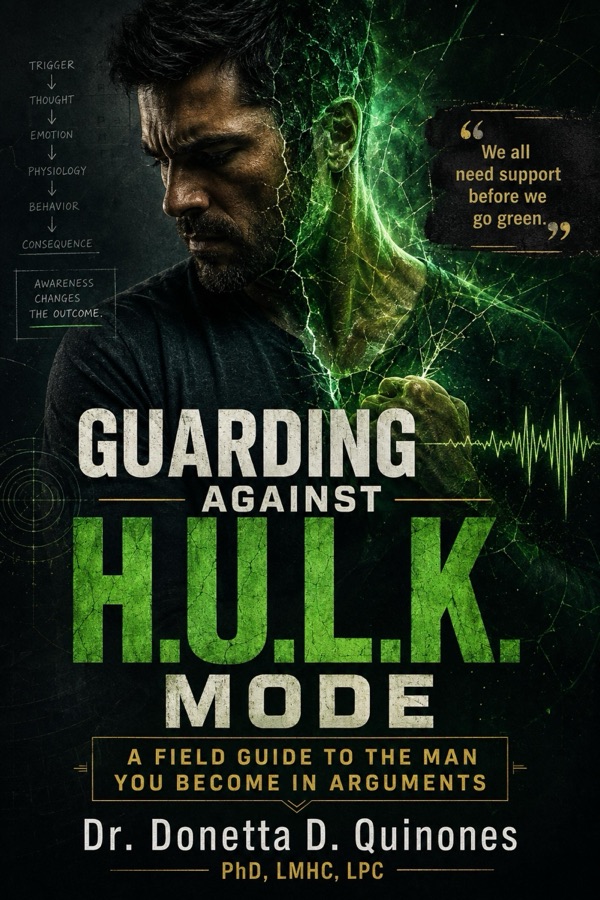
The four warning signs that the change is starting are in Chapter 1, and they are the reason the title has periods in it: Heat rising, Uncontrollable, Language shrinking, and Knowing what she’s going to say. A man who learns to catch his H gains the one thing most men have never had in an argument, which is notice, and notice is where every other choice in this book begins.
There is a second recurring section, called FILM ROOM. Most of us did not learn what male anger looks like from a textbook; we learned it from films, from a comic book an uncle kept in a closet, and from a scene watched as a boy that is still quietly doing structural work in our heads. That pattern shows up in men again and again, which means that before I can teach anything, I am competing with an archive, and that archive is wrong in four or five specific and correctable ways.
So instead of pretending the films are not in the room, this book brings them in. There are twenty-one FILM ROOM sections, on everything from a World Cup final to a Pixar cartoon to sixty years of a comic book that keeps curing its hero and taking the cure back. They are the most enjoyable part of the book, and they do real work, because watching a transformation sequence from the outside, at zero cost to anybody, is a training environment real life never offers. Athletes watch the tape of a game they already lost for the same reason: to see the play clearly enough to run it differently next time.
(The films get the same scrutiny as the studies, and in a few places the popular memory of a famous scene turns out to be wrong in ways that make the real version more useful: Frankenstein’s monster was not born with a criminal brain, Mr. Hyde is small, and Marvel cured the Hulk in 1991 and then spent eight years explaining that it never happened.)
A third recurring section is called THE OLDER STORY. This is a Christ-centered book, and long before anyone filmed a man turning into something he did not recognize, Scripture was telling that story with remarkable honesty, through Cain in the field, Saul with a spear in his hand, and Jonah sitting outside Nineveh arguing with God about his own anger. Each chapter reads one of those figures with the curiosity FILM ROOM brings to a movie, asking what life may have been like for him in his own setting and what his story says to the man reading today. The faith in these pages is woven through every chapter, not bolted on, because the God who asked Cain a question before the damage was done is still asking questions now (see Genesis 4:6–7).
One more thing belongs here, because it is the most important sentence in the book: this book explains a reaction, and it does not excuse a behavior. Chapter 1 sets those two jobs side by side, and I will keep them separate on every page, because the single most predictable misuse of trauma language is a person learning a beautiful new vocabulary for why the other person should have expected it. Understanding where a reaction comes from is meant to make change possible, never to make the people nearby responsible for absorbing it.
The same principle draws a line around who this book is for. If you are afraid of someone, or someone is afraid of you, or a person in your house has organized their behavior around managing your reaction (what they say, what they wear, who they see, how they spend money, whether they tell you the truth about small things), then what is happening in your home is a different problem from the one this book addresses, and the tools in here will not fix it. They may even make it worse, because a person who is controlling someone can learn to do it in a calmer voice, and control spoken calmly is still control.
Chapter 17 returns to this with the research and instructions, but no one should have to read that far to get help.
IF YOU NEED HELP NOW. If anyone is in immediate danger, call 911. In the United States, the National Domestic Violence Hotline is 1-800-799-7233, or text START to 88788. It is not only for people being hurt. If you are frightened of what you might do, that number is also for you, and calling it is maintenance rather than a confession.
Most of us would never call ourselves weak for taking the car in when the engine starts making a sound we do not like, and reaching out early is the same kind of common sense, the way a man protects the people he loves and the man he wants to be.
If You Only Read Six Chapters
Not every man will read every page, and a short path walked is better than a long one abandoned, so if time or patience is limited, start with these six:
Chapter 1: You Weren’t There, for the four warning signs and the one rule that governs everything after it.
Chapter 7: The Seven Beats, for how an argument unfolds step by step and where a man can actually get in.
Chapter 10: The Four Protectors, for the four shapes the other guy takes (Smash, Vanish, Fixer, and Sentry) and which one is yours.
Chapter 15: Name a Time, for the negotiated break, the way to leave a fight without abandoning the person in it.
Chapter 17: Where the Metaphor Dies, for the line between a reaction and control, and what to do if anyone in the house is afraid.
Chapter 19: The Repair, for the five-part apology and how trust is rebuilt over time.
Men’s groups and church studies that want to walk through the book together can reach GraceRoot Institute at graceroot.institute.
Now, let’s talk about the green guy.
Part One: The Conversion
Chapter 1: You Weren’t There
Have you ever replayed an argument the next morning and realized that the part bothering you most was not that you got angry, because anger is a familiar visitor, but that somewhere in the middle of it you seemed to leave the room while your mouth kept talking? Many men describe a version of themselves that shows up a few times a year, one they have never been formally introduced to and mostly know secondhand, by what is different in the room afterward. She is holding her coffee cup with both hands, the quiet in the house has a particular texture to it, and his throat is sore even though he does not remember raising his voice. It can feel as though this other man borrowed his face, his phone, his car keys, and his marriage, and then made decisions with all of them that the man himself would never have made.
Academic Research Solutions Inc., dba GraceRoot Institute