A Christ-centered, trauma-informed book
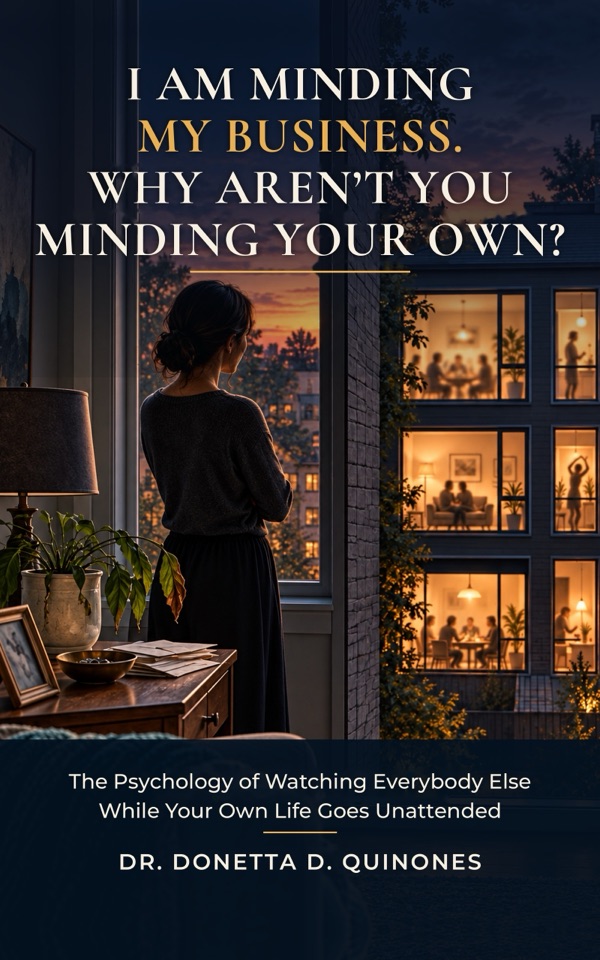
I Am Minding My Business. Why Aren’t You Minding Your Own?
The Psychology of Watching Everybody Else While Your Own Life Goes Unattended
Visibility is not an invitation.
Welcome home.
The premise
Have you ever opened your phone for one quick thing and looked up forty minutes later knowing the state of three marriages, a cousin’s new job, and exactly who unfollowed whom — while the text from someone in your own house sat unanswered?
It happens to the most caring people we know. Paying attention is how we know who needs a casserole, notice that a friend has gone quiet, and keep a community’s children safe. In a world where everybody’s life is visible, keeping up can feel like love, and sometimes it is.
It can be far easier to analyze someone else’s marriage than to admit the distance growing in ours, easier to critique another parent than to face the old wounds shaping how we parent. None of that means every concern is jealousy or every observation is avoidance. It means the question is worth asking: are we looking everywhere except where our attention is most needed?
What we can see has changed enormously in the last twenty years. What we have been invited to manage has not.
The argument, in one line
Paul told a restless young church “to seek to lead a quiet life, to mind your own business, and to work with your own hands” (1 Thessalonians 4:11, CSB). Yes, the title of this book is in the Bible. And to mind something has always meant to tend it: mind the baby, mind the stove, mind the store.
Minding our business, in Paul’s sense, means faithfully tending our own affairs far more than it means staying out of other people’s. Social media has added a confusion that is not a kind of business at all — I know about it, so it must be mine — and much of the exhaustion people carry comes from believing that it is.
Five kinds of business
Picture a life as a house. The bedroom holds what requires trust before it is shared. The kitchen is where we decide what we take in and what we pass along. The living room is where we learn that not everyone who would like a seat has been offered one. The front porch is the part other people may see without being invited in. The backyard is where the weeds are. Around it all stands a fence with a gate — and a healthy gate is meant to swing.
Room by room, the book shows what belongs to us, what belongs to someone else, and what belongs to God alone.
The one exception
“Mind your business” has been used in too many families and churches to keep children and vulnerable adults from being protected. This book will not hand anyone a Bible verse to hide behind.
Four things make a therapist’s questions helpful in the office and intrusive at the dinner table: an invitation, consent, a purpose, and a boundary. That simple test follows the reader through the whole house — and it shows when a purpose is strong enough to override the lack of an invitation. When someone is being harmed, their yard is your business. A full chapter gives clear, safe steps for when a child or vulnerable adult may be at risk: tell the people whose job it is to act.
From the Introduction
Before anyone reaches for the nosy people in their life, the book starts with a confession.
I have a confession to make, and since this is a book about minding our business, it seems only fair that I start with mine: I am a professional busybody. Before anyone reaches for my credentials to see whether they are still valid, allow me to explain. I am a licensed therapist, which means I have spent years studying human behavior, examining the way the mind protects itself, and helping people understand why they do what they do, even when what they do makes absolutely no sense to them or to anyone who loves them. My degrees, my licenses, and my training legally qualify me to sit across from people I have only just met and ask questions that would get me escorted away from the family barbecue.
How is your relationship with your mother? What happened in your childhood? Why do you keep returning to relationships that hurt you? What part do you think you play in keeping this problem alive? Try asking those questions over Thanksgiving dinner and see how long it takes before somebody tells you to mind your business.
In my office, however, people schedule those questions on purpose. They put the appointment on their calendars, they drive across town in traffic, and then, fairly often, they spend the first twenty minutes explaining why they would rather not talk about the very thing they came to talk about. I sit there, professionally minding their business, and I am grateful for the privilege of it, because there is something sacred about being invited into the parts of a life that most people never see. The irony, though, is not lost on me. I make a living helping people mind their business, and I have to work at minding my own.
I can help someone untangle the patterns that have been running their relationships for twenty years, and somehow overlook the stack of mail on my kitchen counter that has been there long enough to qualify for its own zip code.
Where it closes
On a beach, after breakfast, Jesus has just restored Peter and told him to follow. And the very first thing Peter does is turn around, look at John, and ask what his story will be. It is the question we ask about a sibling, a coworker, or an old friend whose porch looks better than ours.
Jesus does not answer it. He hands Peter’s own life back to him: “what is that to you? As for you, follow me” (John 21:22, CSB).
Who it is for
What it will not do
Fourteen chapters
Plus the Toolkit: the five-kinds sorting chart, the Kitchen Test, a personal boundary system, a seven-day walk through the house, Three Sentences Ready, steps for when you are worried about a child or vulnerable adult, a prayer-request policy your team can adopt, and an eight-session discussion guide.
The author
The founder and CEO of GraceRoot Institute and Dareu2bu Counseling Services, with more than twenty years of experience in mental, emotional, and spiritual health through research, training, counseling, and ministry.
Her work is trauma-informed and relationally focused: helping people discover their authentic identity, establish healthy boundaries, and achieve lasting personal growth.
Also by the author: The Hoarded Heart, Emotion Is Not Permission, and every book from GraceRoot · Articles
Close the right windows, open the right doors, and go home to the life that has been waiting for you.
GraceRoot courses are psychoeducational learning programs, not emergency care, legal advice, or a replacement for therapy. Certificates document GraceRoot completion. Court, employer, board, or continuing education acceptance should be confirmed before purchase unless a page states a specific approval.