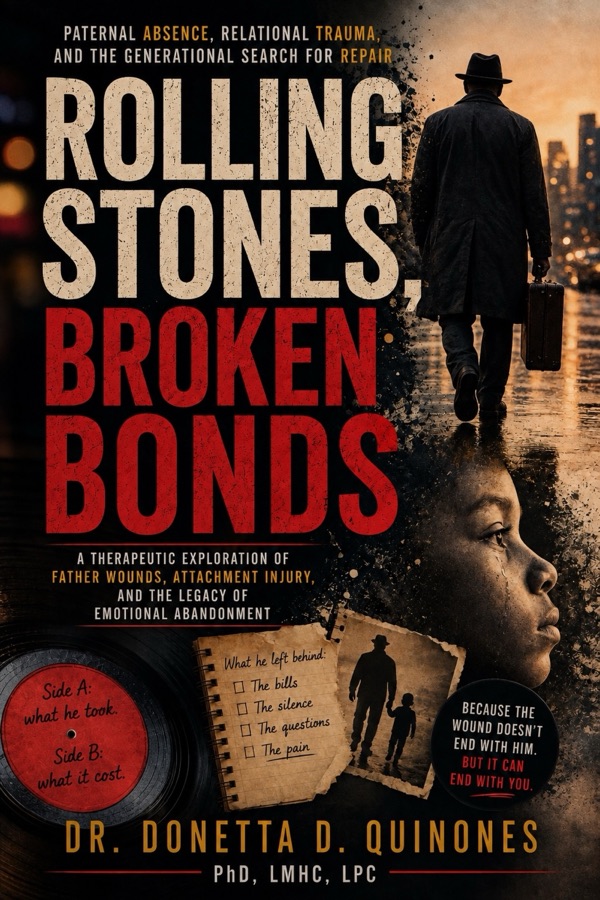
Table of contents
- Author’s Note
- Introduction: The Soundtrack of Absence
- Chapter One: When Fathers Are Physically Gone but Psychologically Everywhere
- Chapter Two: The Rolling Stone Archetype
- Chapter Three: Attachment Injuries Passed Down
- Chapter Four: Many Children, Many Homes, No Emotional Map
- Chapter Five: The Repair Fantasy
- Chapter Six: Presence Without Attunement
- Chapter Seven: Relational Injury and Adult Intimacy
- Interlude: The Soundtrack We Sing Along To
- Chapter Eight: Parenting From an Unhealed Place
- Chapter Nine: Accountability Without Shame
- Chapter Ten: Breaking the Cycle
- Conclusion: When the Stone Finally Stops Rolling
- Appendix A: A Reader’s Guide for Groups
- Appendix B: A Listener’s Field Guide
- Appendix C: For Clinicians — A Working Summary
- References and Further Reading
Author’s Note
Every person described in this book is a composite.
That word deserves more than a line of legal cover, because it describes something true about how clinical knowledge actually accumulates. No one in these pages is a client. Each figure — Marcus, Tasha, Denise, Reggie, Nia, Jasmine, Andre, Bianca, Curtis, Yolanda, Elias, Ray — was assembled from patterns that appear again and again across many people, in many rooms, over many years, until the pattern itself became recognizable independent of any individual who carried it. Names, occupations, cities, family configurations, and identifying circumstances are invented. The sentences these people say are constructions, written to be faithful to how the wound sounds rather than to any particular person who spoke.
If you find yourself in one of them, that is not because your file was opened. It is because the pattern is that common.
A second note, about what this book is and is not. This is not therapy, and it is not a substitute for it. It is a map. Maps are useful precisely because they are not the territory; a map lets you see the shape of a country you have only ever walked through in the dark. But no one has ever been healed by a map. If what you read here opens something that feels larger than you can hold, that is not a failure of the book or of you. It is information. It means the material is live, and live material is best handled with another human being in the room.
If you are in crisis, or if reading stirs thoughts of harming yourself, please stop reading and reach out — to a therapist, a physician, a crisis line, a pastor, a person who loves you. The book will still be here.
A third note, about fathers. This book takes paternal absence seriously as an injury, which means it does not soften what was lost. It also refuses to make fathers into monsters, because monsters cannot be understood and what cannot be understood cannot be interrupted. Some readers will want more condemnation than they find here. Others will want more forgiveness. The book declines both assignments. Its position is that understanding and accountability are not opposites, and that the people who eventually break these cycles are almost always the ones who managed to hold both.
Program Clarity
GraceRoot courses are psychoeducational learning programs, not emergency care, legal advice, or a replacement for therapy. Certificates document GraceRoot completion. Court, employer, board, or continuing education acceptance should be confirmed before purchase unless a page states a specific approval.
Finally, a note about the song. “Papa Was a Rollin’ Stone” appears throughout these pages as a metaphor and a cultural reference point, never as a subject of musical analysis, and its words are nowhere reproduced. What matters here is not the record. What matters is what the record named, and why millions of people recognized it instantly.
Introduction: The Soundtrack of Absence
The song starts with almost nothing.
A bass line, walking by itself. A hi-hat. Then a stretch of instrumental so long that if you released it today an algorithm would kill it before anybody heard a word. It just circles. Building a room before anyone walks into it.
And when a voice finally shows up, it’s a kid asking his mother a question.
The song is “Papa Was a Rollin’ Stone.” Norman Whitfield and Barrett Strong wrote it. The Undisputed Truth cut it first in the spring of 1972, and then The Temptations released their version that September and it went to number one and won three Grammys the next year. The setup is simple: on the day their father is buried, his children ask their mother who he actually was. And she tells them. He wandered. He was never really theirs. Whatever he left behind, it wasn’t money and it wasn’t himself.
That record is more than fifty years old. It still gets played at cookouts. In barbershops. Over grocery store speakers between the deli and the eggs. In cars, where somebody turns it up without deciding to.
And it still does something almost nothing else in American culture does. It says the thing out loud. The thing a whole lot of people have never once said in their own voice, about their own father, to a single other human being.
I’ve watched this happen in my office more times than I can count.
A man in his forties will spend six sessions describing his entire childhood in the tone of a guy reading you the mileage log from a company van. Everything’s fine. It was fine. We were fine. And then the song comes up — not because I brought it up, but because he did, sideways, in a story about a wedding reception — and something in his face slips.
That song is about my house.
And then, almost every time, the second sentence:
I never thought about it like that.
That gap — between knowing what happened in your childhood and having ever, one single time, thought about it like that — is the entire country this book is trying to map.
What that song got right
There’s a reason this record outlived roughly nine thousand other songs from 1972, and it isn’t only the bass line, though let’s be honest, it’s partly the bass line.
The song is built strange. It isn’t a song about a man. It’s a song about the space where a man was supposed to be, narrated by the people stuck living in that space. The father never talks. He never shows up. He’s dead before the first line. What you get instead is his outline, traced by the people he left — his wife’s exhaustion, the neighbors’ verdict, the kids’ confusion about a person they’re supposed to be grieving and never met.
Which is, more or less exactly, what having an absent father is like from the inside.
It isn’t an event. Events end. It’s a shape. A hole with edges, and you grew around it, the way a tree grows around a fence post nobody ever came back for.
And here’s the part people miss: an absent father is not experienced by a child as nothing. He’s experienced as a very loud presence made entirely out of questions.
Where is he. Why isn’t he. Was it me. Is he coming. What’s he like. Am I like him. Would he like me. Does he think about me on my birthday. Does he have other kids. Are they better.
Those questions don’t need answers to do their work. They just need a kid’s brain, which will go ahead and answer them anyway, with no information, using the only research material available at that age — which is the kid.
This is the whole problem in one sentence. Children do not conclude my father has limitations. Children conclude I must be the kind of person a father leaves.
And that conclusion isn’t really a thought. It’s more like weather. It becomes the climate the rest of the personality grows up in, and by the time you’re old enough to question it, it doesn’t feel like a belief anymore. It feels like the truth about you.
The second thing the song got right is the mother, and I’m going to keep coming back to her.
She’s the one who has to answer the question. She’s the one who was there. She’s handling the money and the logistics and the explanations and her own grief stacked underneath everybody else’s, and she’s doing it with basically no acknowledgment, because a culture that will hum a song about her husband’s absence for fifty years never got around to writing one about her presence.
So let me say this early, in writing, so there’s no confusion later: this book is not going to make mothers the villain. In most of these stories, the mother is the entire reason there’s a person left alive to sit in my office and talk about it.
And the third thing the song got right — the thing that makes it a useful metaphor instead of just a great record — is that it named the man with a phrase that already existed.
Nobody invented the rolling stone in 1972.
An old American character
Muddy Waters recorded “Rollin’ Stone” in 1950, and the character was already ancient by then — the rambler, the man who catches the next train because standing still feels like dying, running back through the blues and forward into country and rock and roll and every western ever made. Look at what that tradition does with him: it calls him free, and the women and children he leaves behind are scenery. “Papa Was a Rollin’ Stone” is the answer record — the same man, filmed from inside the house.
That flip is the premise of this whole book. We’re going to look hard at the man — carefully, and without contempt, because he’s got an origin story of his own that turns out to matter enormously. But we’re going to look at him from where the people he left were standing, because that’s where the injury is, and that’s the only place the cycle can actually get interrupted.
Absence and distance are not the same thing
Okay. First hard turn, and it’s coming early because everything after it depends on it.
Most people hear “absent father” and picture geography. He lived somewhere else. He was gone. There’s a photograph, a last name, maybe a phone number that stopped working. That version is real. Roughly one in four American kids — about 17.8 million of them, per the Census Bureau’s 2023 Current Population Survey — live in a home with no biological, step, or adoptive father in it.
But that number counts households. It does not count hearts, and it’s not really what this book is about.
Because the man who was gone and the man who sat in that recliner every single night of your childhood can leave behind shockingly similar wreckage.
Academic Research Solutions Inc., dba GraceRoot Institute