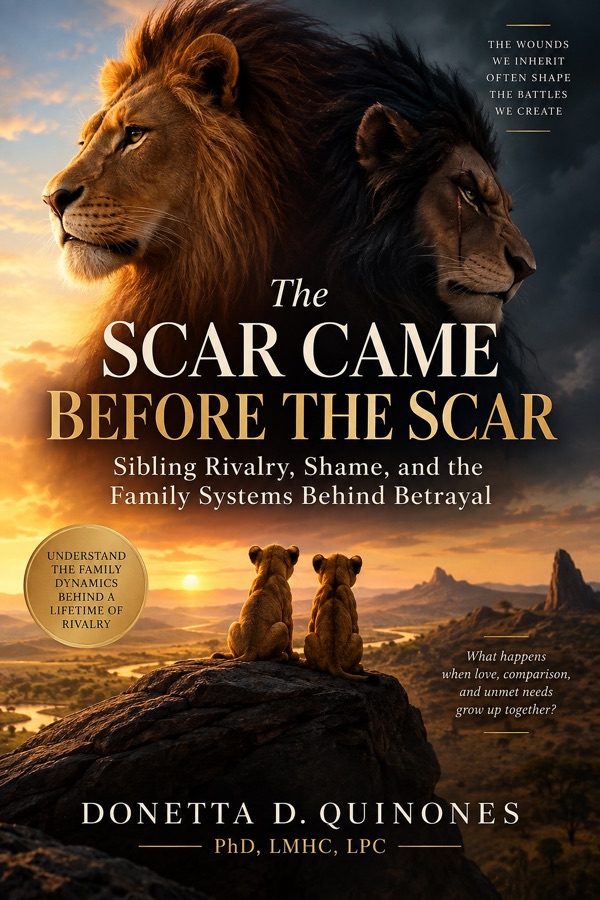
A Note Before We Start
Welcome back, if you were here for No One Came Looking for Simba. And welcome, if this is your first time sitting down with a book that uses a beloved family film to open a door that is very hard to open any other way. Last time it was a cartoon lion and a mother who never came. This time it is two cubs who begin as brothers, and a question that lives in more families than any of us would guess: how does someone who once loved his brother come to feel that his brother’s very existence is a verdict on him?
You may already be thinking of a face. A sister. A brother. The one you stopped calling, or the one who stopped calling you. Or you may be a parent reading with a small dread, wondering whether you are about to find out which child you got wrong. Whoever you are — the one who carried the family, the one the family carried, the one who did something you have not yet said out loud — you are welcome here, and you will be treated gently. This is a book about wounds between siblings, and I would rather be careful with you than clever.
* * *
A word about the lions, because it is a fair question.
Mufasa: The Lion King is a story, not a study. Taka is not a client, Obasi and Eshe are not parents being assessed, and nothing that happens between two animated cubs can tell us what is true of your family. What the film offers is a gift of a different kind: a story most of us already know the ending of, that finally has a beginning.
For thirty years Scar had no childhood. He arrived on screen already finished — the voice, the ledge, the four words in the gorge — and the ending told us who he was so completely that none of us had to wonder. Then a film came along and showed us a small lion at the edge of a river, saying to a half-drowned stranger, I have a secret. I always wanted a brother.
Program Clarity
GraceRoot courses are psychoeducational learning programs, not emergency care, legal advice, or a replacement for therapy. Certificates document GraceRoot completion. Court, employer, board, or continuing education acceptance should be confirmed before purchase unless a page states a specific approval.
That line is the moment this book is built on. Not to argue that Scar was misunderstood; he chose what he chose, and the choosing is part of what we will look at. But to ask the question families bring into my office in a hundred different forms:
What has to happen inside a person, and inside a family, for a beloved brother to become evidence — and for betraying him to start to feel justified?
That question has a research literature behind it, scattered across several fields that rarely talk to one another. It also has a much older literature behind it. The first death in Scripture is a brother killing a brother, over favor. Jacob and Esau, Leah and Rachel, Joseph and the brothers who sold him, the older son standing outside the party in Luke 15 while the music plays for the one who came home — these stories have been asking my question for three thousand years, and they are, in my experience, some of the most psychologically exact accounts of sibling rivalry ever written. They will sit in the room with the research, and with the film. Where the three agree, you can lean your weight on it. Where they do not, you will be told.
You will also find, here and there, moments where the film is quietly ironic — where the story hands a character exactly what he was trying to avoid. Families run on the same ironies, and seeing one in a lion is sometimes the only way to see it in yourself.
* * *
Four promises, since you are giving me your time.
The film is a lens, not evidence. A scene from Mufasa is a shape to think with, never proof. A research finding is a different kind of sentence, and the two will be kept clearly apart. Where the film’s version of events is uncertain, the text says so. And where the story stops fitting your life, your life wins.
This is not a book about bad parents. Obasi and Eshe will not be sorted into the villain and the saint, because that is not how families work, and it is not how healing works either. The question asked of each of them is gentler and far more useful: what did the relationship teach? What did each cub learn about belonging, competence, responsibility, and what he was owed? If you are a parent of more than one child, you may have already decided which one you failed. Hold that loosely for a while. It is rarely the whole story, and there is more room for grace in it than you think.
There is one sentence from the earlier book that has to be said here too, early and once: parental intention is not identical to childhood impact. A parent can favor one child for reasons that are entirely understandable, and the other child’s heart still records what it records. Both are true. Neither cancels the other.
Understanding Scar is not defending Scar. You will spend much of this book learning how envy forms, how shame turns difference into threat, and how entitlement quietly converts she didn’t choose me into something of mine was taken. None of that is an excuse. A cause is not a permission slip. If anything, understanding should make a person more responsible for what they do next, not less, because now they know what they are working with. God said as much to Cain before Cain had done anything at all: sin is crouching at the door. Its desire is for you, and you must rule over it. The wound is real. So is the door.
Family roles are positions, not people. You will not find golden child or narcissist or toxic sibling used as diagnoses here. When a popular word appears, the text will tell you what it is and what it is not, because you deserve to know which parts of this book can hold your weight. Roles describe how a family arranges itself under pressure. They describe the chair, not the person sitting in it — and the same person can sit in three different chairs over a lifetime. The child who was protected at nine is very often the one holding everyone up at forty-five. Hold the roles lightly. A family can be rearranged.
* * *
Every chapter has the same shape, so that you never have to find your footing twice.
The Scene — a moment from the film, or a family like the ones in my office. What the Scene Lets Us Ask — the question, asked as a question. The Family System — how the pattern lives between people rather than inside one person, with a box called What We Actually Know that says plainly how strong the evidence is. The Older Story — a passage of Scripture that has been looking at the same thing for a very long time. The Scar Before the Scar — what was already true before anything visible happened. The Practice — one thing you can actually do this week, with a note about who should skip it. And Four Questions Before You Leave, for you alone, or for a counselor, or for a table with your sibling at it, when you are ready.
At the back of the book you will find a short guide for parents, for adult siblings, for clinicians, and for the reader whose repair is not possible. The longer worksheets the chapters sometimes point to — the family map, the ledgers, the audits, and a plan for reading this book with a group — live in a companion workbook, Finding the Scar Before the Scar, so that this book could stay a book you can hold in one hand. Nothing here depends on it.
About the title. The visible scar is an event; it happens on a day, and you can point to it. The psychological scar is a process, and it was running long before that day. So throughout the book the phrase changes shape: the scar before the rivalry, the scar before Sarabi, the scar before the lie, the scar before the betrayal. And at the end, the scar after the scar, which is the part that is still a choice.
* * *
A word about the size of this book, since you have noticed it. It is a big book, and it has a great deal to say about a cartoon lion, and I know exactly how that sounds. Here is my defense, offered with a smile. Most of us will happily sit in the dark for three hours while a man in a costume saves a city, and never once check our watch. We will binge a season in a weekend. We will read every review of a restaurant we are not going to. Your family — the people who taught you what love costs, what you were owed, and who got the bigger piece of the cake — is a more interesting story than any of those, and it is the only one you are actually in. So this book is long the way a good conversation with someone who has finally understood you is long: you do not notice until it is over, and then you wish it weren’t. Read it a chapter at a time. Skip to the chapter with your name on it if you need to. The lion is the doorway. Your family is the house. It is worth the walk through.
* * *
One last thing, because how you are while you read this matters to me.
Some chapters go to tender places — shame, the sibling everyone protected, betrayal, and a chapter that asks not only what happened to you but what happened because of you. That last one is not what most people expect from a book they picked up because a brother or sister hurt them. It is here on purpose, and it is here with kindness. If anything in these pages starts to move faster than you can hold, please set the book down and find a person to be in a room with. Sibling wounds go better with a witness. Your sibling was the witness for most of your childhood, which is exactly why you may need a different one now.
Academic Research Solutions Inc., dba GraceRoot Institute