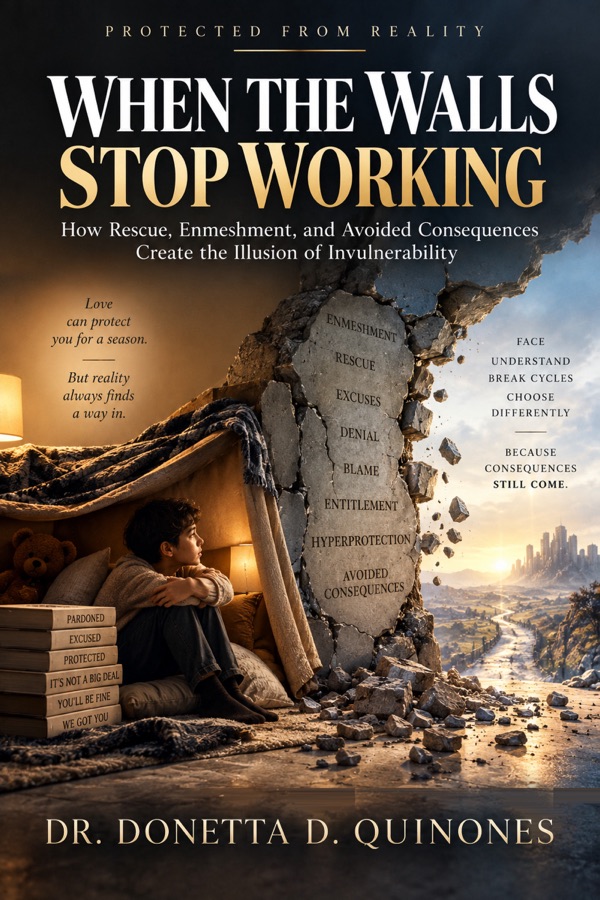
Table of contents
- Note on the Stories in This Book
- If You Need Help Right Now
- The Consequence Has Not Disappeared
- Part I: Protected From Reality
- 1. Protected From Reality
- 2. When Love Removes the Consequence
- 3. You Can Be Loved and Still Be Wrong
- Part II: Building Nineveh
- 4. N: Normalization
- 5. I: Insulation
- 6. N: Narrative Protection
- 7. E: Enmeshment
- 8. V: Validation Becomes Vindication
- 9. E: Externalization
- 10. H: Hyperprotection
- Part III: The Illusion of Invulnerability
- 11. Borrowed Invulnerability
- 12. Nobody Told Me No
- 13. What Happened Because of You?
- 14. Someone Else Always Pays
- 15. The Escalation Problem
- Part IV: Who Are We Protecting?
- 16. Who Are We Protecting?
- 17. Am I My Brother’s Keeper?
- 18. When Loyalty Becomes Collusion
- 19. Don’t Make Them Face It
- Part V: When Belonging Requires Not Knowing
- 20. Everybody Knew
- 21. The Loyalty Tax
- Part VI: When the Walls Stop Working
- 22. When the Walls Stop Working
- 23. Mercy Is Not Permission
- 24. When Accountability Feels Like Persecution
- 25. The Collapse of Borrowed Invulnerability
- Part VII: Learning to Live Without the Wall
- 26. Someone Else Doesn’t Have to Pay
- 27. Accountability Without Humiliation
- 28. Empathy Without Enabling
- 29. Boundaries Without Abandonment
- 30. Conviction Without Condemnation
- 31. Faithfulness Without Vindication
- 32. Teaching Children to Be Wrong
- 33. Teaching Children to Stand Apart
- When the Walls Come Down
- Toolkit
- Bibliography
- About the Author
Note on the Stories in This Book
The people you will meet in these pages are real in every way that matters and fictional in every way that could identify them. Each is a composite: a person assembled from several families, several churches, several counseling rooms, with names, ages, occupations, and circumstances changed and blended so that no one who has ever sat across from me will find themselves here. If a story sounds like your family, that is not because it is your family. It is because these patterns are so common that most of us recognize them on sight.
The research cited throughout is real and is documented in the notes and the bibliography at the back of the book. Where a finding is contested or has been qualified by later work, the text says so. The Scripture is quoted from the New International Version unless otherwise noted, and the readings offered are my own; they are meant to invite you into the text, not to settle it.
Where to start. The parts stand on their own, and this is a long book to read in order when you are tired. If you are the one who has been paying — the parent, the spouse, the sibling, the daughter who handles everything — begin with Chapter 14, then Chapter 18, then Chapter 29, and read the Conclusion before you go back for the rest. If you are the one who has been protected, begin with Chapter 11 and then Chapter 26. If you are reading this because of something happening at your church, begin with Chapter 10 and then Chapter 23. And if what you need is the practical material rather than the argument, every script, test and exercise in this book is collected in the Toolkit at the back.
Program Clarity
GraceRoot courses are psychoeducational learning programs, not emergency care, legal advice, or a replacement for therapy. Certificates document GraceRoot completion. Court, employer, board, or continuing education acceptance should be confirmed before purchase unless a page states a specific approval.
If You Need Help Right Now
This book is meant to inform and encourage. It is not therapy, it is not medical care, and reading it does not put you in a treatment relationship with me. There is no substitute for a professional who knows your name and your situation, and some of what this book describes is not a pattern to be understood but a danger to be left.
So before anything else: if you are in immediate danger, call 911. And if any of the following fits your house rather than someone else's, start here rather than with Chapter 1. The numbers below are free, confidential, and answered around the clock unless noted.
988 Suicide & Crisis Lifeline. Call or text 988, or chat at 988lifeline.org. For thoughts of suicide, self-harm, or any emotional crisis.
National Domestic Violence Hotline. Call 1-800-799-7233, text START to 88788, or chat at thehotline.org. For monitoring, intimidation, coercive control, or physical harm by a partner or a family member.
StrongHearts Native Helpline. Call 1-844-762-8483 or visit strongheartshelpline.org. Culturally grounded advocacy for Native and Alaska Native people.
Childhelp National Child Abuse Hotline. Call or text 1-800-422-4453, or visit childhelphotline.org. For anyone worried about a child, including the child.
National Sexual Assault Hotline (RAINN). Call 1-800-656-4673 or chat at hotline.rainn.org.
SAMHSA National Helpline. Call 1-800-662-4357 or visit samhsa.gov. Free, confidential treatment referral and information for substance use and mental health, in English and Spanish.
National Alliance for Eating Disorders Helpline. Call 1-866-662-1235, Monday through Friday, 9:00 a.m. to 7:00 p.m. Eastern.
To find a therapist. Ask your physician or your insurer for an in-network list, or search a directory such as Psychology Today or Open Path Collective, which maintains reduced-fee therapists. A church that takes this seriously will usually keep a referral list; ask for it before you need it.
These are United States numbers. Outside the United States, findahelpline.com will give you the equivalent service in your country in about thirty seconds.
A word to the reader who is about to skip this page because it is for other people. Most of the families in this book believed the same thing, for years, with great sincerity, and the belief was the wall. If you found yourself reading any of these lines twice, that is worth noticing, and noticing is not the same as deciding.
The Consequence Has Not Disappeared
INTRODUCTION
“Nineveh is like a pool whose water is draining away. ’Stop! Stop!’ they cry, but no one turns back.” — Nahum 2:8
Here is a proposition that may sound wrong the first time you read it, and that keeps sounding wrong for a while after that.
Dysfunctional families rarely eliminate consequences. They redistribute them.
We tend to imagine that when a parent steps in to fix what a child broke, or a wife quietly pays the debt her husband ran up, or a congregation decides not to ask its leader the question everyone is thinking, the consequence has been prevented. Something painful was about to happen, and love got there first.
But sit with any of those families long enough, in a counseling office or around a Thanksgiving table, and you will notice something. The consequence did not vanish. It moved.
The child does not pay for the broken window. The parent does. The addicted adult does not pay, at least not yet. The spouse pays, in sleepless nights and second jobs and a slow erosion of trust that no one has words for. The leader does not pay. The congregation pays, in the members who quietly leave and the ones who stay and stop believing what they hear from the pulpit.
Consequence, it turns out, is remarkably loyal. It always finds someone to stay with.
Consequences can be delayed, displaced, absorbed, concealed, negotiated down, or transferred to someone with less power to refuse them. What they cannot do is disappear. Reality is not that accommodating.
This is a book about what happens to people, families, churches, and institutions when they organize themselves around the belief that it is. And it is a book about how the God who is rich in mercy nevertheless refuses to be the God who makes reality go away.
TWO VISITS TO THE SAME CITY
There is a city in the Bible that God warned twice. The two visits are separated by more than a century, and they end very differently. The puzzle of how a city gets from the first ending to the second is the puzzle this book exists to solve.
Start with the walls. They ran seven and a half miles around the city, reportedly a hundred feet high and broad enough on top for three chariots abreast. The Tigris ran along one side; a smaller river ran straight through the middle, so the Assyrians, who were nothing if not thorough, dammed it and hung gates across it. Nineveh had thought about every way a consequence might get in.
The first visit is the one everyone knows. A reluctant prophet named Jonah is sent to Nineveh, the capital of the Assyrian empire, a city so notorious for cruelty that Jonah would rather drown than deliver the message. He goes anyway, eventually, and preaches perhaps the shortest sermon in Scripture: forty days, and Nineveh will be overthrown. Then the astonishing thing happens. The city believes him. From the king to the cattle, Nineveh puts on sackcloth. The king decrees that everyone must turn from their evil ways and from their violence. And God, seeing what they did and how they turned, relents.
Notice the sequence. Warning. Recognition. Repentance. Behavioral change. Mercy. The repentance was not merely emotional; the king’s decree specifically names the violence in their hands. Mercy followed transformation, not as its substitute but as its reward.
Then a hundred and fifty years pass, and this is where the mystery begins. No council met to repeal the sackcloth. The people who had fasted died, their children heard the story, their grandchildren heard it less often, and at some point a generation looked at the walls, still standing, and drew the obvious conclusion.
The second visit is the one almost no one preaches on. The prophet Nahum is given an oracle concerning the same city. But this is Nineveh at the height of its power: the “city of bloodshed, full of lies, full of plunder, never without victims” (Nahum 3:1). It is a city that has forgotten. Its fortresses are like fig trees whose first-ripe fruit drops into the mouth of whoever shakes them. Its walls, once the very symbol of its safety, become the thing that breaks: “The river gates are thrown open and the palace collapses” (Nahum 2:6). The city that had engineered its rivers was undone through them; one Greek historian even records a tradition that the river in flood tore out a stretch of the great wall.
Notice this sequence too. Power. False security. Continued exploitation. Resistance to correction. Judgment. Collapse.
And then, silence. Nineveh fell in 612 BC and was erased so thoroughly that two centuries later ten thousand Greek soldiers marched past its empty walls, asked the locals what the place had been, and got a muddled story about the Medes. Nobody mentioned Assyria. It stayed a nameless hill for more than two thousand years, until an Englishman started digging across the river from Mosul.
The danger in Nahum’s Nineveh was not simply that the city had walls. Cities need walls. Children need protection. Trauma survivors need defenses. The danger was that the walls had worked for so long that the city had reason to believe they always would. Mercy, received often enough without anything changing, starts to look less like a gift and more like a policy.
Academic Research Solutions Inc., dba GraceRoot Institute