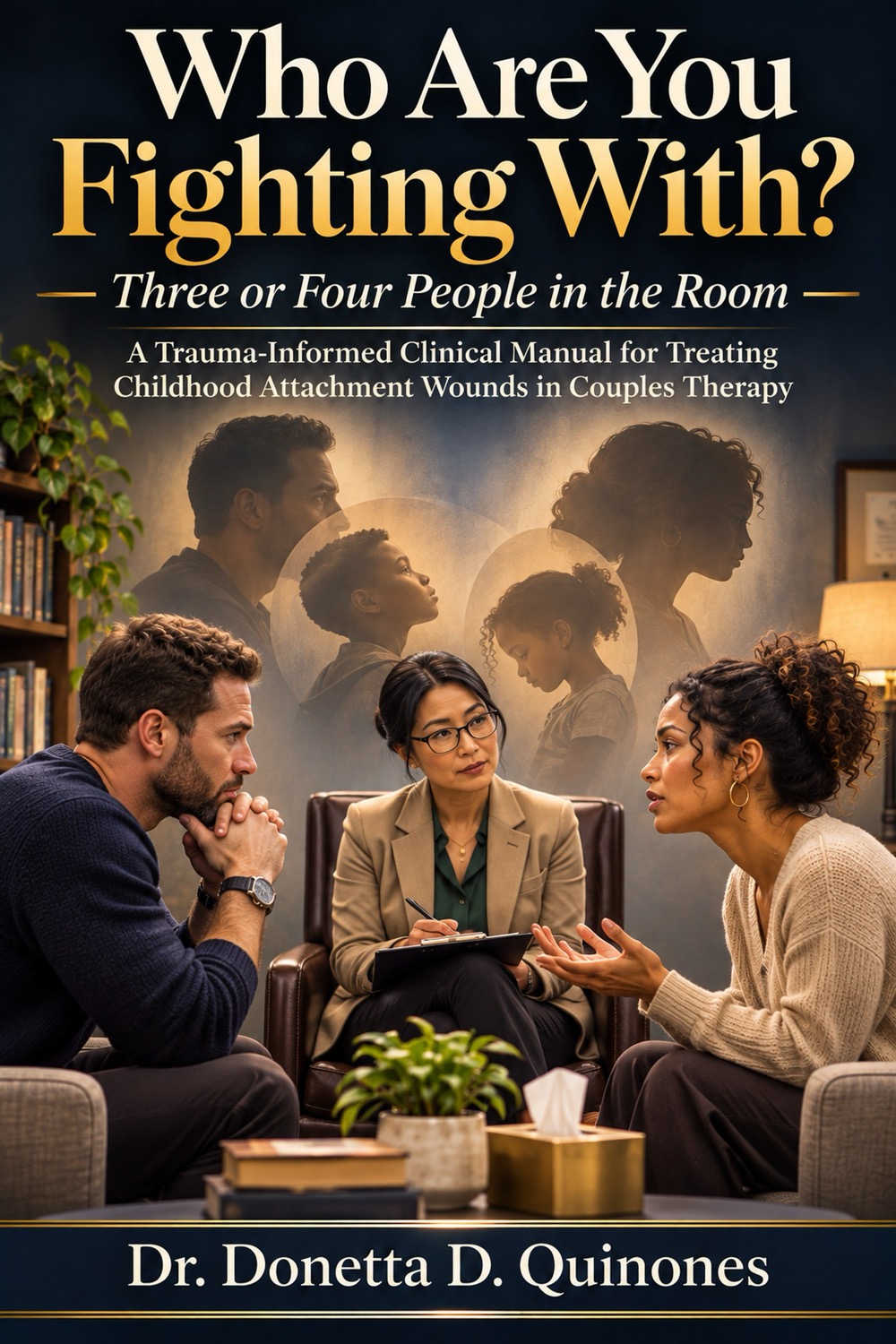
A trauma-informed clinical manual for couples therapy
Who Are You Fighting With?
Three or Four People in the Room
Only two of them are on the invoice.
The claim
Have you ever sat with a couple, watched a childhood wound rise in the middle of an ordinary argument, and wondered how to address it without turning the hour into individual therapy with a witness?
This is a working manual for clinicians who treat couples, organized around one claim: a great deal of what presents as a couple problem did not begin as one. The material was installed in houses neither partner has seen, by people who may never set foot in the office, and it arrives on a Tuesday afternoon dressed as an ordinary argument about money, dishes, or who forgot to call.
Most books pick the history or the partner sitting right there. This one holds the couple and the history together, so that neither is sacrificed to the other.
The one position it takes without qualification
Conjoint work is contraindicated wherever one partner is frightened of the other. Chapters 22 through 24 treat this at length, and they are the only chapters that are not optional, because every other tool in the manual depends on the room being safe enough to use it.
Start with Chapters 1, 22 and 23. Together they take roughly forty minutes, and they mark where this framing can help and where it can do harm.
Built for 4:15 on a Thursday
It is a reference manual, written to be opened by a clinician with a couple coming in at 4:30 and a specific problem in mind. Know where the scripts live in one chapter and you can find them in every other.
The Evidence Ladder
Most clinical books present findings and clinical hunches in the same typeface. Here every substantive claim carries a labeled tier, with a full inventory in Appendix A, so you can check a claim before repeating it to a client, a supervisee, or a licensing board. Where something is the author’s own and untested, the page says so.
From Chapter 1
Gerald and Maxine came in over the dishwasher. Officially it was communication, which is what nearly every couple writes on the intake form, but nine minutes into the first session the conversation was on the dishwasher, and there it stayed, because that is where the argument lives.
He loads it wrong, and on that point Maxine is correct: the big pans go in front, which blocks the spray arm, which means somebody rewashes eight things by hand at ten o’clock at night, and that somebody has been Maxine for nine years. She has explained the arm, demonstrated the arm, and once, in a moment she is not proud of, photographed the arm.
Gerald’s position, delivered with the patience of a man asked to care about a kitchen appliance more than any reasonable person should, is that it is a dishwasher.
Who it is for
It assumes you already know how to conduct therapy. Faith appears chiefly in labeled, optional sidebars, for clients who have asked for it.
What you can use on Monday
Thirty chapters, six parts
For the other side of the desk
The manual’s companion, written for your clients. It uses the same tools with the same names, so what happens in session can continue at the kitchen table.
The author
The founder and CEO of GraceRoot Institute and Dareu2bu Counseling Services, with more than twenty years of experience in mental, emotional, and spiritual health through research, training, counseling, and ministry.
More: every book from GraceRoot · Articles
GraceRoot courses are psychoeducational learning programs, not emergency care, legal advice, or a replacement for therapy. Certificates document GraceRoot completion. Court, employer, board, or continuing education acceptance should be confirmed before purchase unless a page states a specific approval.