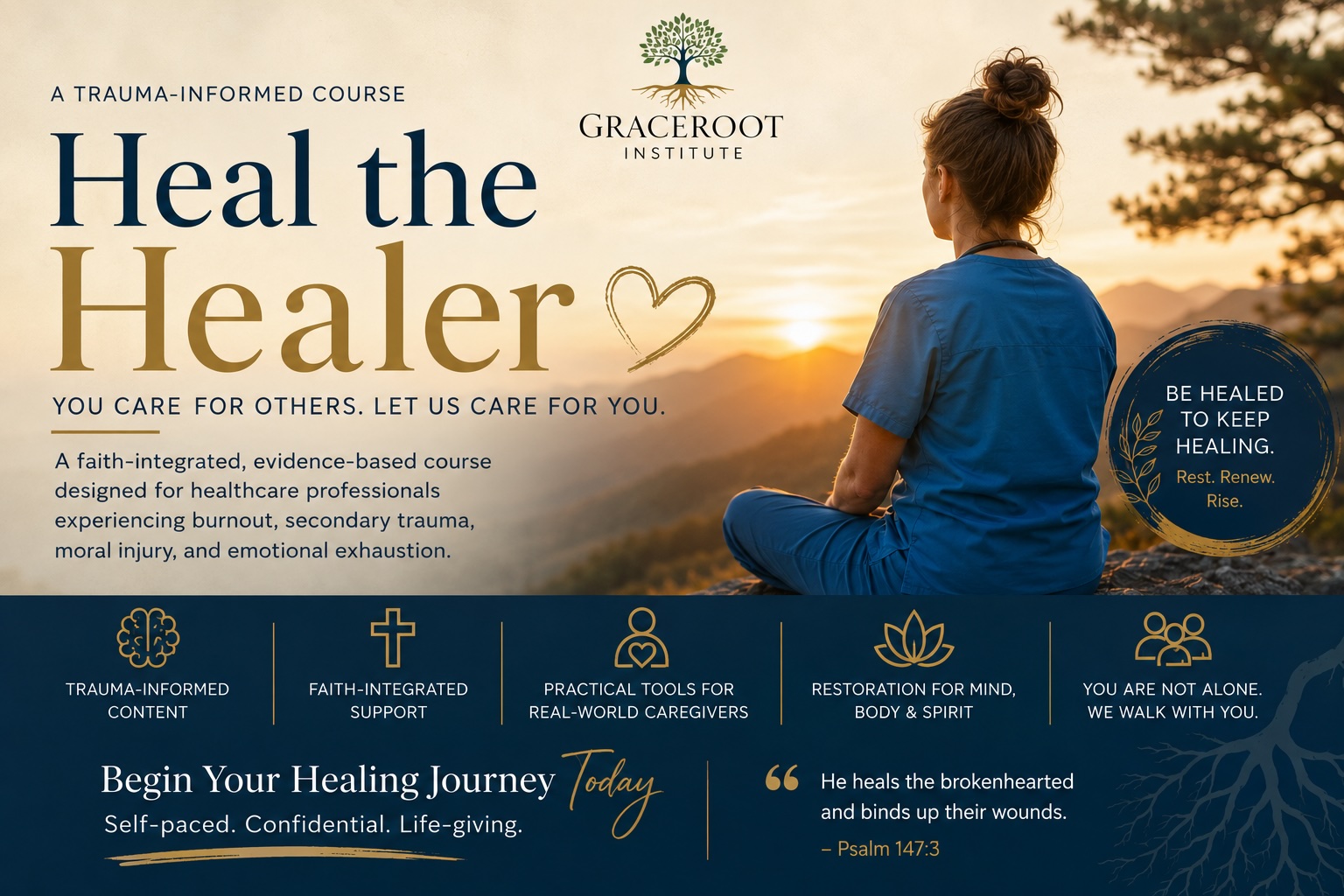
Emotional Exhaustion, Burnout & Compassion Fatigue — Burnout as nervous-system depletion, not personal failure. course banner

Healing the Healers · Course 1

Emotional Exhaustion, Burnout & Compassion Fatigue

Burnout as nervous-system depletion, not personal failure.

A trauma-informed, evidence-based continuing-education course on recognizing and healing emotional exhaustion, burnout, compassion fatigue, and secondary traumatic stress in healthcare workers — with optional faith and servant-leadership integration.

6modules182flash cards60quiz questions

Dr. Donetta Quinones, PhD, LPC, LMHC · GraceRoot Relationship Healing Institute · Healing the Healers series

Who this is for

A graduate-level professional-development series of sixteen separate courses for nurses, physicians, chaplains, and healthcare teams — reframing burnout as nervous-system depletion, not personal failure, and rebuilding resilience through the Relational Integrity framework.

Burnout, moral injury, and compassion fatigue are not signs of weakness — they are predictable responses of a human nervous system exposed to chronic stress and suffering. This series treats the healer with the same dignity they extend to every patient.

What you will be able to do

  • By the end of this lesson, you will be able to define burnout using the WHO ICD-11 and Maslach's three-dimensional model. (Module 1)
  • By the end of this lesson, you will be able to describe the HPA axis and the acute stress response. (Module 2)
  • By the end of this lesson, you will be able to identify the early emotional signs of burnout. (Module 3)
  • By the end of this lesson, you will be able to distinguish the multiple types of rest. (Module 4)
  • By the end of this lesson, you will be able to state SAMHSA's first principle (safety) and apply it inward. (Module 5)
  • By the end of this lesson, you will be able to reframe resilience as flexible process, not endless endurance (Bonanno). (Module 6)

Physiology, not failure

Grounded in polyvagal theory and stress neuroscience, the series reframes exhaustion as a recoverable nervous-system state rather than a character flaw.

Relational Integrity

A unifying framework connecting how we relate to ourselves, our patients, our teams, and our families — the connective tissue of sustainable caregiving.

Whole-person renewal

Each module integrates an optional faith and servant-leadership section, honoring the spiritual dimension of vocation alongside clinical evidence.

The modules

01Understanding Burnout
Burnout is one of the most used — and most misused — words in healthcare. This module builds precise, evidence-based language for the syndrome, separating it from ordinary stress, compassion fatigue, and secondary traumatic stress, so that you can locate yourself honestly and target the right intervention.
02The Neuroscience of Exhaustion
Burnout is not only psychological — it is written into the body's stress-response machinery. This module opens the hood on the neurobiology of chronic stress: the HPA axis, the autonomic nervous system, allostatic load, the window of tolerance, sleep, and the brain's remarkable capacity to heal. Understanding the mechanism turns self-care from a vague virtue into targeted physiology.
03Recognizing Warning Signs
Burnout rarely announces itself; it accumulates quietly until a person is far down the road. This module trains your early-warning system across five domains — emotional, physical, cognitive, relational, and spiritual — and then builds a simple weekly practice so you can intervene while intervention is still easy and inexpensive.
04Healing Emotional Capacity
Recovery is not a luxury earned after the work is done; it is the work that makes the work sustainable. This module moves from recognizing depletion to actively rebuilding the reserve caregiving draws upon — through rest, boundaries, self-compassion, support, emotional processing, and spiritual renewal.
05Trauma-Informed Self-Care
Generic self-care advice often falls flat for clinicians carrying real occupational trauma. Trauma-informed self-care applies the same principles we use to care for traumatized patients — organized here around SAMHSA's six trauma-informed principles — to the care of ourselves.
06Long-Term Resilience
Recovery returns you to baseline; resilience changes the baseline. This final module looks beyond crisis management to a sustainable career and life — reframing resilience, building protective habits and relational anchors, crafting sustainable work, preventing relapse, and committing everything learned to a written personal charter.

Format & what you get

  • 6 modules, each with six lessons, each with learning objectives, a hook, core content with key terms, I-do / We-do / You-do scaffolding, a case study, an interactive activity, a check for understanding, an optional faith & servant-leadership reflection, key takeaways, a personal reflection and references, plus a flashcard deck and a 10-question post-test.
  • 60 quiz questions, checked as soon as you answer; 80% passes. Retake as often as you like.
  • 182 flash cards, in the course’s own words.
  • A printable certificate of completion once you finish.
  • Written answers, quiz scores and completed modules save as you go, in your own browser.

Your instructor

Dr. Donetta Quinones, PhD, LPC, LMHC

Price

$149

One payment. Self-paced, revisit any time, and questions go to support@graceroot.institute. Secure checkout through PayPal.

A trauma-informed, evidence-based continuing-education course on recognizing and healing emotional exhaustion, burnout, compassion fatigue, and secondary traumatic stress in healthcare workers — with optional faith and servant-leadership integration.

Restoring the people who care for everyone else.

Program Clarity

GraceRoot courses are psychoeducational learning programs, not emergency care, legal advice, or a replacement for therapy. Certificates document GraceRoot completion. Court, employer, board, or continuing education acceptance should be confirmed before purchase unless a page states a specific approval.