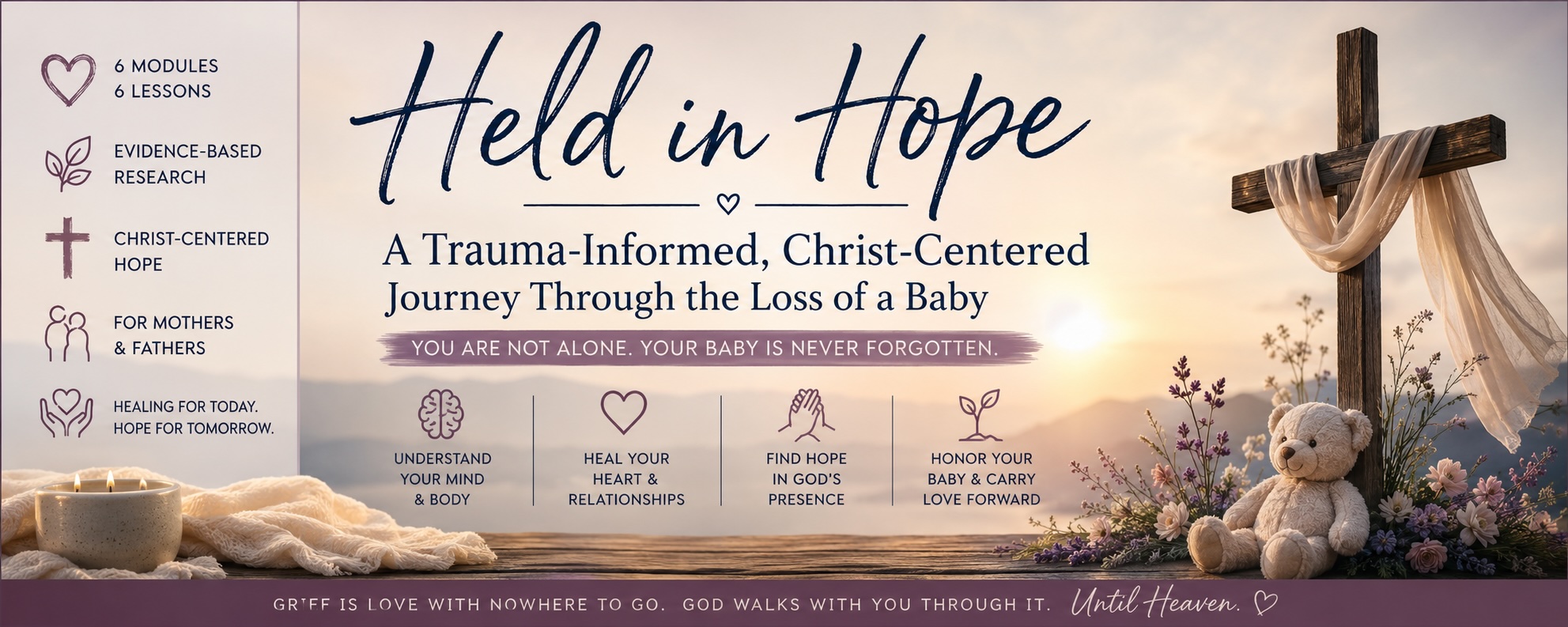
Held in Hope
Supporting parents after miscarriage, stillbirth, neonatal loss, and premature infant death — integrating trauma psychology, attachment science, grief research, neuroscience, family systems, and biblical hope.
Secure checkout. After payment you'll have full access on your dashboard. This is educational support, not a substitute for professional grief or mental-health care.
Course Philosophy
The death of a baby is unlike any other loss. Parents are not only grieving a child. They are grieving an identity, an imagined future, an interrupted attachment, changes to their marriage, changes to their body, changes to their faith, changes to family systems, and changes to their nervous system.
This course recognizes that the death occurred not only in the nursery — but also in the brain, body, relationships, and spiritual life of the parents. Rather than asking parents to "move on," this course teaches them how to carry love while rebuilding life.
Trauma-Informed Principles
- Safety, choice, collaboration, and empowerment
- Cultural sensitivity and faith integration
- Relational Integrity Framework
- Grief without timelines
- Attachment-informed, neurobiology-informed care
Christ-Centered Foundation
Core Scriptures woven through the course:
Psalm 34 · Isaiah 43 · John 11 · Romans 8 · Lamentations · Job · Psalm 139 · Matthew 5 · Revelation 21 · 1 Thessalonians 4 · John 14
How the Course Works
Each of the 36 lessons follows the same rhythm, built on research-based instructional design: clear learning objectives stated from your perspective; an opening hook that meets you where you are; direct instruction that breaks dense material into manageable steps; an interactive activity to practice and apply; a gentle knowledge check; a private reflection journal; and a closing that gathers the takeaways and bridges to the next lesson.
Your progress and journal entries are saved privately in your own browser on this device. Nothing is transmitted anywhere.
New here? Start with the Introduction & Course Video — a gentle one-minute welcome and an overview of the course's philosophy, science, and Christ-centered foundation.
| Module | Focus |
|---|---|
| 1 · When the World Stops | Understanding pregnancy and infant loss — definitions, trauma vs. grief, invisible attachment, birth trauma, normal reactions, and the God who meets us in unspeakable loss |
| 2 · The Mother's Journey | Her brain, body, heart, and spirit — postpartum physiology after loss, the maternal brain, identity, somatic trauma, faith questions, and compassion instead of shame |
| 3 · The Father's Hidden Grief | One of the least-discussed areas in psychology — how fathers grieve, their nervous systems, masculinity, secondary trauma, spiritual burdens, and becoming whole |
| 4 · Healing Together | Marriage after baby loss — grief mismatches, intimacy, family and boundaries, parenting living children, and relational integrity |
| 5 · What No One Talks About | Hidden questions — subsequent pregnancy anxiety, the searching brain, anniversary reactions, friendships, silent seasons of faith, and continuing bonds |
| 6 · Living Forward | Without leaving your baby behind — post-traumatic growth, legacy, hope for future pregnancies, a new family narrative, lifelong faith, and Held Until Heaven |
Two supplementary pages — Special Topics and Evidence Base & When to Seek Help — are available in the navigation at any time.
Introduction & Foundations
Begin here — a course video, the philosophy behind Held in Hope, and how to walk through it.
Held in Hope
A gentle 1-minute welcome · captions on · optional narration
The video plays entirely within this file — no internet required. Narration is off by default and uses your browser's built-in voice; captions remain on screen either way.
Why This Course Exists
The death of a baby is unlike any other loss, and it has too often been met with silence, minimization, or advice to simply "move on." Held in Hope was created to fill that silence with something better: a comprehensive, trauma-informed, Christ-centered path through one of the deepest sorrows a human being can know. When a baby dies through miscarriage, stillbirth, neonatal death, or the death of a premature infant, parents are not only grieving a child. They are grieving an identity, an imagined future, an interrupted attachment, and a cascade of changes to their marriage, their bodies, their faith, their extended families, and even their nervous systems. This course honors the full scope of that loss rather than reducing it to a single, tidy category of grief.
A central conviction runs through every module: the death occurred not only in the nursery, but also in the brain, the body, the relationships, and the spiritual life of the parents. A mother's body continues its postpartum physiology as though the baby had lived; a father carries trauma from a delivery room where he stood powerless; a marriage strains under two griefs that move on different timelines; a believing heart wrestles with questions it never expected to ask. Because the wound is this multidimensional, the healing must be as well. Rather than asking parents to leave their child behind, this course teaches them how to carry love while rebuilding life — the difference between forgetting and integrating, between severing a bond and transforming it.
Who This Course Is For
Held in Hope is written directly to bereaved mothers and fathers, and it is equally attentive to couples and whole family systems, including surviving siblings and grieving grandparents. It is designed to be used flexibly across many settings: churches and bereavement ministries, Christian and integrative counseling centers, hospitals and perinatal palliative care programs, and pregnancy resource centers. A parent can walk through it privately at their own pace; a counselor can assign lessons as psychoeducation between sessions; a small-group facilitator or pastor can use it as the backbone of a support group. The language is warm and accessible for grieving parents, while the underlying science and theology are rigorous enough to satisfy clinicians, chaplains, and reviewers who need to trust the material they are recommending.
The Trauma-Informed Foundation
Every lesson is built on established trauma-informed principles, because grief after infant loss so frequently coexists with genuine traumatic stress. The course prioritizes safety — emotional, physical, and spiritual — and consistently offers choice and control back to the reader, who is invited to pause, skip, or return to any lesson as their nervous system requires. It works through collaboration and empowerment rather than prescription, treating parents as the experts on their own experience. It practices cultural sensitivity toward the many ways families mourn, integrates faith without coercion, and is anchored throughout by a Relational Integrity Framework that keeps connection, repair, and mutual validation at the center of relational healing. Crucially, the course insists on grief without timelines, and it is deliberately attachment-informed and neurobiology-informed, so that reactions parents fear are "crazy" can be understood as the predictable workings of a bonded brain and body.
These principles are not decorative labels; they shape the moment-to-moment design of the material. When a lesson approaches traumatic content — a silent delivery room, a resuscitation, a difficult medical decision — it pauses to offer grounding, names that strong bodily reactions are expected, and gives explicit permission to step away. When it addresses shame, it replaces self-blame with compassion. When it discusses symptoms, it carefully distinguishes the wide, normal spectrum of adaptive mourning from the narrower set of signs that warrant professional evaluation, always framing help-seeking as courage rather than failure.
The Christ-Centered Foundation
Held in Hope is unapologetically Christ-centered, offering not clichés but the deep resources of biblical faith for people in anguish. It recovers the largely forgotten practice of lament — the honest, faithful bringing of grief, anger, and unanswered questions directly to God, modeled by fully a third of the Psalms and by Jesus himself on the cross. It rests on a theology of presence, the truth that God's answer to suffering is often his own nearness rather than a tidy explanation, and it lifts the eyes toward resurrection hope and the promise of reunion without ever rushing a parent past their sorrow. Core Scriptures recur across the modules — Psalm 34, Isaiah 43, John 11, Romans 8, Lamentations, Job, Psalm 139, Matthew 5, Revelation 21, 1 Thessalonians 4, and John 14 — forming a scriptural spine that carries the reader from the depths of loss toward a durable, honest hope.
This faith integration is careful never to weaponize theology against grieving parents. The course directly confronts and dismantles harmful misconceptions — that suffering is divine punishment, that a strong faith would not grieve, that doubt is disqualifying — and replaces them with the biblical portrait of a God who is "close to the brokenhearted," who weeps at tombs, and who welcomes the little ones into his arms. For the Christian parent, healing is framed within the "already and not yet" of redemption: real hope and real grief held together, faithfully, for as long as this life requires.
Integrating Rigorous Science with Compassionate Care
What distinguishes this curriculum is its refusal to choose between scientific rigor and spiritual depth. It draws on contemporary research and clinical guidance in perinatal grief and bereavement (Cacciatore, Gold, O'Leary, Burden), attachment theory and continuing-bonds research (Bowlby, Ainsworth), interpersonal neurobiology (Siegel), trauma treatment (van der Kolk, Herman), Polyvagal Theory (Porges), perinatal mental health (Postpartum Support International; ACOG), complicated and prolonged grief research (Shear and colleagues), Emotionally Focused Therapy (Johnson), and family systems theory (Bowen) — all woven together with Christian spiritual formation, lament theology, and biblical pastoral care. The result is a course in which a neuroscience of attachment sits beside a Psalm, and a discussion of the polyvagal nervous system leads naturally into a practice of grounded prayer.
The neurobiological thread deserves particular emphasis, because it is where many parents first find relief from the fear that they are losing their minds. The course explains how the amygdala, hippocampus, and prefrontal cortex behave under traumatic stress; how pregnancy durably remodels the maternal brain; how oxytocin and the attachment system keep the heart reaching for a baby who has died; and how the autonomic nervous system cycles between mobilization and shutdown. Understanding these mechanisms transforms terrifying, secret experiences — phantom cries, expected kicks, hypervigilance, milk coming in — into recognizable, normal expressions of a body and brain that loved. Science, here, becomes a form of compassion.
A Map of the Journey
The six modules trace a deliberate arc. Module 1, When the World Stops, establishes shared understanding — the many faces of loss, the crucial distinction between trauma and grief, the invisible attachment of pregnancy, the trauma of birth without life, the normal reactions parents fear, and the God who meets people in unspeakable loss. Module 2, The Mother's Journey, tends her brain, body, heart, and spirit, from postpartum physiology and the maternal brain to identity, somatic trauma, faith questions, and the movement from shame to compassion. Module 3, The Father's Hidden Grief, addresses one of the least-discussed areas in all of psychology — how fathers grieve, their often-untreated nervous systems, masculinity and grief, secondary trauma, spiritual burdens, and the path to wholeness.
Module 4, Healing Together, turns to the marriage — why couples grieve differently, the four common grief mismatches, the rarely addressed subject of sexual intimacy after loss, navigating family and boundaries, parenting living children while grieving, and the relational integrity that keeps two grieving people reachable to each other. Module 5, What No One Talks About, opens the hidden questions parents carry — subsequent pregnancy anxiety, the searching brain, anniversary reactions, the reshaping of friendships, seasons when faith feels silent, and the liberating research on continuing bonds. Module 6, Living Forward, looks toward a meaningful future without leaving the baby behind — post-traumatic growth, legacy, hope for future pregnancies, a new family narrative, lifelong faith, and the closing promise of being Held Until Heaven. Two supplementary pages gather the special topics and the evidence base with clear guidance on when to seek additional help.
How to Use This Course
Each of the thirty-six lessons follows the same research-based instructional rhythm, so that the material is not only moving but genuinely learnable. Every lesson opens with clear learning objectives stated from your perspective, followed by a hook that meets you where you are, several paragraphs of direct instruction that break dense material into manageable steps, a core Scripture, a set of key terms, and an "I do / we do / you do" activity that models a skill, practices it with you, and then releases you to apply it. A brief, low-stakes knowledge check offers instant feedback; a private reflection journal invites you to write; and a closing gathers the takeaways and bridges to the next lesson. Your progress and your journal entries are saved privately in your own browser, on your own device — nothing is transmitted anywhere.
Move through the course at whatever pace your grief allows. There are no deadlines and no "right" speed; you may pause, skip, return, or repeat any lesson, and if a section feels like too much on a given day, that is wisdom rather than failure. Facilitators and counselors may assign lessons in sequence or select those most relevant to a particular parent or group. Above all, remember what this course is and is not: it is a psychoeducational and pastoral companion, not a replacement for professional medical or mental-health care. If you are in crisis or notice the warning signs described in the Evidence Base page, please reach toward a licensed professional, your physician, a trusted pastor, or — in the United States — the 988 Suicide & Crisis Lifeline or Postpartum Support International at 1-800-944-4773. Reaching for help is an act of courage and love, and you were never meant to carry this alone.
The Many Faces of Pregnancy Loss
Naming what happened is the first act of honoring your baby.
Learning Objectives
By the end of this lesson, you will be able to:
- Define the major types of pregnancy and infant loss and describe how each differs.
- Explain why the type of loss shapes — but never ranks — the depth of a parent's grief.
- Locate your own experience within a landscape of losses that are all real and all worthy of grief.
Somewhere, right now, a mother is being handed a discharge form that asks for her baby's date of birth and date of death on the same line. Somewhere a father is carrying an empty car seat back out of a hospital. The world has words for weddings and graduations, but it stumbles over this. Before we can heal from something, we have to be allowed to name it. So we begin here — not with a clinical checklist, but with the truth that whatever kind of loss brought you to this page, your baby was real, and so is your grief.
Direct Instruction
Pregnancy and infant loss is not a single experience but a family of experiences, each with its own medical definition, its own timing, and its own particular sorrows. Understanding the distinctions matters, not because some losses "count more" than others — they do not — but because naming your specific loss accurately can loosen the isolation of feeling that no category quite fits you.
Miscarriage refers to the spontaneous loss of a pregnancy before 20 weeks of gestation. It is medically common, occurring in an estimated 10 to 20 percent of known pregnancies, yet its frequency does nothing to soften the blow for the parents who experience it. Because miscarriage often happens early and privately, it is one of the most disenfranchised of all losses — grieved deeply but witnessed by almost no one.
Stillbirth is the death of a baby at or after 20 weeks of gestation, before or during birth. Parents who experience stillbirth often labor and deliver, holding a baby they had felt move inside them days or hours earlier. The cruelty of birth and death arriving together is a particular kind of trauma we will return to in Lesson 4.
Neonatal death is the death of a baby within the first 28 days of life. These families often carry memories of a NICU, of monitors and alarms, of holding their living child and then saying goodbye — a compressed lifetime of parenting lived in days.
Premature infant death occurs when a baby born too early cannot survive despite medical intervention. Parents may swing between hope and dread for hours or weeks, a grief shaped by the exhausting labor of holding on.
Sudden Infant Death Syndrome (SIDS) is the unexplained death of a seemingly healthy baby, usually during sleep. The absence of an explanation is its own wound: parents are left to grieve without a "why," often haunted by unanswerable questions.
Medical termination after fetal diagnosis — sometimes called termination for medical reasons — occurs when parents receive a devastating prenatal diagnosis and make an anguished decision out of love. This loss frequently carries a heavy layer of moral injury, which we will explore later in the course. These parents wanted their babies with everything in them; the grief is no less real, and often more complicated by guilt others impose.
Across all of these, one truth holds: the grief a parent feels is not measured by gestational weeks or by how long the baby lived. A loss at eight weeks and a loss at eight months are not the same experience, but neither ranks above the other on some ledger of sorrow. Attachment — as we will see in Lesson 3 — begins long before birth, and grief follows love, not the calendar.
Key Terms
- Gestational age
- The age of a pregnancy measured in weeks from the first day of the last menstrual period; used to distinguish miscarriage from stillbirth.
- Disenfranchised grief
- Grief that society does not fully acknowledge or permit to be mourned openly — common with early loss.
- Moral injury
- The lasting psychological and spiritual distress that results from decisions that violate one's deepest values, even when no true wrong was done.
Interactive Activity — "Name and Honor"
I do: A parent might say, "Our daughter died at 22 weeks. That is a stillbirth. She had a name — Ruth — and she was our child." Naming the loss and the baby together honors both the fact and the person.
We do: Notice how the sentence holds two things at once — a clinical fact and a beloved person. Grief needs both: accuracy so we are not gaslit, and love so we are not reduced to a diagnosis.
You do: In the reflection space below, write one or two sentences naming your own loss the way you would want it honored. There is no wrong way to do this.
✓ Check for Understanding
Low-stakes and just for you. Choose the best answer.
1. What primarily distinguishes a miscarriage from a stillbirth?
2. Why does the course insist that no type of loss "ranks above" another?
Reflection Journal
Name your loss the way you would want it honored. What kind of loss was it, and who was your baby to you?
Your words are saved only in this browser, on this device. Nothing is sent anywhere.
Closing & Bridge
Today you learned that pregnancy and infant loss wears many faces — miscarriage, stillbirth, neonatal death, prematurity, SIDS, and loss after a fetal diagnosis — and that none of them outranks another in grief. You named your own loss and the baby at its center. In the next lesson we will draw an important distinction that changes everything about healing: the difference between trauma and grief, and why so many parents carry both at once.
Trauma and Grief Are Different
"I wasn't safe" and "I lost someone I love" are two wounds — and you may carry both.
Learning Objectives
By the end of this lesson, you will be able to:
- Distinguish trauma ("I wasn't safe") from grief ("I lost someone I love").
- Identify the brain regions involved in the traumatic stress response and what each does.
- Recognize why intrusive memories, freeze responses, and hospital triggers are physiological — not personal failings.
A mother once said, "Everyone keeps telling me to grieve, but grief isn't the word for what happens when I hear a heart monitor beep in a TV show and suddenly I can't breathe." She was right. What she was describing wasn't only sorrow — it was her body reliving a moment when it believed she or her baby was in danger. Grief and trauma can share the same room, but they are not the same guest.
Direct Instruction
At the heart of this lesson is a distinction that reorganizes how parents understand their own suffering. Grief is the response to loss — the ache of missing someone you love, the reshaping of a life around an absence. Its core message is, "I lost someone I love." Trauma is the response to threat — the nervous system's reaction to an experience of danger, helplessness, or horror. Its core message is, "I wasn't safe." These are different injuries requiring different care, and pregnancy and infant loss frequently inflicts both at the same time.
To understand why, we look at three regions of the brain. The amygdala is the brain's smoke detector — a fast, wordless alarm system that scans for danger and, when triggered, floods the body with stress hormones before conscious thought can catch up. During a medical crisis, the amygdala files away sights, sounds, and smells as danger signals. Later, a beeping monitor or an antiseptic scent can set off the alarm again, even years afterward.
The hippocampus is the brain's librarian — it timestamps memories and files them as "past." Under extreme stress, high levels of cortisol can impair the hippocampus, so traumatic memories are stored without a clear "this is over" label. This is why intrusive memories of the loss don't feel like remembering; they feel like reliving, as though the event is happening now.
The prefrontal cortex is the brain's wise counselor — the region responsible for reasoning, perspective, and calming the alarm. In moments of overwhelming threat, the prefrontal cortex goes partly offline; the thinking brain is temporarily overpowered by the survival brain. This is not weakness. It is the design of a nervous system built to survive danger, functioning exactly as intended.
When the survival brain takes over, parents often experience a freeze response — a sense of numbness, unreality, or being frozen in place. Many parents later judge themselves harshly: "Why didn't I do more? Why did I just stand there?" But freezing is one of the body's automatic survival strategies, alongside fight and flight. It is chosen by the brainstem in milliseconds, not by the person.
Intrusive memories — flashbacks, unbidden images, nightmares — are hallmark signs that an experience was traumatic, not merely sad. So are hospital triggers: the smell of hand sanitizer, the sound of an elevator ding, the sight of a maternity ward. These reactions are the amygdala doing its job with memories the hippocampus never got to properly file.
Why does the difference matter for healing? Because grief and trauma respond to different kinds of care. Grief is helped by remembering, by telling the story, by allowing the love and sorrow to move. Trauma, when it is still raw, can be worsened by forcing the story too soon; it first needs safety, regulation, and a nervous system that has learned it is no longer in danger. Much of the harm parents experience comes from well-meaning people applying grief remedies to trauma wounds, or expecting a traumatized nervous system to simply "process feelings" when what it needs first is to feel safe.
Key Terms
- Amygdala
- The brain's rapid threat-detection center; triggers the stress response before conscious thought.
- Hippocampus
- The memory-filing region that timestamps events as "past"; impaired under extreme stress.
- Prefrontal cortex
- The reasoning and regulating region that goes partly offline during overwhelming threat.
- Freeze response
- An automatic survival state of numbness or immobility, chosen by the brainstem, not the conscious mind.
Interactive Activity — "Sorting the Wounds"
I do: Consider the statement, "I keep seeing the moment the ultrasound tech went quiet." That is a trauma memory — a threat replay. The statement "I miss the weight of her in my arms" is grief — a longing for someone loved.
We do: Notice that the same event can generate both: the silence in the room (trauma) and the empty arms afterward (grief). One asks for safety; the other asks for tenderness.
You do: In the reflection space, list two or three things you carry from your loss, and beside each, gently note whether it feels more like "I wasn't safe" (trauma) or "I lost someone I love" (grief). There is no wrong sorting, and many will be both.
✓ Check for Understanding
Low-stakes and just for you.
1. Which statement best captures the core message of trauma?
2. Why do traumatic memories often feel like reliving rather than remembering?
Reflection Journal
List a few things you carry from your loss. Beside each, note gently whether it feels more like trauma ("I wasn't safe") or grief ("I lost someone I love") — or both.
Your words are saved only in this browser, on this device.
Closing & Bridge
You learned today that grief says "I lost someone I love" while trauma says "I wasn't safe," and that a baby's death often delivers both wounds through the same event. You met the amygdala, hippocampus, and prefrontal cortex, and you saw that intrusive memories and freeze responses are physiology, not failure. Next we turn to one of the least-discussed truths in all of grief research: attachment begins in pregnancy — and when a baby dies, that attachment does not simply switch off.
The Invisible Attachment
Your love did not begin at birth — and it did not end at death.
Learning Objectives
By the end of this lesson, you will be able to:
- Explain that parent-infant attachment begins during pregnancy, not at birth.
- Describe how the attachment system keeps "searching" for the baby after death.
- Reframe experiences like phantom crying or expecting movements as normal expressions of a real bond.
Weeks after her son died, a mother found herself walking toward the nursery at 2 a.m., half-awake, certain she had heard him cry. She stopped in the doorway of an empty room and wondered if she was losing her mind. She was not. Her body was doing exactly what a bonded parent's body does — reaching for a baby it still loves. This lesson is about that reaching, and why it is one of the most important and least-explained parts of your grief.
Direct Instruction
One of the most overlooked truths in grief care is that attachment begins during pregnancy. Long before a baby is born, parents are already bonding — and they do it through countless small acts. They talk to the baby. They plan a future. They touch a growing belly and feel movement answer back. They dream. They choose a name. They watch an ultrasound and memorize a profile. They imagine first steps, first words, a wedding decades away. Each of these is a thread of attachment, and together they weave a real and powerful bond well before a first breath is ever taken.
Attachment, in the work of researchers like John Bowlby and Mary Ainsworth, is a biological system — not merely a feeling but a drive, as fundamental as hunger or thirst. Its entire purpose is to keep a parent oriented toward, and reaching for, their child. This system does not check a birth certificate before it activates. It builds itself through the months of pregnancy, tuning a parent's brain and body to the presence of their baby.
Here is the truth that explains so much of what parents experience: when the baby dies, the attachment remains. The bond does not dissolve at the moment of loss. The attachment system, having spent months orienting toward the baby, continues to search — because searching is precisely what an attachment system is built to do when the attached figure is missing. This is the same ancient mechanism that makes any bonded creature look for a lost loved one.
This "searching" behavior is not a sign of denial or madness. It expresses itself in ways that frighten parents who do not understand it: phantom crying, the vivid auditory sense of hearing the baby cry; expecting to feel baby movements months after loss, the body still braced for a familiar flutter; looking toward the nursery reflexively; waking at feeding times, the internal clock still set to a rhythm that no longer has a purpose. A parent may catch themselves reaching for a baby who is not there, or turning at the sound of another infant's cry with their whole body flooding.
Understood correctly, these are not symptoms of a broken mind. They are the aftershocks of a real bond — evidence that your love was genuine, embodied, and deeply wired into your nervous system. The attachment system is doing what love asks of it: reaching for the one it cannot find. This can be excruciating. It can also, in time, be strangely comforting: your body's stubborn searching is the physical proof that your baby mattered, that the bond was real, and that you are, unmistakably, this child's parent.
The work ahead is not to sever this attachment — a theme we will return to powerfully in Module 5 with continuing bonds — but to let the searching gradually soften into a different kind of holding: a love that is carried rather than chased. For now, it is enough to know that the reaching is normal, and that it means something beautiful about the depth of your bond.
Key Terms
- Prenatal attachment
- The emotional bond parents form with their baby during pregnancy, through talking, touch, planning, and imagination.
- Attachment system
- A biological drive that orients a parent toward their child and activates searching behavior when the child is absent.
- Searching behavior
- The instinctive reaching, listening, and looking for a lost attachment figure — normal after any profound bond is broken.
Interactive Activity — "The Threads of Bonding"
I do: A father reflects, "I bonded when I felt the first kick against my hand. That was the moment he became real to me." He can name a specific thread of attachment.
We do: Every parent's threads differ — a name, a heartbeat on a screen, a nickname, a nursery painted a certain color. Together these threads formed a bond that death did not erase.
You do: In the reflection space, name three or four ways you began bonding with your baby during pregnancy or their brief life. Then notice: those threads are the measure of your love, and they explain why your heart still reaches.
✓ Check for Understanding
Low-stakes and just for you.
1. According to the lesson, when does parent-infant attachment begin?
2. Why might a parent hear phantom crying or expect to feel movements after loss?
Reflection Journal
Name three or four ways you began bonding with your baby. What threads of attachment did you weave?
Your words are saved only in this browser, on this device.
Closing & Bridge
You learned that attachment begins in pregnancy, that it is a biological system built to reach for your child, and that its continued searching after loss — phantom cries, expected movements, waking for feedings — is the normal echo of a real bond, not a sign you are "going crazy." In the next lesson we look closely at a wound many parents carry silently: the trauma of giving birth to a baby who has died, and why birth trauma so often travels alongside grief.
The Trauma of Birth Without Life
When the room where life should begin becomes the room where you say goodbye.
Learning Objectives
By the end of this lesson, you will be able to:
- Identify hospital and birth experiences that commonly become traumatic.
- Explain why birth trauma frequently coexists with, and complicates, grief.
- Extend compassion to yourself for reactions rooted in a genuinely traumatic medical event.
Birth is supposed to end in a cry. The whole architecture of a delivery room — the warmer, the little hat, the anticipation of everyone present — is built around the expectation of new life. When that cry never comes, the silence is not merely sad. It is a rupture of everything the body and mind were braced for. Many parents describe the delivery of a baby who has died as the single most traumatic experience of their lives, and this lesson gives that experience the acknowledgment it deserves.
Direct Instruction
Grief after infant loss rarely arrives alone. For a great many parents, it is fused with birth trauma — the psychological injury of a delivery experience marked by danger, helplessness, or horror. Understanding the specific experiences that become traumatic helps parents make sense of reactions that might otherwise feel inexplicable or shameful.
Consider the experiences parents describe. Emergency surgery — an unplanned cesarean under crisis conditions, sometimes under general anesthesia, sometimes while conscious and terrified. Laboring while knowing the baby has already died — the almost unimaginable task of enduring hours of contractions to deliver a child one already knows will not breathe. Silent delivery rooms — the absence of the newborn cry, the hushed movements of staff who do not know what to say, the quiet that announces the loss before any words are spoken. Holding a deceased infant — a moment that can be tender and precious and also, for a nervous system in shock, profoundly disorienting.
There are also the medical interventions themselves: monitors, IV lines, catheters, injections, examinations — a body subjected to procedure after procedure during the most vulnerable hours of a life. There are insensitive comments, sometimes from exhausted or undertrained staff, that lodge in memory like splinters: a careless word about "trying again," a form filled out too briskly, a question asked without gentleness. And there are the multiple procedures that may follow — autopsy discussions, paperwork, repeated retellings of the story to new personnel, each one reopening the wound.
Why does birth trauma so often coexist with grief, and why does it matter? Because the two wounds interact. Trauma can freeze grief in place: a parent so flooded by threat memories may be unable to access the tender sorrow underneath, because every time they approach the memory of their baby, the amygdala sounds the alarm about the danger of the delivery. As we learned in Lesson 2, trauma and grief call for different care, and when they are tangled together, healing requires tending to both — first helping the nervous system learn it is safe, so that the grief has room to breathe.
It is also crucial to name that birth trauma is not a matter of weakness or of "not coping well." The experiences above meet the clinical criteria for traumatic events — they involve real or perceived threat to life, whether the baby's or the mother's, and a profound sense of helplessness. A parent who develops flashbacks of the operating room, who cannot drive past the hospital, who dissociates at the smell of antiseptic, is not overreacting. Their nervous system correctly registered a life-threatening emergency and is responding accordingly.
Fathers and partners are not exempt from birth trauma either — a theme we will develop fully in Module 3. Watching a spouse hemorrhage, hearing alarms, being ushered out of a room, standing helpless while the people you love most are in danger: these are traumatic in their own right, and partners often carry them in silence.
Naming birth trauma is the beginning of healing it. When parents understand that their reactions are the predictable results of a genuinely traumatic event — not evidence of instability — they can begin to extend to themselves the compassion the experience truly warrants, and to seek the specific kinds of help that trauma responds to.
Key Terms
- Birth trauma
- Psychological injury arising from a childbirth experience involving danger, helplessness, or horror.
- Dissociation
- A protective mental disconnection from one's surroundings, body, or emotions during or after overwhelming events.
- Traumatic event (clinical sense)
- An experience involving actual or perceived threat to life, serious injury, along with intense fear or helplessness.
Interactive Activity — "Gentle Witness"
I do: A parent notes, "The sound of the door closing when they wheeled me to surgery — that's the part I can't shake." Naming the specific traumatic moment brings it into the light where it can be tended.
We do: Naming a traumatic moment is not the same as reliving it. We name it briefly, as a witness would, and then return to safety — noticing the ground, the breath, the present.
You do: If you feel ready — and only if you feel ready — name in the reflection space one part of your birth or hospital experience that felt more like trauma than grief. Then take three slow breaths and remind yourself: that was then; I am here now. If it feels like too much today, skip this and return when you wish.
✓ Check for Understanding
Low-stakes and just for you.
1. Why does birth trauma often complicate grief?
2. A parent who dissociates at the smell of antiseptic is best understood as:
Reflection Journal
If you feel ready, name one part of your birth or hospital experience that felt more like trauma than grief. Then remind yourself: that was then; I am here now. (Skip freely if today is not the day.)
Your words are saved only in this browser, on this device.
Closing & Bridge
You learned that birth without life is frequently traumatic — through emergency surgery, silent delivery rooms, medical procedures, and insensitive words — and that this trauma tangles with grief, requiring care for both. You practiced gently witnessing a hard memory and returning to safety. In the next lesson we address the reactions that most frighten parents into thinking they are "going crazy," and we will see how often those very reactions are entirely normal.
Common Reactions Parents Fear Mean They Are "Going Crazy"
The strangest experiences of grief are often the most normal.
Learning Objectives
By the end of this lesson, you will be able to:
- Recognize a range of unsettling grief reactions as common and normal after infant loss.
- Connect these reactions to the attachment, hormonal, and nervous-system realities you have already learned.
- Replace the fear of "going crazy" with informed self-understanding.
"I didn't tell anyone," a mother admitted, "because I was sure they'd think I'd lost my mind. I kept smelling his blanket. I checked a baby monitor for a nursery that was empty. I felt him kick — I know I felt it — three months after he died." She was not losing her mind. She was grieving with a body and brain that had been physically shaped by pregnancy and bonding. This lesson exists to tell you, plainly: you are not going crazy.
Direct Instruction
Among the cruelest secondary sufferings of infant loss is the private terror that one is going insane. Parents experience reactions so strange, so vivid, so contrary to ordinary life that they hide them from everyone — and hiding deepens the isolation. This lesson brings those reactions into the light and names them for what they overwhelmingly are: normal responses to a profound loss experienced by a bonded body and brain.
Hearing baby cries. Many parents hear the distinct sound of their baby crying — in another room, in the shower's white noise, in the moments before sleep. As we learned in Lesson 3, this phantom crying is the attachment system searching. The auditory cortex, primed for months to listen for this specific sound, produces it.
Feeling kicks months later. The sensation of fetal movement can persist long after loss. The body spent months registering these flutters; the nervous system's memory of them does not vanish on schedule. This is sometimes called phantom kicks, and it is widely reported and entirely normal.
Milk production after death. Perhaps nothing feels more cruelly absurd than a body producing milk for a baby who has died. Yet, as we will explore in Module 2, the body's postpartum physiology proceeds according to hormones, not according to the survival of the infant. This is biology, not madness — though it can be emotionally devastating, and there are compassionate medical options for managing it.
Checking monitors. Parents may find themselves compulsively checking a baby monitor, a crib, a car seat — the body enacting the vigilance of parenthood with no baby to protect. This is the protective instinct of attachment with nowhere to land.
Feeling the baby's presence. Many parents sense their baby near — a comforting weight, a warmth, an impression of being watched over. Across cultures and faith traditions this is common and often deeply meaningful. It need not be explained away; for many it is a source of genuine comfort and spiritual significance.
Wanting to smell baby clothes. Scent is wired directly to memory and emotion through the olfactory system's close ties to the amygdala and hippocampus. Seeking the smell of a baby's blanket or clothing is the body reaching for connection through its most primal memory channel. It is an act of love, not of pathology.
Dreams. Vivid dreams of the baby — holding them, losing them, searching for them — are common. Dreams are one of the mind's ways of processing overwhelming experience and of continuing the bond. They can be painful and they can be gifts; sometimes both at once.
Hypervigilance. A heightened state of alertness — scanning for danger, unable to relax, startling easily — is a hallmark of a nervous system that has learned the world is not safe. After a loss that often felt sudden and uncontrollable, hypervigilance is the survival brain trying to prevent the next catastrophe.
The unifying truth is this: these reactions arise from real biological and psychological processes — attachment, hormones, memory, the survival brain — set in motion by a genuine bond and a genuine trauma. They are not signs of a mind coming apart. They are signs of a parent who loved. There is, of course, a threshold at which grief reactions may signal a condition needing additional clinical support — prolonged grief disorder, major depression, PTSD, or an anxiety disorder — and we will address that carefully in the Evidence Base page and Module 5. But the reactions in this lesson, in themselves, are the ordinary landscape of extraordinary loss.
Key Terms
- Phantom kicks
- The persisting sensation of fetal movement after pregnancy loss; a common, benign bodily memory.
- Hypervigilance
- A state of heightened alertness and threat-scanning driven by a nervous system braced for danger.
- Olfactory memory
- Memory tied to scent, wired closely to the brain's emotion and memory centers, which is why smells evoke the baby so powerfully.
Interactive Activity — "You Are Not Alone in This"
I do: A parent reads the list and thinks, "The milk coming in — I thought I was the only one, and I felt insane. Now I see it's biology." Recognition brings relief.
We do: Each reaction on the list has been reported by countless bereaved parents. Naming them as shared experiences dissolves the shame of secrecy.
You do: In the reflection space, write down any reaction you have had that made you fear for your sanity. Then, beside it, write the reassurance this lesson offers: This is a normal response of a body and brain that loved my baby.
✓ Check for Understanding
Low-stakes and just for you.
1. A mother's body producing milk after her baby has died is best understood as:
2. What is the unifying message of this lesson about strange grief reactions?
Reflection Journal
Write down any reaction that made you fear for your sanity. Beside it, write: "This is a normal response of a body and brain that loved my baby."
Your words are saved only in this browser, on this device.
Closing & Bridge
You learned that hearing cries, feeling phantom kicks, producing milk, checking monitors, sensing your baby's presence, seeking their scent, dreaming, and hypervigilance are overwhelmingly normal — the ordinary landscape of extraordinary loss. In the final lesson of Module 1, we turn to the God who does not stand at a distance from this suffering, but enters it — through David, Job, Rachel, Mary, and Jesus weeping — and we learn the ancient practice of lament.
God Meets People in Unspeakable Loss
The Bible does not rush past grief. It sits down inside it.
Learning Objectives
By the end of this lesson, you will be able to:
- Identify biblical figures who experienced profound loss and how Scripture honors their grief.
- Describe the theology of lament as faithful, honest grief brought to God.
- Give yourself permission to bring anguish — not only praise — into your relationship with God.
When Jesus arrived at the tomb of his friend Lazarus — knowing full well he was about to raise him — the shortest verse in the Bible records what he did first: "Jesus wept." He did not skip to the miracle. He stood in the grief of the sisters and wept with them. If the Son of God took time to cry at a graveside, then your tears are not a failure of faith. They are its companion.
Direct Instruction
A quiet lie afflicts many grieving Christians: that faith and sorrow cannot coexist, that a truly faithful parent would "have peace," that grief this deep must mean something is spiritually wrong. Scripture dismantles this lie on nearly every page. The Bible is not a book that hurries past loss; it is a book that enters loss and honors it, giving us language and companionship in the darkest valleys.
Consider David, who lost an infant son and fasted and wept on the ground for seven days, pleading with God (2 Samuel 12). His grief was raw and physical and unashamed. Consider Job, who lost all ten of his children in a single day and tore his robe and fell to the ground — and whom Scripture does not rebuke for his anguished questions but honors for his honesty. God's response to Job is not a tidy explanation but a self-revealing presence; sometimes the answer to suffering is not a reason but a Person.
Consider Rachel, whose weeping for her children echoes across the centuries: "A voice is heard in Ramah, weeping and great mourning, Rachel weeping for her children and refusing to be comforted, because they are no more" (Jeremiah 31:15; Matthew 2:18). Scripture does not scold Rachel for refusing false comfort. It records her grief as sacred and real. Consider Mary, the mother of Jesus, of whom Simeon prophesied that "a sword will pierce your own soul too" (Luke 2:35) — a mother who would one day watch her son die. God does not exempt even the most faithful from the piercing of grief.
And consider Jesus weeping at the tomb of Lazarus (John 11). Here is the deepest comfort of the Christian faith: God in the flesh, standing at a grave, moved to tears. Jesus was "deeply moved in spirit and troubled." He did not consider grief beneath him or contrary to his mission. He wept — and then he acted. The God we worship is not a distant, unmoved observer of human suffering but "a man of sorrows, and acquainted with grief" (Isaiah 53:3).
This brings us to the theology of lament. Lament is the biblical practice of bringing honest grief — including anger, confusion, and protest — directly to God. Fully a third of the Psalms are laments. They say things like, "How long, O LORD? Will you forget me forever?" (Psalm 13) and "My God, my God, why have you forsaken me?" (Psalm 22) — the very words Jesus himself cried from the cross. Lament is not the opposite of faith; it is one of faith's most courageous forms. To lament is to keep talking to God even when you do not understand him, to bring your fist and your tears into his presence rather than walking away.
Lament typically moves through honest complaint, bold petition, and — often, though not always immediately — a turn toward trust. But the trust in lament is hard-won and real, not a denial of pain. You do not have to arrive at "yet I will praise him" today. The Psalms give you permission to dwell in "how long" for as long as you need. God is not fragile; he can hold your anger, your questions, and your grief without withdrawing his love.
For the grieving parent, this changes everything about how one prays. You are not required to perform peace you do not feel. You are not disqualified from faith by your anguish. The invitation of Scripture is to bring your unspeakable loss to the God who meets people precisely there — in the ashes, at the tomb, in the voice weeping in Ramah — and who has promised never to leave you.
Key Terms
- Lament
- The biblical practice of bringing honest grief, protest, and questions directly to God as an act of faith.
- Theology of presence
- The truth that God's answer to suffering is often his own nearness rather than a tidy explanation.
- "Man of sorrows"
- Isaiah's description of the Messiah as one acquainted with grief, affirming that God enters human suffering.
Interactive Activity — "Writing a Lament"
I do: A grieving father writes, "How long, Lord? I don't understand why you let this happen. But I am still here, still talking to you." That is a lament — honest, unresolved, and faithful.
We do: A lament has room for complaint ("why?"), for petition ("help me"), and, when it comes, for a fragile turn toward trust. All three are welcome; none is required today.
You do: In the reflection space, write your own short lament to God. Say the true thing — the anger, the question, the plea. You do not have to tie it up neatly. The Psalms rarely do.
✓ Check for Understanding
Low-stakes and just for you.
1. What is lament, biblically understood?
2. What does "Jesus wept" at Lazarus's tomb reveal for grieving parents?
Reflection Journal
Write your own short lament to God. Say the true thing — the question, the anger, the plea. You don't have to resolve it.
Your words are saved only in this browser, on this device.
Closing & Bridge
You learned that Scripture honors the grief of David, Job, Rachel, Mary, and Jesus himself, and that lament is a courageous form of faith — permission to bring anguish, not only praise, into God's presence. This closes Module 1. In Module 2 we turn to the mother's particular journey: her brain, body, heart, and spirit, beginning with a startling truth — her body does not know her baby died.
Your Body Doesn't Know Your Baby Died
The cruelest and most misunderstood truth of maternal loss.
Learning Objectives
By the end of this lesson, you will be able to:
- Explain how postpartum physiology continues regardless of the baby's survival.
- Identify the major hormonal shifts a bereaved mother's body undergoes.
- Reframe distressing physical experiences as biology, not betrayal or failure.
Three days after her daughter was stillborn, a mother's milk came in. She sat on the edge of the bathtub and sobbed, not only from grief but from a sense of grotesque betrayal: how could her own body prepare to nourish a baby who was gone? No one had warned her. This lesson gives every bereaved mother the warning, the explanation, and the compassion she deserves — because your body is not betraying you. It simply does not know.
Direct Instruction
Of all the sufferings of maternal loss, few are as disorienting as the discovery that the body continues its postpartum work as if the baby had lived. The mother's physiology was set in motion by pregnancy itself, and it proceeds on a hormonal timetable that has no way of registering the death of the infant. Understanding this can transform a source of shame and horror into something a mother can grieve with self-compassion rather than self-blame.
Pregnancy is orchestrated by a remarkable cascade of hormones, and birth — whether the baby lives or dies — triggers the next stage of that cascade. Oxytocin, the hormone of bonding and labor, surges around birth and remains active; it drives the longing to hold and nurture, which is part of why the ache to reach for the baby is so physically intense. Prolactin rises to stimulate milk production, and so milk comes in regardless of whether there is a baby to feed — often two to four days after delivery, sometimes accompanied by engorgement, leaking, and physical pain layered atop emotional agony. Estrogen and progesterone, which soared during pregnancy, plummet after birth in a steep withdrawal that profoundly affects mood, sleep, and emotional regulation, contributing to the tearfulness and volatility many mothers feel.
Beyond hormones, the body carries out the full work of postpartum recovery. The uterus contracts and shrinks back toward its pre-pregnancy size, often with cramping. Bleeding (lochia) continues for weeks. For mothers who delivered by cesarean, there is a major abdominal surgery to heal from — an incision, restricted movement, real pain — while simultaneously grieving. Pelvic recovery proceeds as tissues that stretched for birth slowly restore themselves. The body, in other words, does everything it would do for a living baby: it heals, it bleeds, it produces milk, it aches to hold — because it was built to sustain life and it cannot tell that the life it prepared for is gone.
This is the research truth so often overlooked: the body continues postpartum physiology regardless of infant survival. A bereaved mother is, physiologically, a postpartum mother in every respect except the one that matters most to her heart. She needs the same physical care, rest, and recovery that any new mother needs — and she needs it while carrying a grief that no new mother should have to bear.
Knowing this matters for two reasons. First, it removes a layer of shame. A mother who understands that her milk, her longing, and her tears are biology can stop interpreting them as her body's cruelty or her own instability. Second, it opens the door to practical, compassionate care. There are gentle medical options for suppressing lactation, for managing pain, for supporting the steep hormonal descent. A mother does not have to endure these physical realities without help, and asking for that help is wise, not weak. (If milk supply, bleeding, mood, or pain becomes severe or alarming, that is a signal to contact a medical provider — postpartum bodies, grieving or not, sometimes need prompt care.)
There is even, for some mothers, a strange tenderness available here. The body's insistence on preparing to nourish is, at its root, an expression of how completely it committed to this child. The milk is grief made physical. It is not a betrayal of your baby; it is the last echo of your body's readiness to love and sustain them.
Key Terms
- Prolactin
- The hormone that stimulates milk production; it rises after birth regardless of the infant's survival.
- Estrogen/progesterone withdrawal
- The steep postpartum drop in pregnancy hormones that strongly affects mood and emotional regulation.
- Lochia
- The normal postpartum vaginal bleeding that continues for weeks as the uterus heals.
- Lactation suppression
- Medical and comfort measures used to ease or stop milk production after loss.
Interactive Activity — "Biology, Not Betrayal"
I do: A mother reframes: "My milk coming in isn't my body mocking me. It's my body doing what pregnancy set in motion. It's the proof of how ready I was to feed him."
We do: Each physical experience — the milk, the cramping, the tears — can be met with the same sentence: This is biology, and I deserve care for it.
You do: In the reflection space, name one physical experience of your postpartum body that has been especially hard. Then write beside it what compassionate care that part of you needs — rest, medical help, gentleness, a word of grace.
✓ Check for Understanding
Low-stakes and just for you.
1. Why does a bereaved mother's milk still come in after her baby dies?
2. What is the key reframe this lesson offers?
Reflection Journal
Name one physical experience of your postpartum body that has been especially hard. What compassionate care does that part of you need?
Your words are saved only in this browser, on this device.
Closing & Bridge
You learned that a bereaved mother's body continues its full postpartum work — milk, hormonal withdrawal, healing, the ache to hold — because physiology cannot register the death, and that these experiences are biology deserving of care, not betrayal. Next we go deeper into the brain: recent neuroscience showing that pregnancy permanently reshapes the maternal brain, and that those changes remain after loss.
The Maternal Brain After Loss
Pregnancy rewired you to be a mother. That wiring remains.
Learning Objectives
By the end of this lesson, you will be able to:
- Describe how pregnancy produces lasting changes in maternal brain networks.
- Connect these neural adaptations to protective instincts, hypervigilance, memory, and identity after loss.
- Understand that "still feeling like a mother" is neurologically true, not wishful thinking.
"People keep implying I should go back to who I was before," a mother said. "But I can't. I'm not her anymore." She was more right than she knew. Pregnancy had physically remodeled her brain — and those changes did not reverse when her baby died. This lesson is about the maternal brain that remains, and why it means you are, and always will be, this child's mother.
Direct Instruction
In recent years, neuroscience has confirmed what mothers have long sensed: pregnancy changes the brain, and it does so durably. Landmark neuroimaging research has shown that pregnancy is associated with lasting changes in the structure and function of maternal brain networks — particularly regions involved in social cognition, empathy, threat detection, and attachment. These are not temporary fluctuations; some persist for years. Pregnancy, in a real sense, builds a maternal brain, and that brain does not un-build itself when a baby dies.
Why would nature reshape the brain this way? Because parenting a vulnerable newborn demands specific capacities: an acute sensitivity to an infant's cues, a fierce orientation toward the baby's safety, and a reorganization of priorities around this new life. The changes are adaptive — they prepare a mother to protect and attune to her child. But when the child is gone, these same adaptations remain active with no baby to receive them, and this explains several of the most painful features of maternal grief.
Protective instincts persist. The maternal brain is primed to guard a baby, and after loss this can turn into a diffuse, aching protectiveness with nowhere to go — sometimes redirected toward other children, sometimes felt as a phantom vigilance. Hypervigilance, which we met in Module 1, has a neurological basis here: the threat-detection systems heightened by motherhood, combined with a nervous system that experienced the loss as danger, keep a mother scanning for catastrophe. Memory is affected too — the maternal brain encodes the baby vividly, which is why sensory memories can be so intense and intrusive. And attachment circuitry, built during pregnancy, continues to orient toward the child, underlying the searching behavior of Module 1.
Perhaps most importantly, this neuroscience speaks to identity. When a mother says "I still feel like a mother," she is not clinging to a fantasy or refusing reality. Her brain was physically organized around motherhood, and that organization endures. Motherhood is not only a social role that can be revoked by circumstance; it is, in part, a neurological reality written into the architecture of her brain. This is a profound source of dignity for bereaved mothers: your motherhood is real, embodied, and permanent — confirmed not only by love but by biology.
This understanding reframes the pressure mothers feel to "get back to normal." There is no going back to the pre-pregnancy brain, because that brain has been transformed. The task is not to erase the maternal brain but to help it find new, life-giving ways to express its capacities — the very work of continuing bonds and legacy we will explore in later modules. A mother's protectiveness might one day become advocacy; her heightened empathy might become a ministry to others who suffer; her vigilance might, with healing, soften into a tender watchfulness over her baby's memory.
For now, the healing truth is this: you are not imagining your motherhood, and you are not failing to "move on." You are a mother whose brain was built for a child — and that is not a wound to be undone but a reality to be honored, even as it aches.
Key Terms
- Maternal brain
- The durable structural and functional changes in a mother's brain produced by pregnancy.
- Neural adaptation
- Lasting change in brain circuitry in response to experience — here, the reorganization of the brain around motherhood.
- Social cognition network
- Brain systems for empathy and reading others' cues, strengthened in pregnancy and heightened after.
Interactive Activity — "Your Motherhood Is Written In"
I do: A mother says aloud, "My brain was built around my baby. Feeling like a mother isn't denial — it's my biology telling the truth."
We do: Each aching instinct — to protect, to watch, to attune — is evidence of a brain shaped by real motherhood. These instincts can, in time, find new expression.
You do: In the reflection space, complete this sentence: "I am a mother, and I know it because…" Then name one maternal instinct you still feel, and imagine — gently, with no pressure — a future way it might one day find expression.
✓ Check for Understanding
Low-stakes and just for you.
1. What does recent neuroscience say about the maternal brain?
2. When a bereaved mother says "I still feel like a mother," this is best understood as:
Reflection Journal
Complete this sentence: "I am a mother, and I know it because…" Name one maternal instinct you still feel.
Your words are saved only in this browser, on this device.
Closing & Bridge
You learned that pregnancy durably remodels the maternal brain — its protective instincts, vigilance, memory, and attachment circuits — and that these changes remain after loss, making your motherhood a neurological reality, not merely a role. This leads naturally into the next lesson's aching questions of identity: Am I still a mother? Do I count my baby? How do I answer "how many children do you have?"
Identity After Baby Loss
The questions strangers ask can reopen the deepest wound.
Learning Objectives
By the end of this lesson, you will be able to:
- Name the identity questions bereaved mothers commonly wrestle with.
- Understand "ambiguous loss" and disenfranchised grief as they relate to maternal identity.
- Develop your own honest, sustainable answers to painful social questions.
At a dinner party, a woman turned to a bereaved mother and asked the most ordinary question in the world: "So, do you have any kids?" The room went on chatting, unaware that the floor had just dropped out beneath one guest. How she answered would either honor her child or erase him — and she had about two seconds to decide. This lesson is about that impossible question, and the identity it touches.
Direct Instruction
Grief after infant loss is not only about missing a baby; it is about the collapse and reconstruction of a mother's very identity. She stepped into pregnancy becoming a mother — reorganizing her sense of self, her future, her daily rhythms around a child. When the child dies, she is left holding a motherhood with no living child to make it visible to the world, and this generates a set of agonizing questions that deserve to be spoken aloud.
"Am I still a mother?" As we saw in the last lesson, the answer is yes — biologically, neurologically, and by the reality of her love. But the world often does not confirm this, and so the question haunts. A mother may feel like an imposter in a role no one else acknowledges, grieving a status others do not recognize she holds.
"Can I celebrate Mother's Day?" This holiday, meant to honor mothers, can become an annual wound. A bereaved mother may feel she has no right to the day, or may find it unbearable to be surrounded by celebrations of living children. The truth is that she is fully entitled to the day — she is a mother — and also that grieving through it is entirely understandable. She may choose to mark it in her own way, or to protect herself from it; both are valid.
"Do I count my baby?" When asked how many children she has, does she include the child who died? This is one of the most searing questions in all of bereaved parenthood. To leave the baby out feels like a betrayal, an erasure. To include the baby often invites awkwardness, pity, or intrusive questions from strangers. There is no universally right answer — only the answer that honors her child while protecting her heart in a given moment.
These struggles are intensified by two dynamics we name explicitly. The first is disenfranchised grief — grief that society does not fully acknowledge. Because a bereaved mother's child is not visibly present, others may minimize the loss ("at least you can try again," "it wasn't a real baby yet"), leaving her to grieve in isolation. The second is ambiguous social identity — the disorienting experience of being a mother without the social markers of motherhood, of holding an identity the world keeps failing to confirm. This ambiguity is exhausting; every social interaction carries the risk of the unanswerable question.
The path forward is not to resolve these questions once and for all — they may accompany a mother for life — but to develop her own honest, sustainable answers, held flexibly. Many mothers prepare a few responses in advance so they are not caught defenseless. To a safe person: "I have two children here and a son, Micah, who died before he was born." To a stranger at a checkout line, when she lacks the energy: a simple number, chosen not as denial but as self-protection, with her baby still counted in her heart. The point is that she decides — reclaiming agency over a question that once felt like an ambush. Her child is always counted where it matters most, whatever she says in a given moment.
Key Terms
- Disenfranchised grief
- Grief society fails to acknowledge or validate, deepening the mourner's isolation.
- Ambiguous loss
- A loss lacking clear social recognition or closure, creating ongoing disorientation of identity.
- Ambiguous social identity
- Holding a real identity (motherhood) that the surrounding world repeatedly fails to confirm.
Interactive Activity — "Your Answers, Your Terms"
I do: A mother prepares two answers: a full one for safe people ("I have three children; my youngest, Grace, was stillborn") and a brief one for hard moments — always counting Grace in her heart.
We do: Having answers ready restores agency. The question stops being an ambush and becomes something she has already decided how to meet.
You do: In the reflection space, draft your own answer(s) to "How many children do you have?" — one for safe people and, if you wish, one for hard moments. Remember: your baby is always counted where it matters most.
✓ Check for Understanding
Low-stakes and just for you.
1. "Disenfranchised grief" refers to:
2. What does the lesson recommend for the question "How many children do you have?"
Reflection Journal
Draft your own answer(s) to "How many children do you have?" — one for safe people, and, if you wish, one for hard moments.
Your words are saved only in this browser, on this device.
Closing & Bridge
You explored the identity questions bereaved mothers carry — Am I still a mother? Can I celebrate Mother's Day? Do I count my baby? — and the disenfranchised, ambiguous nature of this grief, and you began drafting your own answers on your own terms. Next we turn to how trauma lives not only in the mind but in the body, and the somatic symptoms mothers so often carry.
Trauma Stored in the Body
The body keeps the score — and it keeps it in the pelvis, the chest, the breath.
Learning Objectives
By the end of this lesson, you will be able to:
- Recognize common somatic (body-based) symptoms of trauma after infant loss.
- Explain why trauma is stored in the body and how the nervous system holds it.
- Identify gentle, body-based approaches that support nervous-system healing.
A mother could talk about her loss calmly — until she had to schedule a routine pelvic exam, and her whole body rebelled: racing heart, nausea, a bone-deep refusal. Her mind had made peace with the appointment; her body had not. Trauma, it turns out, does not live only in our thoughts. It lives in our tissues, our nervous systems, our breath. This lesson honors what the body remembers.
Direct Instruction
Building on the trauma neuroscience of Module 1, this lesson makes a crucial point: trauma is not only a psychological event but a physiological one, stored in the body and nervous system. The pioneering work of trauma researchers has shown that overwhelming experiences are encoded not merely as narrative memories but as bodily states — patterns of tension, arousal, and shutdown that persist long after the event. For a mother whose loss involved medical crisis, physical pain, and the ordeal of birth, the body becomes a primary site of both trauma and healing.
The somatic symptoms mothers report are numerous and real. Pelvic tension is common — the pelvic region, so central to pregnancy and birth trauma, often holds chronic guarding, and this can make gynecological care, intimacy, or even sitting comfortably difficult. Panic — sudden surges of racing heart, shortness of breath, and terror — reflects a nervous system tipped into fight-or-flight, often triggered by reminders. Medical avoidance is frequent and understandable: after a traumatic hospital experience, the thought of doctors, exams, or hospitals can provoke such dread that mothers avoid necessary care, which we must name gently as both protective and potentially costly to their health.
Anniversary reactions — which we will explore fully in Module 5 — often manifest bodily, as the body "remembers" the timing of the loss even when the conscious mind has not marked the date. Body memories are physical sensations that replay aspects of the trauma: a cramping that echoes labor, a tightening that recalls a procedure, sensations without an obvious present cause. And hospital triggers — smells, sounds, fluorescent lights, the texture of a gown — can set off intense physiological reactions, as the amygdala fires on stored danger cues.
Why does the body hold trauma this way? Because in moments of overwhelming threat, the survival brain mobilizes the entire body — muscles brace, breath quickens, systems flood with stress chemistry. When the threat is inescapable, as loss often is, that mobilized energy has nowhere to discharge, and the body can remain stuck in states of hyperarousal (panic, vigilance) or hypoarousal (numbness, shutdown, collapse). Polyvagal Theory, developed by Stephen Porges, helps explain this: the autonomic nervous system has a hierarchy of states, and trauma can leave a person cycling between fight-or-flight activation and a deeper "shutdown" state, unable to access the calm, connected state that signals safety.
The hopeful implication is that healing, too, can be approached through the body. Because trauma lives in the nervous system, gentle body-based practices can help restore a sense of safety: slow, extended exhalations that signal the nervous system to calm; grounding through the senses (feeling the feet, naming what is seen); gentle movement; and, when appropriate, trauma-informed bodywork or therapies specifically designed for the body, such as somatic experiencing or EMDR, ideally with a trained professional. The aim is not to force the body to relax but to help it slowly relearn that the danger has passed.
A word of compassion: if your body reacts strongly — to a pelvic exam, a hospital, an anniversary — you are not being dramatic or weak. Your body is holding what it endured. It deserves patience and gentle care, not judgment. And healing the body is not a betrayal of your grief; it is part of learning to carry your love without being ruled by fear.
Key Terms
- Somatic symptoms
- Body-based expressions of psychological distress, such as pelvic tension, panic, or body memories.
- Polyvagal Theory
- Porges's framework describing how the autonomic nervous system shifts among states of safety, mobilization, and shutdown.
- Hyperarousal / hypoarousal
- Nervous-system states of too much activation (panic, vigilance) or too little (numbness, collapse).
- Grounding
- Sensory techniques that anchor a person in the present to calm a triggered nervous system.
Interactive Activity — "A Gentle Return to Safety"
I do: A mother practices: when panic rises, she exhales slowly for a count of six, presses her feet into the floor, and names five things she can see. Her body begins, slowly, to settle.
We do: These are not cures but tools — small, repeatable signals of safety that, over time, help the nervous system relearn calm. Slow exhales especially tell the body the danger has passed.
You do: Try one grounding practice now: exhale slowly, feel your feet, and name five things you can see. Then, in the reflection space, note one body-based reaction you carry and one gentle practice you could offer it.
✓ Check for Understanding
Low-stakes and just for you.
1. Why is trauma described as being "stored in the body"?
2. Which practice most directly signals the nervous system that it is safe?
Reflection Journal
Note one body-based reaction you carry. What gentle, grounding practice could you offer it?
Your words are saved only in this browser, on this device.
Closing & Bridge
You learned that trauma is stored in the body — as pelvic tension, panic, medical avoidance, anniversary reactions, and body memories — and that gentle, body-based practices can help the nervous system relearn safety. Next we turn to the spiritual questions that press hardest on grieving mothers, questions of blame, failure, and whether God is punishing them.
Faith Questions Mothers Ask
The questions whispered at 3 a.m. deserve honest, gracious answers.
Learning Objectives
By the end of this lesson, you will be able to:
- Name the hardest spiritual questions bereaved mothers commonly carry.
- Distinguish harmful theological misconceptions from grounded, grace-filled truth.
- Begin to release self-blame and receive God's compassion.
"Did God take my baby because of something I did?" A mother asked this in a whisper, ashamed even to voice it, certain the answer might be yes. This question — and others like it — can torment the faithful in the dark. This lesson brings these questions into the light and answers them not with clichés, but with the truth of who God is.
Direct Instruction
Grief pierces not only the heart but the theology of a believing mother. In the aftermath of loss, questions arise that can distort her image of God and deepen her suffering if left unexamined. These questions deserve to be spoken and answered honestly — not with dismissive clichés, but with careful, compassionate truth. We take them one at a time.
"Did God punish me?" This is perhaps the most common and most damaging fear. It arises from an ancient and mistaken theology — the assumption that suffering is always divine punishment for sin. Jesus directly confronted this. When asked whose sin caused a man's blindness, he answered, "Neither this man nor his parents sinned" (John 9:3), decoupling suffering from personal guilt. When told of people killed in tragedies, he warned against assuming the victims were worse sinners (Luke 13:1–5). The death of a baby is not God's punishment of a mother. To believe so is to believe something Scripture does not teach and Jesus explicitly denied.
"Did I fail?" Mothers often scour their pregnancies for the thing they did wrong — the coffee, the missed vitamin, the stressful day, the exercise. This is the mind's desperate attempt to find control in the face of the uncontrollable. But the vast majority of losses result from causes entirely beyond a mother's control — chromosomal, developmental, medical circumstances no vigilance could have prevented. A mother did not fail her baby. Her body's inability to sustain a life it desperately wanted is not a moral failing; it is a heartbreak.
"Could I have prevented it?" Closely related, this question keeps mothers trapped in an endless loop of hypotheticals. The honest answer, in the overwhelming majority of cases, is no. And even where medical factors existed, hindsight is not the same as culpability. A mother acted on the knowledge and instincts she had at the time, with love. Torturing herself with what she "should have known" is a form of self-punishment that her baby would never want for her.
"Why did God allow this?" This is the deepest question, and honesty requires humility: we do not fully know. Scripture does not offer a formula that explains every specific loss. What it offers instead is the assurance, from Romans 8, that nothing — "neither death nor life… nor anything else in all creation" — can separate us from God's love, and that God works even in the midst of terrible things for good, though not that terrible things are themselves good. This is not a tidy answer. It is a Person to trust in the absence of an answer, the theology of presence we met in Module 1.
"Can my baby be with Jesus?" This question aches with longing, and here Scripture offers real comfort. When David's infant son died, David said, "I will go to him, but he will not return to me" (2 Samuel 12:23) — expressing confident hope of reunion. Jesus welcomed children and declared, "the kingdom of heaven belongs to such as these" (Matthew 19:14). The historic Christian hope, which we will develop fully in Module 6, is that little ones who die are safe in the arms of a God whose love for them exceeds even a parent's. Your baby is held.
The thread through all these questions is a movement from self-blame toward grace. The God revealed in Jesus is not a punisher looking for a reason to strike, but a shepherd who gathers lambs in his arms (Isaiah 40:11) and a father who runs toward his children. Releasing the false theology of blame is not a betrayal of responsibility; it is receiving the truth of God's character — and it is the beginning of being able to grieve without also condemning yourself.
Key Terms
- Retributive theology (misconception)
- The mistaken belief that suffering is always divine punishment for personal sin — a view Jesus explicitly rejected.
- Theology of presence
- Trusting God's nearness and character in the absence of a full explanation for suffering.
- Grace
- God's unearned favor and compassion, received rather than achieved.
Interactive Activity — "Answering the 3 a.m. Question"
I do: A mother writes her tormenting question — "Did I fail him?" — and beside it the truer word: "My body could not sustain a life I loved with everything in me. That is grief, not guilt."
We do: Each accusing question can be met with a truer, more gracious sentence grounded in God's character and in the facts of loss.
You do: In the reflection space, write the faith question that torments you most. Then write beside it the truer, more gracious answer this lesson offers — and read it back to yourself slowly.
✓ Check for Understanding
Low-stakes and just for you.
1. How did Jesus address the belief that suffering is punishment for sin?
2. What comfort does Scripture offer about "Can my baby be with Jesus?"
Reflection Journal
Write the faith question that torments you most. Beside it, write the truer, more gracious answer this lesson offers.
Your words are saved only in this browser, on this device.
Closing & Bridge
You brought the hardest faith questions into the light — Did God punish me? Did I fail? Could I have prevented it? Why did God allow this? Can my baby be with Jesus? — and met each with grace rather than blame. In the final lesson of Module 2, we turn from answering questions to receiving something: compassion instead of shame, and the slow, sacred work of self-forgiveness.
Receiving Compassion Instead of Shame
You did not fail. And you are allowed to be gentle with yourself.
Learning Objectives
By the end of this lesson, you will be able to:
- Distinguish guilt from shame and recognize how each operates in grief.
- Practice replacing self-blame with self-compassion and received grace.
- Begin the process of self-forgiveness where it is needed.
Imagine your dearest friend had lost her baby, and she came to you convinced it was her fault. What would you say? You would take her hands and tell her the truth: This was not your fault. You loved that baby with everything you had. Now imagine offering those same words to yourself. Most grieving mothers extend to strangers a compassion they refuse to give themselves. This final lesson of Module 2 is about closing that gap.
Direct Instruction
The journey through the mother's grief culminates not in an answer but in a posture: receiving compassion instead of shame. To do this well, we must first understand the difference between two experiences that often masquerade as one another. Guilt says, "I did something bad." Shame says, "I am bad." Guilt, when it is accurate, can be constructive — it points to a specific wrong that can be repaired. But shame is corrosive; it attacks the self, whispers that a mother is fundamentally defective, unworthy, and beyond grace. After infant loss, most of what mothers feel is not accurate guilt but toxic shame — a global condemnation of the self for an outcome she did not cause.
Replacing self-blame begins with telling the truth about causation, as we did in the last lesson: the loss was, in the overwhelming majority of cases, beyond her control. But information alone rarely dislodges shame, because shame is not primarily rational — it is a felt state, often rooted in the survival brain. This is why the work must also be relational and embodied: shame heals in the presence of compassion, whether from a safe person, from God, or from a mother's own newly gentle inner voice.
Receiving grace is the spiritual heart of this healing. Grace, by definition, cannot be earned; it is given. A grieving mother does not have to become "better" or "stronger" or figure everything out to be worthy of God's tenderness. The gospel's scandalous claim is that she is already held, already loved, already gathered like a lamb into the shepherd's arms — not because she performed well, but because that is who God is. Many mothers find that the hardest part of faith in grief is not believing God loves others, but allowing themselves to receive that love. Receiving is itself an act of faith.
Healing guilt requires discernment. Where there is genuine guilt — a real decision a mother regrets, a real limitation — the path is not denial but honest acknowledgment brought into the light of grace and, where possible, self-forgiveness. Even in the rare cases where a mother bears some real responsibility, condemnation is not the biblical response; confession, grace, and restoration are. God does not deal with his children through shame. "There is now no condemnation for those who are in Christ Jesus" (Romans 8:1).
Self-forgiveness is often the last and hardest frontier. A mother may believe God forgives her, may believe others do not blame her, and still refuse to release herself. Self-forgiveness is not saying "what happened didn't matter." It is saying, "I will stop punishing myself for something I did not choose and could not control — or for a limitation that makes me human, not monstrous." It is choosing to extend to yourself the same compassion you would offer your dearest friend. This is not selfishness; it is the necessary ground on which continued living becomes possible.
Practically, self-compassion can be cultivated. When the accusing voice rises, a mother can learn to respond as she would to a beloved friend — with kindness, with truth, with tenderness. She can place a hand on her own heart and speak gently to herself. She can let safe people, and God, reflect back to her a worth she cannot yet feel on her own. Over time, the harsh inner voice softens, not because the grief disappears, but because it is finally held in compassion rather than condemnation. This is the note on which the mother's journey rests — not "I have gotten over it," but "I am learning to carry it gently, and to let myself be carried."
Key Terms
- Guilt vs. shame
- Guilt says "I did something bad"; shame says "I am bad." Grief usually produces toxic shame, not accurate guilt.
- Self-compassion
- Extending to oneself the same kindness and understanding one would offer a dear friend.
- Self-forgiveness
- Choosing to stop self-punishment for what one did not choose or could not control.
Interactive Activity — "The Friend's Voice"
I do: A mother writes what she would say to a grieving friend, then reads it aloud to herself, hand on her heart: "This was not your fault. You loved her completely. You are allowed to be gentle with yourself."
We do: The words we so easily give others are the words we most need to receive. Speaking them to ourselves, out loud, begins to reroute the inner voice.
You do: In the reflection space, write the compassionate words you would offer a grieving friend — then address them to yourself by name. Read them slowly, with a hand on your heart if you wish.
✓ Check for Understanding
Low-stakes and just for you.
1. What is the difference between guilt and shame?
2. Self-forgiveness, as defined here, means:
Reflection Journal
Write the compassionate words you would offer a grieving friend — then address them to yourself by name.
Your words are saved only in this browser, on this device.
Closing & Bridge
You learned to distinguish corrosive shame from accurate guilt, to receive grace you cannot earn, and to begin the hard, holy work of self-forgiveness and self-compassion. This completes Module 2 and the mother's journey. In Module 3 we turn to one of the least-discussed subjects in all of psychology: the father's hidden grief — real, deep, and too often invisible.
Why Fathers Grieve Differently
His grief is not smaller. It is often just less seen.
Learning Objectives
By the end of this lesson, you will be able to:
- Explain how fathers' grief is often shaped into caregiving rather than open mourning.
- Identify the social expectations that push fathers to hide their grief.
- Recognize that different grieving does not mean lesser grieving.
At the funeral, everyone asked the father, "How is she holding up?" — meaning his wife. No one asked how he was. He nodded, refilled coffee cups, made the arrangements, and drove home to grieve alone in the garage where no one could see. His baby had died too. But the world had quietly assigned him a role: supporter, not mourner. This module exists to give fathers back their grief.
Direct Instruction
The grief of fathers after infant loss is one of the most under-researched and under-supported experiences in all of psychology. Fathers lose their children too — they bonded during pregnancy, they dreamed and planned, they held their babies or longed to — yet their grief is frequently invisible, both to others and sometimes even to themselves. Understanding why fathers grieve differently is the first step toward honoring a sorrow that too often goes unwitnessed.
Research on bereaved fathers reveals a striking pattern: many fathers become caregivers rather than mourners. In the acute aftermath of loss, a father often channels his grief into doing — managing logistics, comforting his partner, making decisions, protecting his family. This is not because he feels the loss less, but because caregiving is how he has been taught to express love and to cope with helplessness. The problem is that this caregiving role can crowd out his own mourning entirely. He becomes the one who holds everyone else, with no one holding him.
This pattern is reinforced by powerful social expectations. Society often expects a father to stay strong — to be the steady one, the rock, the person who does not fall apart. It expects him to protect his spouse — to prioritize her grief above his own, to shield her from further pain, which can mean hiding his own devastation so as not to "burden" her. It expects him to return to work quickly, often within days, with little acknowledgment that he is grieving at all — bereavement leave for fathers is frequently minimal or nonexistent. And it expects him to hide his tears, to grieve privately if at all, in keeping with narrow cultural scripts about masculinity that we will examine in Lesson 3.
Grief researchers have described broad differences in grieving styles that are relevant here — often called intuitive and instrumental grieving. Intuitive grievers process loss primarily through emotional expression: crying, talking, sharing feelings. Instrumental grievers process loss more through thinking and doing: problem-solving, physical activity, taking action. These styles are not strictly divided by gender — many mothers grieve instrumentally and many fathers intuitively — but fathers are more often socialized toward instrumental grieving, and this can make their mourning less legible to a world that equates grief with visible tears. A father building a memorial bench in the backyard may be grieving as profoundly as a mother weeping in bed. Neither is doing it wrong.
The crucial truth of this lesson is that different does not mean lesser. A father's grief that expresses itself in action, in protectiveness, in a jaw clenched against tears at work, is not shallow grief. It is grief wearing the only clothes the world gave it permission to wear. When we fail to recognize this, we compound a father's suffering with isolation — and we set up dangerous consequences we will explore in the next lesson, as unexpressed grief so often turns inward or erupts sideways.
For fathers reading this: your grief is real, whatever shape it takes. You do not have to grieve like your wife, or like anyone else, to be grieving rightly. And the caregiving instinct that makes you strong for others is a genuine gift — but you, too, need to be cared for. The lessons ahead will help you find language and permission for a grief that has been waiting, often for a very long time, to be seen.
Key Terms
- Instrumental grieving
- Processing loss primarily through thinking and doing — action, problem-solving, physical activity.
- Intuitive grieving
- Processing loss primarily through emotional expression — crying, talking, sharing feelings.
- Caregiver role
- The common pattern of fathers channeling grief into protecting and supporting others rather than mourning.
Interactive Activity — "How Does My Grief Move?"
I do: A father reflects, "I don't cry much, but I've rebuilt the whole garage since we lost him. I think that's been my grieving — my hands doing what my mouth couldn't say."
We do: Grief moves through people differently — through tears, through action, through silence, through work. Naming your own way honors it as legitimate.
You do: In the reflection space, describe how your grief tends to move — through doing, through feeling, through both. Then name one way you have been grieving that others might not have recognized as grief.
✓ Check for Understanding
Low-stakes and just for you.
1. What pattern does research reveal about many bereaved fathers?
2. "Instrumental grieving" that expresses loss through action means a father is:
Reflection Journal
Describe how your grief tends to move — through doing, feeling, or both. Name one way you've been grieving that others might not have recognized.
Your words are saved only in this browser, on this device.
Closing & Bridge
You learned that fathers often grieve by caregiving and action rather than open mourning, pushed by expectations to stay strong, protect their spouse, return to work, and hide tears — and that different grieving is not lesser grieving. Next we examine what happens to a father's nervous system when that grief has no outlet: the PTSD, depression, anger, and numbing that so often go untreated.
The Father's Nervous System
Grief that has no way out does not disappear. It goes underground.
Learning Objectives
By the end of this lesson, you will be able to:
- Identify the mental-health consequences fathers commonly experience after loss.
- Explain why fathers frequently suffer these without seeking treatment.
- Recognize warning signs that warrant reaching out for help.
Eighteen months after their stillbirth, a father found himself drinking more than he used to, snapping at coworkers, and lying awake replaying the delivery room. He would have told you he was "fine" — that his wife was the one who had really suffered. He had never once considered that he might be traumatized. This lesson is for every father who has buried his grief and is quietly paying the price.
Direct Instruction
When grief is not permitted expression — when a father is expected to stay strong, return to work, and hold everyone else — it does not evaporate. It goes underground, into the body and the nervous system, and it surfaces in ways that are often not recognized as grief at all. Research on bereaved fathers, though sparse, points to a sobering reality: many fathers experience serious mental-health consequences after infant loss, and most do so without seeking treatment.
The consequences that research and clinical experience identify include several overlapping conditions. PTSD — post-traumatic stress disorder — is common among fathers who witnessed medical emergencies, resuscitation attempts, or their partner's danger during delivery; we will devote all of Lesson 4 to this secondary trauma. Depression frequently develops, but in men it often looks different from the textbook picture: less visible sadness, more irritability, fatigue, loss of interest, and withdrawal. Substance use rises for many fathers, as alcohol or other substances become a way to numb unbearable feeling or to sleep — a coping strategy that offers short-term relief and long-term harm. Anger is perhaps the most socially permitted emotion for men, and so grief that cannot come out as tears often comes out as irritability, rage, or a short fuse. Emotional numbing — a flattening of feeling, a sense of going through the motions, disconnection from loved ones — is both a trauma symptom and a defense against pain too great to feel.
Why do fathers suffer these without seeking treatment? Several forces converge. There is the socialization we discussed in Lesson 1 — the belief that a man should handle things himself, that seeking help is weakness. There is the caregiver role — a father may be so focused on his wife's needs that he never registers his own, or feels he has no right to. There is the invisibility of his grief — because no one asks how he is, he may conclude his suffering does not count. There is the difficulty of recognizing grief when it wears the mask of anger, numbness, or drinking. And there is often simple shame — the fear that admitting struggle would confirm a failure to be the strong protector he believes he must be.
The cost of this untreated suffering is high — for the father himself, whose health and wellbeing erode; for his marriage, which we will address in Module 4; and for his living children, who need a father present rather than numbed or volatile. Naming these consequences is not meant to alarm but to legitimize: if you are a father experiencing these things, you are not weak or broken, and you are not alone. You are having a normal response to an abnormal loss, compounded by a culture that gave you no room to grieve.
There is real hope here. These conditions are treatable. Therapy — particularly trauma-informed therapy — helps. Talking with other bereaved fathers dissolves the isolation. Physical activity, honest conversation with a trusted friend or pastor, and, where appropriate, medical support for depression or PTSD all make a genuine difference. Seeking help is not a betrayal of strength; it is one of the strongest, most protective things a father can do — for himself and for the people who need him. The next lessons will build on this by reclaiming a healthier vision of masculinity and strength that has room for grief.
Key Terms
- Male-pattern depression
- Depression that presents more as irritability, fatigue, and withdrawal than as visible sadness.
- Emotional numbing
- A protective flattening of feeling and disconnection, common in trauma and unexpressed grief.
- Avoidant coping
- Managing pain through numbing, substances, or overwork rather than processing it — offering short-term relief, long-term harm.
Interactive Activity — "An Honest Check-In"
I do: A father takes stock honestly: "Since we lost her, I've been drinking more, sleeping less, and blowing up over nothing. I've been calling it stress. Maybe it's grief I haven't let out."
We do: An honest inventory is not weakness; it is the courage to look at what's really happening beneath the surface of "I'm fine."
You do: In the reflection space, take an honest inventory. Have you noticed changes in your sleep, drinking, temper, focus, or connection to others since your loss? Naming them is the first step toward tending them.
✓ Check for Understanding
Low-stakes and just for you.
1. In men, depression after loss often appears as:
2. Why do many fathers suffer these consequences without seeking treatment?
Reflection Journal
Take an honest inventory. Have you noticed changes in sleep, drinking, temper, focus, or connection since your loss?
Your words are saved only in this browser, on this device.
Closing & Bridge
You learned that unexpressed grief goes underground into a father's nervous system, surfacing as PTSD, depression, substance use, anger, and numbing — often untreated because of socialization, the caregiver role, invisibility, and shame — and that these conditions are treatable. Next we confront the cultural scripts of masculinity that keep men from grieving, and reclaim a healthier, braver strength.
Masculinity and Grief
It takes more strength to weep than to pretend you don't need to.
Learning Objectives
By the end of this lesson, you will be able to:
- Identify cultural messages about masculinity that inhibit healthy grieving.
- Redefine strength to include emotional courage and the permission to mourn.
- Find biblical models of strong men who wept and grieved openly.
"Big boys don't cry." A father heard that sentence a thousand times growing up, and it was still playing in his head at his son's graveside as he fought to keep his face still. But consider: the strongest man who ever lived, Jesus of Nazareth, wept openly at a tomb in front of everyone. What if real strength has been misdefined? This lesson reclaims a masculinity with room to grieve.
Direct Instruction
To understand why fathers so often bury their grief, we must examine the cultural scripts about masculinity that many men absorb from childhood. Messages like "big boys don't cry," "man up," "be the rock," and "don't be weak" teach boys early that emotional expression — especially tears, fear, and vulnerability — is unmanly. These messages are not universal across all cultures, but they run deep in many, and they leave men profoundly unequipped to grieve. A father may have decades of practice suppressing emotion and almost no practice expressing it. When catastrophic loss arrives, he reaches for the only tool he was given: control, silence, endurance.
The tragedy is that this narrow version of masculinity, which equates strength with the absence of emotion, is both false and harmful. It is false because suppressing grief does not make it disappear — as we saw in the last lesson, it drives grief underground into depression, anger, and numbing. It is harmful because it isolates men precisely when they most need connection, and it models for children that pain must be hidden rather than shared.
This lesson invites a redefinition. Healthy strength is not the absence of emotion but the capacity to feel deeply and remain grounded — to be moved without being destroyed, to bear pain without pretending it isn't there. A truly strong man is not one who feels nothing; he is one who can face the full weight of his grief and still love, still show up, still lead. That takes far more strength than stoic avoidance.
Emotional courage is the willingness to feel what is real and to let others see it. It is, in many ways, harder than physical courage. It takes courage for a father to weep in front of his wife, to tell a friend "I'm not okay," to sit with the raw ache of his loss rather than numbing it. This courage is not weakness dressed up — it is one of the bravest things a man can do, and it is the doorway to healing.
Permission to mourn is what many fathers most need and most lack. They need to hear, explicitly, that they are allowed to grieve — that their tears are not a failure of manhood but an expression of love, that stepping back from the caregiver role to tend their own hearts is not selfish but necessary. Sometimes this permission must come from another man, a mentor, a pastor, a friend who has grieved openly and survived.
Scripture offers powerful models of strong men who grieved without shame. David, a warrior and king, wept openly and often — over his infant son, over Absalom, over Jonathan. Jesus himself wept at Lazarus's tomb and sweated in anguish at Gethsemane, never once treating emotion as beneath his dignity. The men Scripture holds up as strong are not emotionless stoics; they are men whose strength included the capacity to feel, to weep, to cry out to God. Biblical masculinity, rightly understood, has enormous room for grief. A father does not have to choose between being a man and being a mourner. The strongest men in Scripture were both.
Key Terms
- Restrictive emotionality
- A learned pattern of suppressing or hiding emotions, common in traditional masculine socialization.
- Emotional courage
- The strength to feel painful emotions honestly and allow others to witness them.
- Healthy strength
- The capacity to feel deeply and remain grounded — being moved without being destroyed.
Interactive Activity — "Redefining Strength"
I do: A father rewrites his old script: "I used to think strength meant feeling nothing. Now I think strength means feeling everything and still standing — and still loving my family out loud."
We do: The old definition can be examined and replaced. Naming a truer definition of strength gives a man permission he may never have been given.
You do: In the reflection space, write the message about being a man that you absorbed growing up. Then write a truer definition of strength — one with room for grief — that you want to live by now.
✓ Check for Understanding
Low-stakes and just for you.
1. How does this lesson redefine "healthy strength"?
2. What do David and Jesus model about masculinity and grief?
Reflection Journal
Write the message about being a man you absorbed growing up. Then write a truer definition of strength — one with room for grief.
Your words are saved only in this browser, on this device.
Closing & Bridge
You examined the cultural scripts — "big boys don't cry," "be the rock" — that inhibit fathers' grief, and reclaimed a strength defined by emotional courage and the permission to mourn, modeled by David and Jesus themselves. Next we turn to a specific and often unrecognized wound many fathers carry: the secondary trauma of witnessing their loved ones in danger.
Secondary Trauma
He didn't give birth — but he watched, powerless, as the people he loved were in danger.
Learning Objectives
By the end of this lesson, you will be able to:
- Define secondary (witness) trauma as it applies to fathers.
- Identify the delivery-room and medical experiences that traumatize fathers.
- Validate a father's traumatic stress as real and worthy of care.
He stood pressed against the wall of the delivery room as alarms blared, as a dozen staff rushed in, as his wife's blood pressure crashed and his baby was rushed away. There was nothing for his hands to do. Nothing to protect, nothing to fix, no one to save. Just watching. Months later, it was that helpless watching that woke him at night. This lesson names a father's trauma for what it is.
Direct Instruction
Trauma does not require that a threat be to one's own body. Witnessing a loved one in mortal danger — feeling the terror and the utter helplessness of being unable to protect them — is itself a recognized source of traumatic stress. For fathers, the delivery room is frequently the site of exactly this kind of secondary trauma, sometimes called witness or vicarious trauma. A father may not have endured the physical ordeal of birth, but he often endured the psychological ordeal of watching the two people he loved most face danger while he stood powerless.
Consider the experiences fathers describe. Watching his wife labor — especially a labor of a baby known to have died, or a labor marked by complications — can be harrowing, as he witnesses her pain and cannot take it from her. Medical emergencies — a hemorrhage, a crash in vital signs, an emergency surgery, the sudden influx of urgent staff — imprint on a father as life-threatening events, because they are. Baby resuscitation — watching medical teams work desperately on his child, the chest compressions, the counting, the machines — is among the most traumatic sights a parent can witness. The loss itself — the moment of death, the pronouncement, the silence — sears into memory. And the ICU or NICU environment, with its alarms and tubes and touch-and-go days, sustains a father in a state of prolonged terror that can be traumatic in its own right.
What makes these experiences so traumatizing for fathers specifically is the combination of helplessness and hypervigilance. A father is often wired, both by biology and by social role, to protect his family. In the delivery-room crisis, that protective drive is fully activated with absolutely no way to act on it. This collision — maximum urgency to protect, zero ability to do so — is a signature ingredient of trauma. The nervous system floods with alarm and finds no outlet, and the memory encodes as a threat that keeps replaying.
Fathers frequently minimize this. "I wasn't the one going through it," they say. "She's the one who suffered." This is understandable but mistaken. Trauma is not a competition, and one person's suffering does not cancel another's. A father can hold deep compassion for his wife's ordeal and acknowledge that watching it traumatized him. Both are true. Denying his own trauma does not honor his wife; it simply leaves his wound untended, where — as we have seen — it will surface in other ways.
The signs of secondary trauma in fathers mirror PTSD: intrusive memories or flashbacks of the delivery room, nightmares, avoidance of hospitals or reminders, hypervigilance, emotional numbing, and a heightened startle response. If a father cannot stop replaying the resuscitation, cannot drive past the hospital, or goes numb whenever the loss is mentioned, these are signs of trauma that deserve care — ideally trauma-focused therapy such as EMDR or trauma-focused cognitive therapy, which have strong evidence for healing traumatic memories.
The message of this lesson is one of validation: father, what you witnessed was traumatic, and your traumatic stress is real. You do not have to have carried the pregnancy to have been wounded by watching it end in danger and death. Your wound is worthy of care, and caring for it is part of how you will be able to walk alongside your wife and family in the days ahead.
Key Terms
- Secondary (witness) trauma
- Traumatic stress from witnessing a loved one in mortal danger, without direct physical threat to oneself.
- Helpless hypervigilance
- The traumatizing collision of a strong drive to protect with no ability to act on it.
- Trauma-focused therapy
- Evidence-based treatments (e.g., EMDR, TF-CBT) that help resolve traumatic memories.
Interactive Activity — "Naming What You Witnessed"
I do: A father acknowledges, "Watching them work on my son — that traumatized me. It's not disloyal to my wife to say that. It's just true, and it needs care."
We do: Naming a witnessed trauma, gently and briefly, brings it out of the shadows where it festers and into the light where it can heal.
You do: If you feel ready, name in the reflection space one thing you witnessed that has stayed with you. Remember to return to safety afterward — feet on the floor, three slow breaths, that was then; I am here now.
✓ Check for Understanding
Low-stakes and just for you.
1. Secondary trauma in fathers refers to:
2. When a father says "I wasn't the one going through it, so my trauma doesn't count," the lesson responds:
Reflection Journal
If you feel ready, name one thing you witnessed that has stayed with you. Then return to safety: feet on the floor, three slow breaths.
Your words are saved only in this browser, on this device.
Closing & Bridge
You learned that fathers often carry secondary trauma from witnessing labor, medical emergencies, resuscitation, and loss while helpless to intervene — and that this traumatic stress is real and worthy of care, not a competition with a mother's suffering. Next we turn to the spiritual weight fathers carry: the burden of feeling responsible, of feeling they failed, and of questioning God.
The Spiritual Burden Fathers Carry
The weight of "I was supposed to protect them" can crush a man in silence.
Learning Objectives
By the end of this lesson, you will be able to:
- Identify the particular spiritual and existential burdens fathers carry after loss.
- Distinguish false responsibility from genuine limitation.
- Bring a father's burdens to God and begin to lay them down.
"I was supposed to protect them. That's my job. And I couldn't." A father said this quietly, and in it was a whole theology of failure he had been carrying alone — a sense that as the protector and provider, the loss was somehow his to answer for. This lesson addresses the specific spiritual weight that presses on fathers, and where it can finally be laid down.
Direct Instruction
Fathers carry a spiritual burden after infant loss that is shaped by the particular roles and expectations they hold — as protectors, providers, and often as the spiritual leaders of their homes. These burdens frequently go unspoken, hidden beneath the caregiving and the stoicism, and left unexamined they can corrode a father's faith and wellbeing. Naming them is the beginning of relief.
Feeling responsible is a heavy and common burden. Many fathers absorb a sense that they were supposed to keep their family safe, and that the death represents a failure of that fundamental duty. This false responsibility is not rational — a father can no more prevent a chromosomal abnormality or a placental failure than he can command the tides — but it is deeply felt, rooted in the protector identity many men hold sacred.
Feeling they failed flows from this. A father may believe he failed his baby, failed his wife, failed as a man. He may replay every decision, searching for the moment he should have done something different. As with mothers in Module 2, this is the mind's attempt to find control in chaos, but in fathers it often attaches specifically to the protector role, becoming a verdict on his adequacy as a man and a husband.
Questioning God is a profound part of a father's spiritual burden. He may wrestle with anger at God, with doubt, with the sense that his prayers went unanswered. If he is the spiritual head of his household, he may feel he cannot voice these doubts without failing his family spiritually — and so he suppresses them, adding spiritual isolation to his grief. But as we learned in Module 1, God welcomes lament; a father's honest wrestling is not a failure of faith but an expression of it.
Protective guilt is a subtle, specific torment: guilt not for something done, but for the inability to protect. It is the guilt of the guardian who could not guard, the shepherd who lost the lamb despite everything. This guilt must be distinguished from genuine wrongdoing. A father who could not prevent an unpreventable loss did not fail morally; he encountered the limits of human power, which is not sin but the human condition.
Financial pressure adds a practical and spiritual weight. Medical bills, funeral costs, lost wages from time off, the expenses of a nursery now empty — these press on a father who often feels responsible for providing, and who may grieve while worrying about money, sometimes returning to work before he has begun to mourn. This burden is real and deserves acknowledgment, not dismissal.
The spiritual path through these burdens begins with distinguishing false responsibility from genuine limitation. Being unable to prevent an unpreventable tragedy is not a failure; it is the reality of being human and finite. God does not hold a father accountable for outcomes beyond his power, and neither should the father hold himself. The gospel frees him from the crushing and false belief that he was ever meant to be his family's ultimate protector — that role belongs to God alone. A father can bring his burdens, his sense of failure, his anger, and his fear to God, who invites him to "cast all your anxiety on him because he cares for you" (1 Peter 5:7). Laying these burdens down is not a one-time act but a practice — and it is one a father does not have to do alone. A trusted pastor, mentor, counselor, or fellow bereaved father can help carry what was never meant to be carried in silence.
Key Terms
- Protective guilt
- The specific guilt of being unable to protect a loved one, distinct from guilt over actual wrongdoing.
- False responsibility
- Holding oneself accountable for outcomes that were beyond one's power to control.
- Genuine limitation
- The human condition of finitude — being unable to prevent the unpreventable, which is not sin.
Interactive Activity — "Laying It Down"
I do: A father names his burden and reframes it: "I've been carrying the guilt that I couldn't protect them. But I couldn't have prevented this. That's not failure — that's being human. I can lay this down."
We do: Each burden — responsibility, failure, protective guilt — can be examined, distinguished from genuine wrongdoing, and offered to God rather than carried in silence.
You do: In the reflection space, name one spiritual burden you have been carrying. Then write a sentence laying it down — offering it to God, who never asked you to be your family's ultimate protector.
✓ Check for Understanding
Low-stakes and just for you.
1. "Protective guilt" is best described as:
2. What key distinction helps a father find spiritual relief?
Reflection Journal
Name one spiritual burden you've been carrying. Then write a sentence laying it down before God.
Your words are saved only in this browser, on this device.
Closing & Bridge
You named the spiritual burdens fathers carry — feeling responsible, feeling they failed, questioning God, protective guilt, and financial pressure — and learned to distinguish false responsibility from genuine human limitation, laying these burdens before a God who never asked you to be the ultimate protector. In the final lesson of Module 3, we turn toward wholeness: building emotional vocabulary, healing through connection, and Christ-centered leadership.
Becoming Whole Again
A father's healing is not a return to who he was, but a growth into who he can become.
Learning Objectives
By the end of this lesson, you will be able to:
- Build an emotional vocabulary for naming and expressing grief.
- Describe how healing happens through connection rather than isolation.
- Envision a Christ-centered, healthy masculinity and fatherly leadership shaped by grief.
Two years after the loss, a father sat in a circle of other bereaved dads and said out loud, for the first time, "I'm devastated. I miss him every single day." The room did not think less of him. Several nodded; one gripped his shoulder. Something in him that had been clenched for two years finally began to unclench. This lesson is about that unclenching — the path to becoming whole.
Direct Instruction
The father's journey through grief does not end in a return to his former self — that self existed before he became this child's father, and there is no going back. Instead, it moves toward a new wholeness: a fuller, more integrated man who has faced profound loss and emerged, not unscarred, but deepened. This lesson gathers the tools for that becoming.
Building emotional vocabulary is a foundational skill, and for many men it must be learned rather than assumed. Grief overwhelms partly because it is a storm of sensations a man has no words for. Learning to name emotions with precision — not just "bad" or "stressed," but grief, longing, terror, rage, guilt, emptiness, tenderness — gives a father handles on experiences that otherwise feel formless and unmanageable. Research on emotional processing shows that simply naming a feeling accurately begins to regulate it; putting words to emotion engages the thinking brain and quiets the alarm. A father can build this vocabulary deliberately — through reading, through therapy, through honest conversation — and each new word is a new tool for healing.
Healing through connection is perhaps the single most important truth of this module. The isolation that so often characterizes fathers' grief is not only a symptom of their suffering but a driver of it. Human beings are wired for co-regulation — we calm and heal in the presence of safe others. A father heals not by white-knuckling his grief in solitude but by letting himself be known: by a wife, a friend, a mentor, a pastor, a group of other bereaved fathers. There is a particular power in fathers connecting with other fathers who have walked this road; the isolation dissolves in the presence of someone who understands without explanation. Connection is not weakness; it is the mechanism of healing itself.
Healthy masculinity, as we reframed in Lesson 3, integrates strength with tenderness, courage with vulnerability. A father becoming whole embodies a masculinity that can grieve openly, ask for help, express love in words, and remain steady and present for his family — not despite his emotional life but through it. This is not a rejection of strength but its fulfillment; a man who has faced his deepest grief and learned to carry it with honesty is stronger, not weaker, than the man who never let himself feel.
Christ-centered leadership offers a father a model for this new wholeness. The leadership Jesus modeled was not domination or emotional invulnerability but self-giving love, honesty, and service — a Savior who wept, who was moved with compassion, who bore burdens and invited others to bring theirs to him. A father who leads his family this way — who grieves openly with his wife rather than performing strength, who acknowledges his pain and points his household toward hope, who serves rather than merely provides — offers his family something far more valuable than a stoic facade. He offers them a model of how to be human in the face of loss, how to grieve with faith, and how to hold sorrow and hope together. In leading his family through grief with honesty and love, a father does not fail at his role; he fulfills it in its deepest sense.
Becoming whole again, then, is not about "getting over" the loss or returning to who he was. It is about growing into a man who can carry his baby's memory with love, lead his family with honest strength, and walk with Christ through a grief that has changed him — into someone more compassionate, more present, and more whole than before.
Key Terms
- Emotional vocabulary
- The range of specific words a person can use to name and thereby regulate their emotions.
- Co-regulation
- The way people calm and heal their nervous systems in the presence of safe others.
- Christ-centered leadership
- Leading through self-giving love, honesty, and service, after the model of Jesus.
Interactive Activity — "One Word, One Person"
I do: A father practices: he names one true emotion — "I feel hollow" — and identifies one safe person he could say it to — "I could tell my brother." Naming and reaching out are the two moves of healing.
We do: Healing happens at the intersection of a named feeling and a safe connection. Both are skills that can be practiced and grown.
You do: In the reflection space, name one emotion you are feeling right now, as precisely as you can. Then name one safe person you could share it with this week — and consider taking that step.
✓ Check for Understanding
Low-stakes and just for you.
1. Why does building emotional vocabulary help a grieving father?
2. According to the lesson, healing for fathers happens primarily through:
Reflection Journal
Name one emotion you're feeling right now, as precisely as you can. Then name one safe person you could share it with this week.
Your words are saved only in this browser, on this device.
Closing & Bridge
You gathered the tools of a father's wholeness — building emotional vocabulary, healing through connection, embodying a healthy masculinity, and leading with Christ-centered honesty and love. This completes Module 3. In Module 4 we bring mother and father together, into the shared and delicate work of grieving as a couple without losing each other along the way.
Why Couples Grieve Differently
Two people lost the same baby — and are living two different griefs.
Learning Objectives
By the end of this lesson, you will be able to:
- Explain why partners grieve the same loss in different ways and on different timelines.
- Connect grieving differences to attachment, temperament, socialization, and physiology.
- Replace the assumption "you don't care" with "you grieve differently."
She was crying every day; he had gone back to work and seemed "fine." She thought he had already forgotten their daughter. He thought she was drowning and he had to stay strong to keep them both afloat. Neither understood the other, and the distance between them grew. They loved the same child. They were simply grieving her in two different languages. This module is about learning to translate.
Direct Instruction
One of the greatest threats to a marriage after infant loss is not the grief itself but the misunderstanding of each partner's grief. When two people who love each other grieve the same child in radically different ways, each can misread the other's grief as indifference, coldness, or emotional excess — and that misreading can drive a wedge between exactly the two people who most need each other. This lesson lays the foundation for Module 4 by establishing a liberating truth: no two attachment systems are identical, and therefore no two people grieve identically.
Why do partners grieve so differently? Several factors converge. First, attachment itself is individual. Each parent bonded with the baby in their own way and to their own rhythm — one perhaps from the moment of the positive test, the other when they felt the first kick or saw the ultrasound. Because grief follows the particular shape of each person's attachment, it takes a particular shape in each person.
Second, temperament and personality differ. Some people are naturally more expressive, others more contained. Some process by talking, others by thinking in solitude. These lifelong differences do not vanish under grief; they shape it. Third, socialization plays a powerful role, as we saw across Module 3 — the different messages men and women often receive about emotional expression lead to different grieving styles, though never in a rigid or universal way. Fourth, for mothers, physiology adds a dimension partners do not share: the hormonal upheaval, the postpartum body, the neurological changes of pregnancy we studied in Module 2. A mother is grieving with a body that was physically transformed by the pregnancy in ways a father's was not.
The result is that two partners may find themselves grieving on entirely different timelines and in entirely different modes. One may be in acute, visible anguish while the other appears composed. One may want to talk constantly about the baby while the other cannot bear to. One may reach the raw depths of grief months after the other. None of this means one partner loved the baby more or is grieving "correctly." It means they are two distinct people whose griefs are as unique as their fingerprints.
This understanding is protective because it heads off the most damaging interpretation couples fall into: reading a partner's different grief as a lack of love. When a husband returns to work, his wife may conclude he has moved on and did not care; in truth he may be grieving through action, or protecting the family, or simply grieving on a delay. When a wife cries daily for months, her husband may fear she is "not getting better"; in truth she may be grieving exactly as her attachment and physiology require. The reframe this lesson offers, and that all of Module 4 builds upon, is simple and transforming: My partner is not failing to grieve, or grieving too much. My partner is grieving differently — and difference is not the same as distance.
Emotionally Focused Therapy, developed by Sue Johnson, reminds us that beneath most conflict in a grieving couple lies not indifference but a longing for connection and a fear of being alone in the pain. When partners can see each other's differing grief as two expressions of the same love and the same loss, they can stop fighting the difference and start reaching across it. That reaching is the work of the lessons ahead.
Key Terms
- Grieving style
- The characteristic way an individual processes loss, shaped by attachment, temperament, socialization, and physiology.
- Grief timeline
- The unique pace at which each person moves through grief; partners are rarely synchronized.
- Emotionally Focused Therapy (EFT)
- An approach (Johnson) that sees relationship conflict as rooted in attachment longings and fears, not indifference.
Interactive Activity — "Two Griefs, One Love"
I do: A partner reframes: "I thought his going back to work meant he didn't care. Now I see he grieves by doing, and by protecting us. He loved her as much as I did — he just carries it differently."
We do: Naming the difference — and attributing it to grieving style rather than lack of love — dissolves a dangerous misreading.
You do: In the reflection space, describe one way your partner's grief differs from yours that has been hard to understand. Then reframe it: what might it look like if that difference is another shape of the same love?
✓ Check for Understanding
Low-stakes and just for you.
1. Why do partners grieve the same loss differently?
2. What is the protective reframe this lesson offers couples?
Reflection Journal
Describe one way your partner's grief differs from yours that has been hard to understand. Then reframe it as another shape of the same love.
Your words are saved only in this browser, on this device.
Closing & Bridge
You learned that partners grieve the same loss differently because attachment, temperament, socialization, and physiology differ — and that difference in grieving is not distance or indifference but another shape of the same love. Next we examine four specific "grief mismatches" that commonly strain couples, and how to navigate each without turning difference into division.
The Four Common Grief Mismatches
One talks, one withdraws. One cries, one stays busy. Neither is wrong.
Learning Objectives
By the end of this lesson, you will be able to:
- Identify four common grief mismatches between partners.
- Understand how each mismatch can become a source of conflict — and of complementarity.
- Develop strategies to bridge these mismatches with empathy rather than judgment.
She needed to talk about their son every night; he needed to not talk about him in order to function. Every evening became a standoff — her reaching, him retreating, both feeling abandoned. What if neither of them was doing grief wrong? What if their opposite needs were both legitimate, and the real skill was learning to make room for both? This lesson maps the four mismatches that trip couples up most.
Direct Instruction
Building on the previous lesson's foundation, we now name four specific patterns of mismatch that recur in grieving couples. Recognizing these patterns helps partners see their conflicts not as evidence of incompatibility or failing love, but as predictable frictions between two legitimate grieving styles — frictions that can be navigated with understanding.
Mismatch one: One talks, one withdraws. One partner processes grief by talking — needing to speak the baby's name, revisit the story, share feelings aloud. The other processes by withdrawing — needing solitude, quiet, and space to feel privately. When these two meet, the talker can feel shut out and abandoned, while the withdrawer can feel pressured and overwhelmed. Both needs are real. The talker is not "too much"; the withdrawer is not "cold." The bridge is negotiation: agreeing on times to talk and times for space, so neither need is starved.
Mismatch two: One cries, one stays busy. One partner grieves through visible emotion — tears, open sorrow. The other grieves through activity — projects, work, staying occupied. The crier may see the busy partner as avoidant or unfeeling; the busy partner may see the crier as stuck or falling apart. But as we learned in Module 3, both are grieving; action and tears are two valid languages of loss. The bridge is respect: honoring that the busy partner's activity may be grief in motion, and that the crier's tears are not weakness but release.
Mismatch three: Different timelines. Grief does not synchronize. One partner may hit the depths early while the other functions, only to have them switch months later. When one is in acute pain and the other has found some stability, they can feel out of step, even resentful — "Why can't you be there for me?" or "Why are you still so upset?" The bridge is patience and communication: understanding that being on different timelines is normal, and that they can take turns holding each other rather than expecting to be in the same place at the same time.
Mismatch four: Different needs for remembering. One partner may want to actively memorialize — keep the nursery, display photos, mark every anniversary, speak often of the baby. The other may find these reminders unbearable and need to put things away to cope. This can feel like a battle between honoring the baby and moving forward, when in fact both partners love the baby and simply need different things to survive. The bridge is compromise and creativity: finding ways for the remembering partner to memorialize (a special box, a ritual, a place) that do not overwhelm the other, and for the other to support that remembering without being forced into it constantly.
The unifying principle across all four mismatches is the phrase that anchors this lesson: neither is wrong. These are not conflicts between a right way and a wrong way to grieve, but between two right ways that happen to differ. When couples grasp this, they can shift from trying to change each other to trying to understand and accommodate each other. Remarkably, these very mismatches can become complementary strengths: the talker helps the couple stay emotionally connected while the withdrawer models the value of quiet; the busy partner keeps life functioning while the crier keeps the heart tender. Difference, met with empathy, can become a form of teamwork. The tools for that empathy — communication, repair, mutual validation — are the subject of this module's final lesson.
Key Terms
- Grief mismatch
- A predictable friction between two partners' differing grieving styles or needs.
- Pursue-withdraw pattern
- A cycle where one partner reaches for connection while the other pulls back for space, each intensifying the other.
- Complementarity
- The way differing grieving styles, met with empathy, can become mutually strengthening.
Interactive Activity — "Naming Our Mismatch"
I do: A couple identifies their pattern: "We're the talk/withdraw mismatch. So we agreed: fifteen minutes to talk after dinner, then space. It's not perfect, but nobody feels abandoned now."
We do: Naming which mismatch you fall into turns a vague, painful conflict into a specific, solvable one — and opens the door to a concrete bridge.
You do: In the reflection space, identify which of the four mismatches most describes you and your partner. Then brainstorm one small "bridge" — a compromise or agreement — that could honor both of your needs.
✓ Check for Understanding
Low-stakes and just for you.
1. In the "one talks, one withdraws" mismatch, the bridge is:
2. What is the unifying principle across all four mismatches?
Reflection Journal
Which of the four mismatches most describes you and your partner? Brainstorm one small "bridge" that could honor both needs.
Your words are saved only in this browser, on this device.
Closing & Bridge
You learned four common grief mismatches — talk vs. withdraw, cry vs. stay busy, different timelines, and different needs for remembering — and saw that neither side is wrong, and that empathy can turn difference into teamwork. Next we address one of the most delicate and least-discussed dimensions of grieving couples: sexual intimacy after loss.
Sexual Intimacy After Loss
A subject grief rarely lets couples talk about — and desperately needs them to.
Learning Objectives
By the end of this lesson, you will be able to:
- Understand how baby loss affects sexual intimacy for both partners.
- Name common barriers: fear, body image, medical trauma, and desire changes.
- Approach intimacy with patience, communication, and mutual compassion.
Months after their loss, a couple realized they had not been physically intimate at all — and neither knew how to bring it up. For her, sex was tangled with the body that had "failed" and the medical trauma of delivery. For him, it stirred grief and a fear of hurting her. The silence itself had become another loss. This lesson gently opens a conversation most couples are never helped to have.
Direct Instruction
Sexual intimacy after infant loss is one of the most rarely addressed topics in grief care, and this silence leaves couples struggling alone with confusion, hurt, and disconnection. Yet the physical relationship is often profoundly affected by loss, and bringing it into open, compassionate discussion is essential for a couple's healing and closeness. We approach this subject with the same care and directness we bring to every other dimension of grief.
Loss affects intimacy through several channels. Fear is often central — fear of another pregnancy and another loss, which can make sex feel dangerous rather than connecting; fear of hurting a partner physically or emotionally; fear that desire itself is somehow a betrayal of grief. Body image is frequently disrupted, especially for mothers, whose bodies changed through pregnancy and now bear the marks of a birth that ended in death. A mother may feel her body failed, or feel alienated from a body that reminds her of loss, making physical vulnerability difficult.
Medical trauma casts a long shadow. When the pelvic region and reproductive body were the site of traumatic medical experiences — examinations, procedures, the delivery itself — touch in those areas can trigger trauma responses, and intimacy can feel unsafe at a bodily level, entirely apart from a couple's love for each other. Touch sensitivity may change; what once felt comforting may now feel activating, or a partner may crave closeness that is purely non-sexual. Desire changes are nearly universal and often mismatched: grief commonly suppresses libido, but not always equally in both partners, and sometimes one partner seeks physical closeness as comfort and connection while the other cannot access desire at all. And pregnancy anxiety — the dread of conceiving again, or conversely an urgent longing to — adds another layer, which we will explore further in Module 5.
These mismatches can wound deeply if misunderstood. A partner who seeks intimacy may feel rejected and unloved when the other withdraws; a partner who cannot bear to be touched may feel pressured and guilty. As with the grief mismatches of the last lesson, the key is to recognize that these differences are about grief and trauma, not about love or attraction. A wife's inability to be intimate is not rejection of her husband; a husband's longing for closeness is not insensitivity to grief. Both are human responses to devastating loss.
The path forward is patience, communication, and mutual compassion. Couples benefit enormously from talking openly — outside of the bedroom, without pressure — about where each of them is: what feels safe, what feels frightening, what kind of closeness each needs. Non-sexual physical affection — holding, lying together, gentle touch with no expectation — can rebuild connection and safety before sexual intimacy returns. There is no correct timeline; some couples reconnect physically within weeks, others need many months, and either is normal. Where medical trauma or pain persists, or where the disconnection becomes entrenched and painful, a counselor trained in this area — or a medical provider for physical symptoms — can help significantly. Above all, this lesson gives couples permission to name a struggle they were never told they were allowed to have, and to face it, like every other part of their grief, together.
Key Terms
- Desire discrepancy
- A mismatch in sexual desire between partners, common and often intensified by grief.
- Trauma-triggered touch response
- When touch in areas associated with medical trauma activates a stress response, apart from feelings toward one's partner.
- Non-sexual affection
- Physical closeness without sexual expectation, which can rebuild safety and connection.
Interactive Activity — "Opening the Conversation"
I do: A partner practices a gentle opener, said outside the bedroom: "I miss being close to you, and I also know we're both hurting. Can we talk about what feels okay right now, with no pressure?"
We do: Naming the topic with tenderness and zero pressure transforms it from a source of silent hurt into a shared challenge to navigate together.
You do: In the reflection space, write what you would want your partner to understand about where you are with physical closeness right now — and, if you're ready, consider sharing it with them gently.
✓ Check for Understanding
Low-stakes and just for you.
1. When one partner withdraws from intimacy after loss, it is usually about:
2. What does the lesson recommend as a path forward?
Reflection Journal
Write what you'd want your partner to understand about where you are with physical closeness right now.
Your words are saved only in this browser, on this device.
Closing & Bridge
You opened a rarely discussed subject — sexual intimacy after loss — and learned how fear, body image, medical trauma, and desire changes affect it, and that patience, communication, and mutual compassion, not a timeline, lead the way. Next we widen the circle to the family and community around the couple, and what to do when they don't understand.
When Family Doesn't Understand
Sometimes the people who love you most say the things that hurt the worst.
Learning Objectives
By the end of this lesson, you will be able to:
- Understand why family, friends, and church members often respond to loss unhelpfully.
- Set healthy boundaries that protect your grief without severing relationships.
- Recognize that grandparents and others carry their own grief too.
"At least you know you can get pregnant." "Everything happens for a reason." "You're young — you'll have another." Each comment landed like a small blow, and each came from someone who loved the couple and was trying, clumsily, to help. Why do the people who care about us so often say exactly the wrong thing — and what do we do about it? This lesson offers understanding and tools.
Direct Instruction
The circle of family, friends, and faith community can be a grieving couple's greatest source of support — or a source of additional wounds. Understanding why loved ones so often respond poorly, and learning to protect your grief without destroying important relationships, is essential to healing within community.
First, why do people say hurtful things? Rarely from cruelty. Usually from discomfort and helplessness in the face of a loss they do not know how to address. Insensitive comments — "at least you can get pregnant," "it wasn't meant to be," "everything happens for a reason," "you can always have another" — typically spring from a desperate urge to fix the unfixable, to say something that makes the pain smaller. But grief cannot be fixed, and attempts to minimize it only communicate that the loss, and the baby, did not matter. People also fall silent, avoiding the topic entirely, which grieving parents often experience as their baby being erased. Much of this reflects a culture that is simply illiterate in grief, not a failure of love.
This is where boundaries become an act of self-care and even of love. Boundaries are not walls to punish people; they are limits that protect your grief while keeping relationships intact where possible. A boundary might sound like: "I know you're trying to help, but comments about trying again are painful for me. What helps most is just hearing you say you're sorry and that you remember our baby." Boundaries can govern topics, visits, social events, and more. You are allowed to decline the baby shower, to leave a gathering early, to ask people not to offer advice. Protecting your grieving heart is not rudeness; it is necessary stewardship of a fragile season.
It also helps to recognize that others are grieving too, in ways that may complicate their support. Grandparents' grief is real and double-edged: they mourn the grandchild they will never hold and ache for their own child's suffering, often feeling helpless to fix either. Sometimes their clumsy responses come from being overwhelmed by their own sorrow. Naming that grandparents are secondary grievers can foster compassion, even as you maintain boundaries. Friends may pull away out of fear of saying the wrong thing, or may simply not comprehend a loss they have not experienced; some friendships deepen through loss while others fade, a painful reality we will explore in Module 5. The church can be a profound comfort or a source of harm — offering casseroles and presence and prayer, or wounding through platitudes, rushed calls to "have faith," or pressure to be "healed" on someone else's timeline. And social media, with its parade of pregnancy announcements and baby photos, can be an ongoing minefield that couples are wise to curate, mute, or step away from without apology.
The goal of this lesson is not to write off the people around you, but to navigate them with clear eyes and firm gentleness: extending grace to those who mean well but stumble, setting boundaries that protect your grief, seeking out the safe people who can simply be present, and recognizing that others carry their own grief. In doing so, a couple protects not only themselves but their marriage — presenting a united front to a world that often does not understand, and turning toward each other when others fail to understand.
Key Terms
- Boundaries
- Protective limits on topics, visits, or interactions that safeguard your grief while preserving relationships where possible.
- Secondary grievers
- Grandparents, siblings, and others who also mourn the loss, sometimes complicating their ability to support the parents.
- Grief illiteracy
- A cultural lack of skill in responding to grief, which produces unhelpful comments despite good intentions.
Interactive Activity — "A Boundary and a Bid for Help"
I do: A couple crafts a script: "We know you love us. Comments about the future are hard right now. What would help most is if you'd say our son's name and remember him with us."
We do: A good boundary names the hurt, assumes good intent, and — crucially — tells the person what would help. It turns a wound into a guide.
You do: In the reflection space, write a boundary script for a person or situation that has been hard. Name what hurts, assume their good intent, and tell them what would actually help.
✓ Check for Understanding
Low-stakes and just for you.
1. Why do loved ones often make hurtful comments after a loss?
2. Boundaries, as taught here, are best understood as:
Reflection Journal
Write a boundary script for a person or situation that has been hard. Name the hurt, assume good intent, and say what would help.
Your words are saved only in this browser, on this device.
Closing & Bridge
You learned why family, friends, and church often respond to loss unhelpfully — discomfort and grief illiteracy, not cruelty — and how boundaries protect your grief while preserving relationships, even as others carry their own grief. Next we turn to a tender challenge many couples face: parenting living children while grieving.
Parenting Living Children While Grieving
How do you hold your grief and your living children in the same arms?
Learning Objectives
By the end of this lesson, you will be able to:
- Support surviving siblings in their own age-appropriate grief.
- Maintain enough routine and stability to help children feel secure.
- Answer children's difficult questions honestly and reduce survivor guilt.
"Mommy, why are you crying again?" a four-year-old asked, and the mother froze — wanting to be honest, terrified of frightening him, unsure how much a small child should carry. Grieving parents of living children face an extraordinary task: to mourn deeply while still showing up as parents. This lesson offers guidance for holding both at once.
Direct Instruction
When a baby dies, surviving children grieve too, and their grieving parents must somehow tend both their own devastation and their children's needs. This is one of the heaviest challenges of bereaved parenthood, and it deserves practical, compassionate guidance.
Helping siblings begins with understanding that children grieve differently from adults — often in bursts, moving quickly between sorrow and play, and expressing grief through behavior, questions, and imagination rather than words. Children take their cues from their parents; seeing a parent cry teaches them that sadness is safe to feel and express. It is healthy for children to know their parents are sad and to understand, in age-appropriate terms, why. What frightens children is not a parent's honest sadness but confusion, secrecy, or the sense that something terrible is being hidden from them.
Maintaining routines is one of the most stabilizing things parents can do for grieving children. Predictable rhythms — meals, bedtimes, school, small rituals — signal to a child that the world is still safe and that they will be cared for, even amid great sadness. Parents need not pretend everything is normal, but preserving the scaffolding of daily life gives children security. This is difficult when grief saps a parent's energy, and it is here that accepting help from others — for meals, childcare, and routines — becomes especially valuable.
Answering difficult questions requires honesty calibrated to a child's age. Children may ask where the baby is, whether they will die too, whether it was their fault, or the same questions repeatedly as they process. Experts advise using clear, simple, truthful language — saying the baby "died" rather than confusing euphemisms like "went to sleep" or "we lost them," which can create fear (of sleep, of being lost) in young children. It is fine, and honest, to say "I don't know" to the unanswerable, and to share age-appropriate faith: that the baby is safe with God, held in love. Reassuring children about their own safety and the family's continued love is essential.
Reducing survivor guilt matters because children sometimes believe, in the magical thinking of childhood, that they caused the death — through a jealous thought, a wish, or something they did or failed to do. Parents should watch for this and address it directly and repeatedly: the baby's death was nobody's fault, and certainly not the child's; nothing they thought or did or felt caused it. Children also need permission to keep living, playing, and being happy — to know that their joy does not dishonor the baby and that their parents want them to keep being kids. Survivor guilt can affect older children and teens as well, and the same reassurance applies.
Throughout, parents can take comfort in knowing they do not have to grieve perfectly to raise resilient children. What children need is not a parent who hides all sorrow, but a parent who models that hard things can be felt, named, and survived within a loving family. In letting their children see grief handled with honesty and faith, parents give them a lifelong gift: the knowledge that love endures loss, and that a family can walk through the valley together. When a child's grief seems stuck, prolonged, or is disrupting their functioning, a child therapist or school counselor can provide valuable support.
Key Terms
- Magical thinking
- A child's developmentally normal belief that their thoughts or wishes can cause external events — a source of survivor guilt.
- Concrete language
- Clear, truthful words about death ("died") rather than euphemisms that can confuse or frighten children.
- Routine as security
- Predictable daily rhythms that reassure grieving children the world remains safe.
Interactive Activity — "Honest and Age-Appropriate"
I do: A parent prepares an answer: "The baby died. That means his body stopped working and he can't be with us here. It's not your fault, and nothing you did caused it. Mommy and Daddy are sad, and we still love you very much."
We do: An answer that is honest, clear, reassuring, and free of blame gives a child both truth and safety.
You do: In the reflection space, draft how you might answer one difficult question a child in your life has asked or might ask — honest, simple, and reassuring.
✓ Check for Understanding
Low-stakes and just for you.
1. Why do experts recommend saying a baby "died" rather than "went to sleep"?
2. To reduce survivor guilt in children, parents should:
Reflection Journal
Draft how you might answer one difficult question a child in your life has asked or might ask — honest, simple, reassuring.
Your words are saved only in this browser, on this device.
Closing & Bridge
You learned to support grieving siblings with honesty and stability — maintaining routines, answering hard questions with clear language, and reducing survivor guilt — while grieving yourself, and that you need not grieve perfectly to raise resilient children. In the final lesson of Module 4, we gather the relational skills that hold a marriage together through grief: relational integrity.
Relational Integrity During Grief
The skills that let two grieving people stay reachable to each other.
Learning Objectives
By the end of this lesson, you will be able to:
- Define relational integrity and its core skills: communication, repair, empathy, and mutual validation.
- Apply these skills to stay connected through the strain of shared grief.
- Turn toward your partner as a refuge rather than away in isolation.
A counselor once told a grieving couple, "You will hurt each other in this. That's not the question. The question is whether you'll learn to repair." That simple reframe freed them — not to be perfect grievers who never wounded each other, but to become a couple skilled at finding their way back. This final lesson of Module 4 teaches the skills of finding the way back.
Direct Instruction
All the understanding of the previous lessons — differing griefs, mismatches, intimacy, family strain, parenting — comes together in a single relational capacity we call relational integrity: the commitment and skill to stay honestly connected, to keep turning toward each other, and to repair the inevitable ruptures that grief produces. Relational integrity does not mean a relationship without conflict or hurt; it means a relationship that remains whole and reachable through conflict and hurt. This is the Relational Integrity Framework woven throughout the course, applied here to the marriage. It rests on four core skills.
Communication is the foundation. Grieving couples must learn to speak their inner experience — their needs, fears, and pain — rather than expecting a partner to read their mind, and to listen to understand rather than to defend. This means using "I" statements ("I feel alone tonight and I need to be near you") instead of accusations ("You never care"), and creating regular, low-pressure space to check in with each other. Grief makes communication harder precisely when it matters most, because pain narrows our capacity to attune to another. Naming this openly — "I'm struggling to be present, but I want to hear you" — is itself a form of honest communication.
Repair is perhaps the most important skill of all, because ruptures are inevitable. Two exhausted, grieving people will snap, misunderstand, and hurt each other. What distinguishes resilient couples is not the absence of rupture but the practice of repair: returning after a conflict to acknowledge the hurt, take responsibility for one's part, and reconnect. Repair can be as simple as, "I'm sorry I was sharp with you earlier. I was drowning in it and I took it out on you. Can we start over?" Research on relationships consistently shows that the capacity to repair, more than the avoidance of conflict, predicts whether a couple thrives.
Empathy is the skill of entering a partner's experience without needing to fix, minimize, or correct it. In grief, empathy means honoring that your partner's sorrow — even when it looks different from yours — is real and valid, and communicating, "I see your pain, and I'm here." It requires setting aside, for a moment, one's own perspective to genuinely feel with the other. Empathy is what allows the grief mismatches of Lesson 2 to become sources of connection rather than division.
Mutual validation completes the framework. Validation is the act of affirming that a partner's feelings make sense — not necessarily agreeing, but acknowledging their inner reality as legitimate. "It makes sense that you're angry." "Of course you're exhausted." In grief, partners desperately need to feel that their experience is seen and accepted by the person closest to them. Mutual validation — each partner offering this gift to the other — creates a relationship in which both people feel safe, understood, and less alone.
The deep principle beneath all four skills, drawn from attachment science and Emotionally Focused Therapy, is this: in grief, a couple's greatest resource is each other. When partners turn toward one another — reaching out, letting themselves be reached, becoming a refuge for each other's pain — grief, though it does not shrink, becomes bearable because it is shared. When they turn away — isolating, blaming, withdrawing — grief compounds into loneliness within the marriage. Relational integrity is the ongoing choice, made again and again, to turn toward. It will not make the grief smaller. But it can ensure that two people who lost a child do not also lose each other — and that, walking together through the valley, they emerge still holding hands.
Key Terms
- Relational integrity
- The commitment and skill to stay honestly connected and repair ruptures through conflict and grief.
- Repair
- Returning after a rupture to acknowledge hurt, take responsibility, and reconnect — the key predictor of thriving relationships.
- Validation
- Affirming that a partner's feelings make sense and are legitimate, even without full agreement.
- Turning toward
- The attachment choice to reach for and be reached by one's partner rather than withdrawing.
Interactive Activity — "The Repair Attempt"
I do: A partner practices a repair: "Earlier I shut down when you wanted to talk about her. It wasn't because I don't care — I was overwhelmed. I'm sorry. Can we try again now?"
We do: A repair names the rupture, takes responsibility, explains without excusing, and reaches back toward connection. It is a skill that grows with practice.
You do: In the reflection space, write a repair attempt for a recent rupture with your partner — or a validation you could offer them ("It makes sense that you feel…"). Consider offering it aloud this week.
✓ Check for Understanding
Low-stakes and just for you.
1. According to relationship research cited here, what most predicts whether a couple thrives?
2. The deep principle beneath relational integrity is:
Reflection Journal
Write a repair attempt for a recent rupture with your partner — or a validation you could offer them ("It makes sense that you feel…").
Your words are saved only in this browser, on this device.
Closing & Bridge
You learned the four skills of relational integrity — communication, repair, empathy, and mutual validation — and the deep principle of turning toward your partner so that shared grief becomes bearable and you don't lose each other. This completes Module 4. In Module 5 we open the door to what almost no one talks about: the hidden questions parents carry in silence.
Subsequent Pregnancy Anxiety
When the thing you long for is also the thing you fear most.
Learning Objectives
By the end of this lesson, you will be able to:
- Understand the anxiety that accompanies pregnancy after loss.
- Recognize hypervigilance, delayed bonding, and protective emotional distance as normal responses.
- Approach a subsequent pregnancy with informed compassion for yourself.
The two lines appeared, and instead of joy she felt terror. A "rainbow baby" was supposed to be a gift — and it was — but every day of the new pregnancy was shadowed by the memory of the last. She held her breath at every appointment, braced for bad news, afraid to love this baby in case she lost this one too. This lesson names an experience millions of parents have and almost none are prepared for.
Direct Instruction
A pregnancy that follows a loss — often called a pregnancy with a rainbow baby — is rarely the uncomplicated joy that others expect it to be. For parents who have buried a child, a new pregnancy reawakens grief and floods them with anxiety, even as it brings hope. Understanding this experience, well documented in perinatal research, helps parents extend compassion to themselves during a season that is far more complex than outsiders realize.
Hypervigilance dominates many subsequent pregnancies. Having learned that the worst can happen, parents lose the innocent assumption that pregnancy leads to a baby. They monitor every symptom, count every movement, dread every appointment, and may seek constant reassurance. This vigilance is not irrational; it is the nervous system's attempt to prevent another catastrophe, rooted in the trauma of the previous loss. It is exhausting, and it is understandable.
Medical trauma resurfaces powerfully. Returning to the same clinics, the same ultrasound rooms, the same procedures that were the site of prior trauma can trigger intense stress responses. The smell of the office, the gel on the wand, the wait for the technician to speak — all can catapult a parent back to the moment they received devastating news. Simply being pregnant again can reactivate stored trauma.
Avoiding attachment and delayed bonding are among the most painful and least understood features of subsequent pregnancy. Parents may unconsciously — or consciously — hold back from bonding with the new baby, delaying the purchase of items, resisting naming the baby, refusing to imagine a future, guarding their hearts against another shattering. This is not a failure to love; it is a protective strategy, an attempt to survive the unbearable prospect of loving and losing again. Understanding this can relieve enormous guilt: a parent who cannot yet feel joyfully attached to a subsequent baby is not a bad parent; they are a wounded one, protecting themselves the only way they know.
It is important to name that subsequent pregnancy anxiety, while normal, can sometimes intensify into clinical anxiety or depression that warrants support. Perinatal mental health organizations recognize pregnancy after loss as a significant risk factor, and specialized support — from a therapist, a "pregnancy after loss" support group, or an understanding medical team — can make a profound difference. Some clinicians and clinics now offer additional monitoring or reassurance appointments specifically for bereaved parents, recognizing the psychological weight they carry.
There is also epigenetic and physiological research suggesting that severe prenatal and perinatal stress can have biological effects, which is one more reason to take a parent's anxiety seriously and to support their wellbeing during a subsequent pregnancy — not to add another layer of fear, but to underscore that caring for a parent's mental and emotional health is genuinely part of caring for the pregnancy. We will explore this further in the Special Topics section.
The compassionate message of this lesson is that if you are pregnant again after loss, your anxiety, your hypervigilance, your guarded heart, and your reawakened grief are all normal. You are not ungrateful, and you are not doomed to pass fear to your baby simply by feeling it. You are a parent carrying both hope and fear at once — and you deserve support, patience, and gentleness as you walk this uniquely difficult road.
Key Terms
- Rainbow baby
- A baby conceived or born after a pregnancy or infant loss.
- Protective distancing
- Consciously or unconsciously holding back attachment to guard against another potential loss.
- Perinatal anxiety
- Anxiety during pregnancy or the postpartum period, elevated after a prior loss and sometimes warranting clinical support.
Interactive Activity — "Holding Hope and Fear"
I do: A parent names both truths: "I am terrified I'll lose this baby too, and I am hoping with everything in me. Both are allowed to be here. Feeling afraid doesn't make me a bad parent."
We do: Naming hope and fear side by side, without forcing one to cancel the other, honors the true complexity of pregnancy after loss.
You do: In the reflection space, if you are or may become pregnant again, write both your hopes and your fears honestly. If this doesn't apply to you, reflect instead on how you might support someone navigating this.
✓ Check for Understanding
Low-stakes and just for you.
1. Why might a parent hold back from bonding during a pregnancy after loss?
2. Hypervigilance during a subsequent pregnancy is best understood as:
Reflection Journal
If you are or may become pregnant again, write both your hopes and your fears honestly. (Or reflect on supporting someone who is.)
Your words are saved only in this browser, on this device.
Closing & Bridge
You learned that pregnancy after loss brings hypervigilance, reawakened medical trauma, and protective distancing — all normal responses deserving support, not shame. Next we explore a tender neuroscience: the way a bereaved parent's brain keeps searching, counting the baby's age and imagining milestones, and why that too is normal.
The Brain Keeps Searching
You count their age. You imagine the birthday. This is love, not madness.
Learning Objectives
By the end of this lesson, you will be able to:
- Explain the neuroscience of why the brain continues searching for the lost baby.
- Normalize counting the baby's age, imagining milestones, and marking birthdays.
- Reframe these experiences as expressions of enduring love rather than pathology.
"She would be three this month," a mother said quietly, "and I know exactly what she'd be doing — the words she'd be saying, the way she'd run. I've never stopped keeping track." She wondered if this was healthy or if she was refusing to let go. This lesson answers her: the brain that keeps counting is a brain that loved, doing exactly what love wired it to do.
Direct Instruction
In Module 1 we introduced the attachment system and its searching behavior. Here we return to that neuroscience to address a specific, tender experience that many bereaved parents carry secretly, unsure whether it is healthy: the way the mind continues to track the baby through time, imagining who they would be as the years pass.
The attachment system, as we learned, is a biological drive that orients a parent toward their child. When the child dies, this system does not simply switch off; it continues to search, and part of that searching is temporal. The parental brain, having prepared to raise a child through developmental stages, keeps projecting the child forward in time. This is why parents may count the baby's age — knowing to the month or day how old their child would be. They wonder what milestones the baby would have reached — first steps, first words, starting school. They imagine birthdays, picturing the candles, the age, the child growing. Some parents track these markers for the rest of their lives.
Why does the brain do this? Because attachment and love are oriented toward a living relationship that unfolds over time. The parental brain was built not for a single moment but for a lifetime of accompanying a child's growth. When death interrupts that trajectory, the brain, still holding the template of the relationship, continues to imagine it. This is closely related to what grief researchers describe as the mind's ongoing relationship with the deceased — a theme we will develop fully in this module's final lesson on continuing bonds. Far from being a sign of denial or being "stuck," this temporal tracking is one of the ways the bond persists in a healthy form.
It is crucial to say clearly: these experiences are normal. Counting your baby's age is not refusing to accept the death; you know your child died, and you still hold their place in the family's timeline. Imagining who they would be is not a delusion; it is the ache of a love that had nowhere to go, continuing to reach forward. Marking birthdays and due dates is not morbid; it is honoring a child who existed and mattered. Parents who do these things are not failing to heal — they are integrating their loss into an ongoing life, keeping their child present in the story of the family.
Understanding the neuroscience can relieve the secret fear that these experiences are pathological. The brain that keeps searching, that keeps counting, that keeps imagining, is a brain that formed a real and lasting bond. In time, and with healing, this tracking often becomes less anguished and more tender — less a raw searching and more a gentle remembering, a way of saying "you are still ours, and we still hold your place." This is not something to be cured but something to be honored.
There is a distinction worth naming: while imagining and remembering are healthy, if a parent becomes unable to accept the reality of the death at all — genuinely believing the baby is alive, or so consumed by searching that they cannot function — that would signal a need for professional support. But the ordinary experiences described here, the quiet counting and imagining that coexist with knowing the truth, are the normal landscape of enduring parental love.
Key Terms
- Temporal tracking
- The mind's continued projection of the deceased child forward through developmental time.
- Continuing bonds
- The healthy maintenance of an ongoing inner relationship with the deceased (explored fully in Lesson 6).
- Enduring attachment
- The persistence of the parent-child bond after death, expressed through remembering and imagining.
Interactive Activity — "Keeping Their Place"
I do: A parent affirms, "I know how old she would be, and I let myself imagine her. That's not me being stuck — that's me keeping her place in our family. It's love reaching forward."
We do: Naming the temporal tracking as an act of love — of keeping the child's place — reframes a secret worry into something honorable.
You do: In the reflection space, if you track your baby through time — their age, imagined milestones, birthdays — write about it here, and name it for what it is: an expression of enduring love.
✓ Check for Understanding
Low-stakes and just for you.
1. Why does a bereaved parent's brain keep "tracking" the baby through time?
2. Counting a baby's age and imagining their milestones is:
Reflection Journal
If you track your baby through time — their age, imagined milestones, birthdays — write about it, and name it as enduring love.
Your words are saved only in this browser, on this device.
Closing & Bridge
You learned that the brain keeps searching across time — counting the baby's age, imagining milestones, marking birthdays — because attachment is built for a lifelong relationship, and that this is enduring love, not pathology. Next we turn to the way grief returns on the calendar and in the body: anniversary reactions.
Anniversary Reactions
Sometimes your body remembers the date before your mind does.
Learning Objectives
By the end of this lesson, you will be able to:
- Define anniversary reactions and identify their common triggers.
- Understand why the body and mind "remember" significant dates and sensory cues.
- Prepare for and move through anniversary reactions with self-compassion.
Every year in late October, a father would feel inexplicably heavy, irritable, and low — for days before he consciously remembered that this was the week they had lost their daughter. His body kept the anniversary even when his calendar didn't. This lesson explains that mysterious phenomenon and helps parents meet it with understanding rather than alarm.
Direct Instruction
Anniversary reactions are resurgences of grief that occur around dates, seasons, or sensory reminders connected to a loss. They are among the most common and least understood features of long-term grief, and understanding them helps parents navigate the recurring waves that can otherwise feel like a frightening return to square one.
The triggers of anniversary reactions are varied. Body memories, which we met in Module 2, mean the body itself can register the timing of a loss, producing physical symptoms — fatigue, tension, unease — sometimes before the mind consciously notes the date. Trauma anniversaries — the date of the death, the delivery, or a traumatic medical event — can reactivate not only grief but trauma responses. Due dates carry a particular ache: the day the baby was supposed to arrive can be as painful as the day they died, a milestone of what should have been. Birthdays — the baby's own, and sometimes the parents' or siblings' — highlight the absence. Holidays, especially family-centered ones and days like Mother's Day and Father's Day, can be excruciating, surrounded by celebration a parent cannot feel. And sensory cues — hospital smells, particular music, a season's light or temperature, a food, a place — can trigger sudden, intense grief through the brain's tight linkage of sensation, memory, and emotion.
Why do these reactions happen? The brain encodes memories with rich contextual detail — time of year, sensory environment, emotional state. When those contextual cues recur, they can reactivate the encoded memory and its associated emotions, sometimes without conscious awareness. This is why a parent may feel grief rising and only later realize an anniversary is near, or be ambushed by sorrow when a certain song plays. Far from being a sign of regression, anniversary reactions are a normal feature of how memory and grief work. Grief is not linear; it moves in waves and cycles, and the calendar and senses are among its most reliable tides.
Preparing for anniversary reactions can soften their impact. Parents who anticipate difficult dates can plan for them — clearing the schedule, planning a meaningful ritual, arranging support, giving themselves permission to grieve rather than being blindsided. Some parents find comfort in intentional remembrance on these days: lighting a candle, visiting a special place, releasing balloons or planting something, speaking the baby's name. Others need simply to be gentle with themselves, expecting less and resting more. There is no single right way; the key is self-compassion and the knowledge that the wave, however intense, will crest and recede.
It also helps partners and families to understand anniversary reactions, so they can offer support rather than confusion when a parent's grief resurges "out of nowhere." As we learned in Module 4, naming these experiences to each other builds the empathy that holds relationships together. And over the years, while anniversaries rarely lose their significance entirely, many parents find that the reactions gradually become more bearable — the waves still come, but they learn to ride them, and often the days become as much about honoring their child as about raw pain.
Key Terms
- Anniversary reaction
- A resurgence of grief around dates, seasons, or sensory reminders linked to a loss.
- State-dependent memory
- The way recurring contextual cues (time, place, sensation) can reactivate encoded memories and emotions.
- Grief wave
- The non-linear, cyclical resurgence of grief that crests and recedes rather than steadily declining.
Interactive Activity — "Marking the Days"
I do: A couple plans ahead: "The due date is coming. Instead of being ambushed, we'll take the day off, light a candle, and say her name together. We'll expect the grief instead of being surprised by it."
We do: Anticipating and planning for hard dates transforms them from ambushes into meaningful, survivable markers.
You do: In the reflection space, name one anniversary, date, or sensory trigger that is hard for you. Then plan one small, compassionate way you could meet it — a ritual, rest, support, or remembrance.
✓ Check for Understanding
Low-stakes and just for you.
1. Why might a parent feel grief rising before consciously realizing an anniversary is near?
2. What is the recommended approach to anticipated hard dates?
Reflection Journal
Name one anniversary, date, or sensory trigger that is hard for you. Plan one small, compassionate way to meet it.
Your words are saved only in this browser, on this device.
Closing & Bridge
You learned that anniversary reactions — triggered by dates, due dates, birthdays, holidays, and sensory cues — are a normal, non-linear feature of grief, and that preparing for them with ritual, rest, and self-compassion softens their impact. Next we address a painful social reality of long-term grief: how loss changes friendships.
Why Grief Changes Friendships
Loss doesn't only take your baby. Sometimes it rearranges your whole circle.
Learning Objectives
By the end of this lesson, you will be able to:
- Understand why some friendships fade and others deepen after a loss.
- Name the pain of isolation, comparison, and feeling forgotten.
- Approach the reshaping of your social world with realistic hope.
The friends she expected to show up disappeared, and a coworker she barely knew brought soup every week for a month. Loss had quietly reshuffled her entire social world, and she grieved not only her baby but the friendships that could not hold her sorrow. This lesson helps parents make sense of that painful, common reshaping.
Direct Instruction
Grief changes friendships. This is one of the quieter secondary losses of infant death, and parents are often unprepared for it. In the aftermath of loss, the social landscape shifts — some relationships fall away, others deepen unexpectedly, and the whole experience adds a layer of grief on top of grief. Understanding why this happens can ease the confusion and self-blame that often accompany it.
Loss of community is a frequent and painful reality. Friends may withdraw — not always from lack of care, but from discomfort, fear of saying the wrong thing, or their own inability to face mortality and grief. Some friends simply do not know how to be present to suffering and disappear rather than risk it. Others may have expected the parent to "recover" quickly and drift away when grief persists. Friendships built around shared pregnancy or parenting can become especially strained, as being around others' babies and pregnancies becomes painful. The result can be a shrinking circle precisely when support is most needed.
Isolation deepens as a result. Bereaved parents often feel profoundly alone — set apart by an experience others cannot understand, and sometimes actively avoided. This isolation can be compounded by the parents' own withdrawal, as social situations become minefields of painful reminders and awkward interactions. The loneliness of grief is real and heavy, and naming it is important.
Comparison stings in particular ways. Watching friends' pregnancies proceed uneventfully, seeing their babies reach the milestones one's own baby never will, scrolling through announcements and celebrations — all of it can provoke a painful mixture of grief, envy, and guilt over the envy. This does not mean a parent wishes ill on others; it means their loss is constantly mirrored back by others' gains, an ache that is entirely human.
Feeling forgotten is perhaps the deepest cut. As time passes, others move on, stop mentioning the baby, and expect the parent to have "moved on" too. But for the parent, the baby is never forgotten, and the world's forgetting can feel like a second loss — as if their child is being erased. Parents often long to hear their baby's name spoken, to know their child is remembered by someone besides themselves.
Yet the reshaping of friendships is not only loss. Many parents discover, alongside the friends who fade, unexpected sources of support — sometimes from acquaintances who show surprising tenderness, sometimes from other bereaved parents who understand without explanation. Grief acts as a kind of clarifier, revealing which relationships can hold depth and which cannot. While the losses are painful, the deepening of certain friendships and the discovery of new, understanding community can become a genuine gift. Support groups and communities of bereaved parents, in particular, offer a place where one's baby is remembered and one's grief is understood — an antidote to isolation that many parents find life-giving.
The realistic hope of this lesson is this: your social world may change, and some of that change will hurt. But you are not unlovable, and you are not doomed to isolation. Reaching toward the people and communities who can hold your grief — and being patient with those still learning how — can, over time, rebuild a circle of support suited to who you are now: a parent who has known deep loss and deep love.
Key Terms
- Secondary loss
- An additional loss that flows from the primary loss — here, the loss of friendships and community.
- Grief as clarifier
- The way loss reveals which relationships can hold depth and which cannot.
- Bereaved-parent community
- Support groups and networks of others who have experienced loss, offering understanding and remembrance.
Interactive Activity — "Mapping Your Circle"
I do: A parent takes stock: "Some friends couldn't stay, and that hurt. But my sister and one bereaved-parent group have been my lifeline. I'm going to invest where the support actually is."
We do: Honestly mapping who can hold your grief — and who cannot right now — helps you direct your limited energy toward genuine support.
You do: In the reflection space, name one relationship that has faded and one that has held (or could). Then name one step toward the support that is actually there for you.
✓ Check for Understanding
Low-stakes and just for you.
1. Why do some friends withdraw after a loss?
2. "Feeling forgotten" is painful for bereaved parents mainly because:
Reflection Journal
Name one relationship that has faded and one that has held (or could). Name one step toward the support that is there for you.
Your words are saved only in this browser, on this device.
Closing & Bridge
You learned that grief reshapes friendships — some fade through others' discomfort while others deepen — and that isolation, comparison, and feeling forgotten are real secondary losses, even as new understanding community can become a gift. Next we turn to a season many believers dread to admit: when faith itself feels silent.
When Faith Feels Silent
Even the darkness where God seems absent has been walked before — by the faithful.
Learning Objectives
By the end of this lesson, you will be able to:
- Normalize seasons of spiritual silence, doubt, and anger as part of faithful grief.
- Understand lament, waiting, and trust as movements within, not against, faith.
- Hold onto hope even when God feels absent.
"I prayed harder than I've ever prayed, and my baby still died, and now when I pray I feel nothing — like I'm talking to the ceiling." A woman said this with shame, certain her faith had failed. But some of the most faithful people in Scripture and church history have walked through exactly this silence. This lesson keeps them company in it.
Direct Instruction
For many believing parents, infant loss precipitates not only grief but a crisis of faith — a season when God feels silent, absent, or even unfaithful. This spiritual struggle can carry deep shame, as parents fear their doubt or anger means they have lost their faith or failed God. This lesson offers a different understanding: that these dark seasons are not the opposite of faith but often part of its deepest journey, walked before by the most faithful.
Lament, which we introduced in Module 1, returns here as a lifeline. Scripture gives believers permission — even a template — for crying out to God in anguish, confusion, and protest. The psalmists ask "How long, O LORD?" and "Why have you forsaken me?" These are not failures of faith but expressions of it: the refusal to walk away from God even while wrestling with him. When faith feels silent, lament is a way to keep the conversation open, to keep speaking into the silence, trusting that God hears even when we feel nothing.
Anger at God is common and often terrifying to admit. Parents may rage at God for allowing their baby to die, for not answering their desperate prayers, for the apparent unfairness of it all. Many fear that this anger is sinful or that God will reject them for it. But Scripture is full of honest anger directed at God — Job's bitter complaints, the psalmists' raw accusations — and God does not recoil from it. A God big enough to create the universe is big enough to hold your anger. Bringing anger to God, rather than letting it drive you from God, is itself an act of relationship and faith.
Trust in this season is not the absence of doubt but the choice to keep holding on despite it. It is not a feeling to be manufactured but a fragile, repeated decision to believe that God is good and present even when he seems neither — a trust that may amount, on the hardest days, to little more than refusing to let go. This kind of trust, forged in darkness, is often deeper and more durable than the untested faith that preceded the loss.
Waiting is central to this experience. Much of the spiritual life of grief is spent waiting — for comfort, for the sense of God's presence to return, for understanding, for hope to feel real again. Scripture honors this waiting: "I wait for the LORD, my whole being waits, and in his word I put my hope" (Psalm 130:5). Waiting is not passive resignation but an active, often agonizing, holding-on in the dark. Many believers have described a "dark night of the soul," a season of spiritual dryness in which God feels absent, that ultimately deepened rather than destroyed their faith.
Hope, finally, is what this season reaches toward — not a naïve optimism that denies the pain, but the stubborn Christian hope grounded in the character and promises of God, and in the resurrection we will explore in Module 6. Hope in grief is often not a bright feeling but a small, defiant ember: the refusal to conclude that darkness is the final word. Parents do not have to feel hopeful to hold onto hope; sometimes holding on is enough, and the feeling returns later.
The reassurance of this lesson is that a season when faith feels silent does not mean your faith has failed or that God has abandoned you. God's presence is not measured by our feelings, and his faithfulness does not depend on our ability to sense it. The same God who felt absent to Jesus on the cross — "My God, my God, why have you forsaken me?" — was accomplishing his deepest work precisely in that darkness. You are not alone in the silence, even when it feels that way, and the silence is not the end of the story.
Key Terms
- Dark night of the soul
- A season of spiritual dryness or perceived divine absence that can ultimately deepen faith.
- Lament
- Faithful, honest crying out to God in anguish and protest — a way to keep the conversation open in silence.
- Hope (biblical)
- Confident trust grounded in God's character and promises, not dependent on present feelings.
Interactive Activity — "Speaking Into the Silence"
I do: A parent prays honestly into the silence: "God, I don't feel you. I'm angry, and I'm scared my faith is gone. But I'm still here, still talking to you. That has to count for something."
We do: Speaking honestly into the silence — even words of doubt and anger — keeps the relationship with God alive and is itself an act of faith.
You do: In the reflection space, write honestly to God about where your faith is right now — the doubt, the anger, the waiting, or the small ember of hope. Whatever is true, say it.
✓ Check for Understanding
Low-stakes and just for you.
1. What does this lesson say about anger at God?
2. Biblical hope in grief is best described as:
Reflection Journal
Write honestly to God about where your faith is right now — the doubt, anger, waiting, or ember of hope. Whatever is true, say it.
Your words are saved only in this browser, on this device.
Closing & Bridge
You learned that seasons when faith feels silent — marked by lament, anger, waiting, and a small ember of hope — are not the failure of faith but often its deepest journey, walked by the faithful before you, including Jesus on the cross. In the final lesson of Module 5, we bring together this module's threads in one of grief research's most important truths: continuing bonds.
Continuing Bonds
Healthy grief does not sever love. It transforms how you carry it.
Learning Objectives
By the end of this lesson, you will be able to:
- Explain the continuing bonds model and how it revised older grief theory.
- Recognize ways parents maintain a healthy, ongoing relationship with their baby.
- Choose meaningful practices to keep your baby's memory present.
For decades, grief was framed as a process of "letting go" and "moving on" — of severing the bond with the deceased in order to heal. But bereaved parents almost universally rejected this, insisting they would never let go of their child. It turns out the parents were right, and the old theory was wrong. This final lesson of Module 5 introduces the research that vindicated a parent's deepest instinct.
Direct Instruction
One of the most important developments in modern grief research is the continuing bonds model. Older theories of grief, influential through much of the twentieth century, held that the goal of grieving was to "detach" from the deceased, to sever the emotional bond and let go, so that the mourner could reinvest their energy elsewhere. Grief was considered resolved when the person had, in effect, moved on. But research and clinical experience — much of it drawing on the testimony of bereaved parents — revealed that this model was not only inaccurate but harmful. Healthy grieving, it turns out, very often involves maintaining an ongoing internal relationship with the deceased rather than severing attachment.
The continuing bonds model recognizes that love does not end at death, and that a healthy relationship with a deceased loved one can continue — transformed from a physical, external relationship into an internal, enduring one. The bereaved do not "get over" their loss and detach; they integrate the loss and carry the relationship forward in a new form. For bereaved parents, this is profoundly validating: the instinct never to let go of their child is not a symptom of unresolved grief but a healthy, natural expression of enduring love. The task of grief is not to stop loving the baby but to find life-giving ways to keep loving them.
Parents maintain continuing bonds in countless meaningful ways. Naming the baby and using that name — acknowledging the child as a real member of the family — is a foundational way of honoring their existence. Family traditions that include the baby — a stocking at Christmas, a candle at gatherings, a place remembered on birthdays — weave the child into the ongoing life of the family. Memory boxes holding ultrasound photos, a hospital blanket, a lock of hair, or other precious mementos give parents a tangible connection to touch and hold. Acts of service done in the baby's memory — kindnesses, donations, volunteering — channel love into action. Scholarships or charitable funds established in the baby's name create a lasting legacy that helps others. And faith rituals — prayers, blessings, entrusting the baby to God, anticipating reunion — express the spiritual dimension of the continuing bond, which for Christian parents includes the hope that the relationship is not only remembered but will one day be restored.
These practices are not about being "stuck" or refusing reality. They coexist fully with accepting that the baby has died. They are, rather, the healthy architecture of a love that continues — ways of keeping the child present, honoring their place in the family, and carrying the bond forward through life. Research suggests that such continuing bonds, when they are comforting rather than distressing, are associated with healthy adaptation to loss. The key is that these connections nourish rather than torment; a bond that keeps a parent locked in unremitting anguish may need gentle attention, but a bond expressed through remembrance, ritual, and love is a sign of health.
For the grieving parent, the continuing bonds model offers a liberating permission: you do not have to choose between healing and holding on. You can grieve and keep your baby close. You can rebuild your life and carry your child within it. This is the heart of the course's core conviction — that healing is not forgetting, but learning to carry enduring love with hope. In Module 6, we build on this foundation to explore how to live forward into a meaningful future without ever leaving your baby behind.
Key Terms
- Continuing bonds
- The modern grief model recognizing that healthy grief often maintains an ongoing inner relationship with the deceased.
- Detachment model (outdated)
- The older theory that healing required severing the bond and "moving on" — now largely revised.
- Legacy practices
- Concrete ways of honoring the baby — naming, traditions, memory boxes, service, scholarships, rituals.
Interactive Activity — "Choosing a Bond"
I do: A family chooses a practice: "We hang a small ornament with her name every Christmas and tell her brother about her. She's part of our family, and she always will be."
We do: Choosing one meaningful continuing-bond practice gives love a concrete channel and keeps the baby present in the family's ongoing life.
You do: In the reflection space, choose one continuing-bond practice that resonates with you — naming, a tradition, a memory box, an act of service, a scholarship, or a faith ritual — and describe how you might begin it.
✓ Check for Understanding
Low-stakes and just for you.
1. How did the continuing bonds model revise older grief theory?
2. Continuing-bond practices like naming and memory boxes are a sign of:
Reflection Journal
Choose one continuing-bond practice that resonates with you — naming, a tradition, a memory box, service, a scholarship, or a ritual — and describe how you might begin it.
Your words are saved only in this browser, on this device.
Closing & Bridge
You learned the continuing bonds model — that healthy grief maintains an ongoing inner relationship with your baby rather than severing it — and chose a practice to keep your child present. This completes Module 5. In our final module, we turn toward the future: how to live forward into a meaningful life without ever leaving your baby behind.
Post-Traumatic Growth
Finding meaning without ever minimizing the pain.
Learning Objectives
By the end of this lesson, you will be able to:
- Define post-traumatic growth and distinguish it from "silver linings" or minimizing pain.
- Identify domains in which growth can emerge after profound loss.
- Hold growth and grief together without one negating the other.
A bereaved mother bristled when someone said her loss had "made her stronger." It felt like an insult — as though her baby's death had a bright side. And yet, years later, she quietly acknowledged that she had changed: she loved more fiercely, she understood suffering, she had become someone who could sit with others in their darkest hours. Both things were true. This lesson holds them together honestly.
Direct Instruction
Post-traumatic growth is a well-researched phenomenon describing positive psychological changes that some people experience in the aftermath of profound adversity. It is essential to understand what post-traumatic growth is and, just as importantly, what it is not, because misunderstanding it can add insult to a grieving parent's pain.
Post-traumatic growth is not the claim that the loss was good, or worth it, or a blessing in disguise. It does not mean the pain was necessary or that a parent should be grateful for their baby's death. It is not a "silver lining" that minimizes the tragedy or implies the parent has "recovered" into a better life. Any framing that suggests the loss was ultimately positive is a distortion that grieving parents rightly reject. The pain is real, the loss is a tragedy, and nothing about growth erases that.
What post-traumatic growth does describe is the reality that, alongside and without diminishing their grief, some people find that the experience of profound suffering changes them in ways they come to value. Researchers have identified several domains in which this growth commonly appears. There can be a deepened appreciation for life and for relationships, a sharpened sense of what truly matters. There can be a discovery of unexpected personal strength — the realization, "I survived what I thought would destroy me." Relationships can deepen, producing greater compassion and closeness with others who suffer. New possibilities or directions in life can emerge, sometimes including a calling to help others. And there can be spiritual deepening — a faith that, having passed through fire, becomes more honest, more durable, and more compassionate.
The crucial insight is that growth and grief coexist. Post-traumatic growth does not replace grief or mark its end; the two live side by side, often for a lifetime. A parent can be permanently changed for the better in certain ways and permanently wounded by their loss. Growth does not require that a parent stop grieving, nor does ongoing grief mean a parent has failed to grow. This is not a contradiction but the complex truth of surviving profound loss: the same experience can deepen and wound us at once.
It is also important to say that post-traumatic growth cannot be forced, rushed, or demanded. It is not a task to accomplish or a sign of proper grieving; some people experience it, others do not, and neither is doing grief wrong. Pressuring a grieving parent to "find the growth" or "make meaning" prematurely is harmful. Growth, when it comes, tends to emerge gradually and organically, often years later, and cannot be manufactured on demand. This lesson simply names the possibility — as an honest hope, not an obligation — that even out of this devastating loss, something of value may one day grow, without any of it justifying or diminishing the pain of losing your baby.
For the Christian, this resonates with the biblical pattern of redemption: not that suffering is good, but that God can bring good even out of terrible things (Romans 8:28), redeeming what was never meant to be, working in and through our pain without ever authoring it or calling it good. This is the theme of the redemptive already/not yet we will explore later in this module.
Key Terms
- Post-traumatic growth
- Positive psychological changes that can emerge after adversity, without implying the adversity was good.
- Coexistence of growth and grief
- The reality that being changed for the better and being permanently wounded can be true at once.
- Meaning-making
- The organic, unforced process of finding significance after loss — a possibility, never an obligation.
Interactive Activity — "Both/And"
I do: A parent holds both truths: "Losing him was the worst thing that ever happened to me, and I will never say it was good. And I have also become more compassionate, more present. Both are true, and neither cancels the other."
We do: Practicing "both/and" language honors grief and growth simultaneously, refusing the false choice between them.
You do: In the reflection space, if you have noticed any way you have changed since your loss, name it — while also naming that the loss remains a tragedy. If you notice no growth yet, that is completely okay; write instead about where you are today.
✓ Check for Understanding
Low-stakes and just for you.
1. Post-traumatic growth means:
2. What does the lesson say about "finding the growth"?
Reflection Journal
If you've noticed any way you've changed since your loss, name it — while also naming that the loss remains a tragedy. (Or simply write where you are today.)
Your words are saved only in this browser, on this device.
Closing & Bridge
You learned that post-traumatic growth names real, valued changes that can coexist with — never replace or justify — grief, and that it cannot be forced but may emerge organically over time. Next we explore one particular expression of meaning many parents find life-giving: creating a legacy that honors their baby's life.
Creating a Legacy
Your baby's short life can leave a long mark on the world.
Learning Objectives
By the end of this lesson, you will be able to:
- Understand how creating a legacy honors a baby's life and channels grief into meaning.
- Explore forms of legacy: advocacy, service, mentoring, and helping others.
- Discern a legacy path that fits your own grief and gifts.
A couple who lost their son to a rare condition started a small fund that has since helped dozens of other families afford the care they couldn't. "He was only with us for nine days," the father said, "but because of him, other babies got a chance. His life is still doing good in the world." This lesson is about that kind of enduring mark — the legacy of a brief but immeasurably significant life.
Direct Instruction
Building on the continuing bonds of Module 5 and the meaning-making of the last lesson, many bereaved parents find profound healing in creating a legacy for their baby — concrete ways of honoring their child's life that also channel grief into purpose and good. A legacy declares that the baby's life mattered, that their existence left a mark, and that their memory continues to do good in the world. This is not a task every parent must undertake, and it should never be rushed or imposed; but for those drawn to it, legacy-building can be a powerful and life-giving expression of love.
Honoring your baby's life is the foundation of legacy. Every legacy begins with the conviction that this child, however briefly present, was a real person of infinite worth whose life deserves to be remembered and celebrated. Legacy is the outward expression of the continuing bond — a way of keeping the baby present not only within the family but in the wider world. This can take countless forms, from the intimate to the public, and there is no hierarchy among them; a private ritual is as valid as a public foundation.
Advocacy is a path many parents choose. Having experienced the gaps in support, awareness, or medical care surrounding pregnancy and infant loss, some parents become advocates — raising awareness, improving hospital bereavement care, supporting legislation, or breaking the silence and stigma around loss. This channels grief into changing the very systems that failed or could better serve grieving families, transforming personal pain into collective good.
Service — acts of kindness and help done in the baby's memory — allows parents to pour their love into the world. This might mean volunteering, supporting other bereaved families, donating to causes, or countless small acts of generosity offered in the child's name. Service gives grief a direction and love a destination, and many parents find that helping others eases their own pain even as it honors their child.
Mentoring and helping others who walk the same road is a particularly meaningful legacy. Bereaved parents are uniquely equipped to support others facing loss, offering the understanding that only shared experience provides. Whether through formal peer support programs, support groups, or informal companionship, using one's own hard-won wisdom to accompany another grieving parent is a way of ensuring that a baby's life continues to bring comfort and hope to others. Many parents describe this as one of the most redemptive dimensions of their grief.
Other legacies include creative expressions — writing, art, music — that honor the baby; charitable funds or scholarships; memorial gardens or plantings; and traditions that carry the child's memory through the generations. The right legacy is deeply personal, shaped by a parent's grief, gifts, capacity, and season of life. Some parents build legacies within months; others need years before they have the energy; some choose quiet, private forms of remembrance rather than public ones. All of these are valid. The essential truth is that a baby's brief life can leave a lasting mark, and that channeling love into legacy — when a parent is ready and drawn to it — can be a source of profound meaning and healing, a way of ensuring that a child who lived, however briefly, continues to matter in the world.
Key Terms
- Legacy
- Concrete ways of honoring a baby's life that channel grief into meaning and good in the world.
- Advocacy
- Working to raise awareness or improve care and systems around pregnancy and infant loss.
- Peer support
- Accompanying other bereaved parents using one's own experience — a uniquely redemptive legacy.
Interactive Activity — "A Legacy That Fits"
I do: A parent discerns their path: "I'm not ready for anything public, but I can knit small blankets for the hospital's bereavement program. That feels like something I can do in her name, at my own pace."
We do: A legacy that fits a parent's gifts, capacity, and season honors the baby without becoming a burden. Small and private is as meaningful as large and public.
You do: In the reflection space, imagine — with no pressure or timeline — one way you might one day honor your baby's legacy. What form (advocacy, service, mentoring, creativity, a fund, a ritual) resonates with who you are?
✓ Check for Understanding
Low-stakes and just for you.
1. Creating a legacy is best understood as:
2. Why is peer support / mentoring described as a uniquely redemptive legacy?
Reflection Journal
Imagine — with no pressure or timeline — one way you might one day honor your baby's legacy. What form resonates with who you are?
Your words are saved only in this browser, on this device.
Closing & Bridge
You explored how creating a legacy — through advocacy, service, mentoring, creativity, or ritual — honors your baby's life and channels grief into meaning, at a pace and in a form that fits you. Next we return to a tender and practical concern: hope, and readiness, for future pregnancies.
Hope for Future Pregnancies
Deciding whether, and how, to try again — with eyes open and heart supported.
Learning Objectives
By the end of this lesson, you will be able to:
- Approach decisions about future pregnancy with self-compassion and without pressure.
- Identify strategies for managing anxiety and preparing emotionally.
- Understand the roles of partner communication and medical collaboration.
"Everyone keeps asking when we'll try again," a couple said, "as if the answer is simple." For them it was anything but — a tangle of longing, terror, grief, hope, and disagreement about timing. Whether and when to pursue another pregnancy is one of the weightiest decisions a bereaved couple faces, and this lesson approaches it with the care it deserves.
Direct Instruction
The question of future pregnancies is deeply personal and often agonizing for bereaved parents. This lesson does not tell parents whether or when to try again — that decision belongs entirely to them — but offers a framework for approaching it with wisdom, self-compassion, and support. It builds on the subsequent pregnancy anxiety we studied in Module 5, turning toward the decision itself and the preparation it invites.
First and most important: there is no right timeline, and no obligation either way. Some parents long to conceive again quickly; others need years; some decide not to pursue another pregnancy at all, and some cannot. Every one of these paths is valid. Well-meaning others often apply pressure in one direction or another — "you should try again soon," or "aren't you rushing it?" — but this decision must be made by the parents alone, according to their own hearts, bodies, circumstances, and, for many, their sense of God's leading. External pressure should be gently set aside.
Managing anxiety is central to any decision to try again, because — as we saw in Module 5 — pregnancy after loss is shadowed by fear. Parents can prepare by building a toolkit before and during a subsequent pregnancy: grounding and nervous-system regulation practices from Module 2, a support network, a plan for coping with triggering appointments, and, where helpful, therapy or a pregnancy-after-loss support group. Anticipating the anxiety rather than being blindsided by it makes it more manageable. It also helps to hold realistic expectations: a subsequent pregnancy will likely be emotionally complex, and that is normal, not a sign that trying again was a mistake.
Preparing emotionally also means tending to grief for the baby who died before and during any attempt to welcome a new one. A new pregnancy does not replace the lost baby, and many parents feel a complicated guilt, as if trying again betrays their first child. It does not; loving a future baby takes nothing from the baby who died. Emotional preparation includes making space to continue honoring the first child even as one hopes for another, and giving oneself permission to feel the full, contradictory mix of grief and hope.
Partner communication is essential, because partners often differ on readiness and timing, and these differences can strain a marriage already stretched by grief. One partner may feel ready while the other is terrified; one may long for another baby while the other cannot yet face it. Using the relational integrity skills of Module 4 — honest communication, empathy, validation — couples can navigate these differences without coercion, making the decision together and honoring each other's fears and hopes. This is a decision to reach mutually, with patience, not one partner overriding the other.
Medical collaboration rounds out the picture. Parents considering another pregnancy benefit from working closely with medical providers who understand their history — reviewing what is known about the previous loss, addressing any medical factors, discussing monitoring and care plans, and building a team that takes their emotional as well as physical wellbeing seriously. Many parents find reassurance in a provider who acknowledges their loss, answers their questions honestly, and offers additional support and monitoring in a subsequent pregnancy. Knowing one has a knowledgeable, compassionate medical team can meaningfully reduce anxiety.
Above all, this lesson offers permission and hope: permission to make this decision on your own terms and timeline, free from external pressure, and hope that — for those who choose it — a future pregnancy, though emotionally complex, can be walked with support, preparation, and faith. Whatever a couple decides, they can approach the future not with naïve optimism nor with paralyzing fear, but with informed, supported, prayerful hope.
Key Terms
- Reproductive decision-making
- The deeply personal process of deciding whether and when to pursue another pregnancy, free from external pressure.
- Emotional preparation
- Building coping tools and continuing to honor the lost baby while hoping for another.
- Medical collaboration
- Partnering with knowledgeable, compassionate providers who address both physical and emotional wellbeing.
Interactive Activity — "Where Am I, Where Are We?"
I do: A partner reflects honestly: "Part of me longs for another baby and part of me is terrified. I don't have to resolve it today. And I need to hear where my spouse honestly is, too, without either of us pushing."
We do: Naming one's own honest position — and inviting a partner's — turns a pressured question into a shared, unhurried conversation.
You do: In the reflection space, write honestly about where you are with the question of future pregnancy — your longings, your fears, your uncertainties. There are no wrong answers, and no timeline you must meet.
✓ Check for Understanding
Low-stakes and just for you.
1. What does the lesson say about the timeline for future pregnancy?
2. Does trying again betray the baby who died?
Reflection Journal
Write honestly about where you are with the question of future pregnancy — your longings, fears, and uncertainties. No timeline you must meet.
Your words are saved only in this browser, on this device.
Closing & Bridge
You learned to approach future pregnancy decisions on your own terms — with no obligatory timeline, with strategies for managing anxiety and honoring the baby who died, and with the support of honest partner communication and compassionate medical collaboration. Next we widen the lens to the whole family's story: building a new family narrative that integrates loss.
Building a New Family Narrative
Your family's story now includes your baby — woven in, not left out.
Learning Objectives
By the end of this lesson, you will be able to:
- Understand how families integrate loss into their ongoing identity and story.
- Describe resilience and healthy remembrance at the family-systems level.
- Craft a family narrative that includes your baby with love and honesty.
When their surviving daughter drew a family picture at school, she included a small figure in the sky with wings and wrote her baby brother's name beneath it. The teacher wasn't sure what to make of it, but her parents understood: their daughter had woven her brother into the family's story. This lesson is about that weaving — the gentle, ongoing work of building a family narrative that holds both loss and life.
Direct Instruction
Drawing on family systems theory, this lesson considers how an entire family — not just individuals — integrates the loss of a baby into its shared identity and ongoing story. A family is a living system, and the death of a baby affects the whole system: its roles, its rhythms, its sense of itself. Healing at the family level involves building a new family narrative that honestly incorporates the loss while allowing the family to continue growing and living.
Integrating loss into family identity means finding a way to tell the family's story that includes the baby who died. Every family has a narrative — an understanding of who "we" are, who belongs, what we have been through together. After a loss, this narrative must be revised, not to center exclusively on grief, but to make a permanent place for the baby within the family's identity. The baby becomes part of the family's story — a child who was, who is loved, who is counted and remembered — rather than a subject to be avoided or erased. This integration allows the family to hold its loss with honesty rather than silence, which research consistently shows is healthier for all members, including children.
Resilience at the family level is not about "bouncing back" to how things were — that family, the one before the loss, no longer exists. Family resilience is the capacity to adapt, to remain connected and functioning, and to grow through adversity together. Resilient families face the loss openly, support one another's differing grief (as we explored in Module 4), maintain the routines and connections that provide stability, and gradually build a new normal that carries the loss forward. Resilience does not mean the family is unmarked by grief; it means the family remains a source of love, safety, and belonging even while carrying sorrow.
Healthy remembrance is the practice through which a family keeps the baby present in life-giving ways — the family-level expression of the continuing bonds we studied in Module 5. This includes shared rituals and traditions, speaking the baby's name naturally, including the baby in how the family understands itself, and giving all members — including children — permission to remember, to ask questions, and to grieve. Healthy remembrance avoids two unhealthy extremes: on one side, a silence that erases the baby and teaches children that grief must be hidden; on the other, a grief so consuming that it prevents the family from living. Between these extremes lies a family that both honors its lost child and continues to laugh, grow, and love — holding memory and life together.
Crafting this narrative is an ongoing, evolving process, not a one-time task. As children grow, they will understand the loss in new ways and ask new questions; as years pass, the family's way of holding the baby will mature. The story is revised and retold across the family's life. What matters is that the narrative remains honest, loving, and inclusive of the baby — a story in which the family neither pretends the loss did not happen nor allows it to be the only thing that defines them. In this way, a family builds an identity resilient enough to carry both grief and hope, and to pass to its children a legacy of a love that endures loss.
Key Terms
- Family systems
- The view (Bowen) of a family as an interconnected emotional unit in which a loss affects the whole.
- Family narrative
- The shared story of who a family is and what it has been through — revised to include the lost baby.
- Family resilience
- The capacity to adapt, stay connected, and grow through adversity together, carrying loss forward.
Interactive Activity — "Telling Our Story"
I do: A family names its narrative: "We are a family of five — three children here, and our son who died, whom we still love and remember. His name is spoken in our home, and he belongs to us."
We do: Articulating a family narrative that includes the baby — honestly and lovingly — gives everyone, especially children, permission to remember and to keep living.
You do: In the reflection space, write a sentence or two describing your family's story in a way that includes your baby. How do you want your family to hold their memory as you continue forward?
✓ Check for Understanding
Low-stakes and just for you.
1. Family resilience after loss means:
2. "Healthy remembrance" avoids which two extremes?
Reflection Journal
Write a sentence or two describing your family's story in a way that includes your baby. How do you want your family to hold their memory?
Your words are saved only in this browser, on this device.
Closing & Bridge
You learned to build a new family narrative that integrates your baby with love and honesty, and that family resilience means adapting and growing together while practicing healthy remembrance between the extremes of erasure and all-consuming grief. Next we turn to the lifelong spiritual journey: walking with Christ through a grief that does not fully end this side of heaven.
Walking with Christ Through Lifelong Grief
Living faithfully in the "already and not yet" — carrying sorrow and hope together.
Learning Objectives
By the end of this lesson, you will be able to:
- Understand resurrection hope as the foundation of Christian grief.
- Explain the "already/not yet" of redemption and how it frames living with lifelong grief.
- Envision living faithfully while carrying enduring sorrow.
Years after their loss, a couple could say honestly that they still grieved — and that they lived with real joy, real purpose, real faith. The grief had not disappeared; it had been woven into a life still marked by hope. How does a Christian hold sorrow and hope together for a lifetime? The answer lies in the strange and beautiful "already and not yet" of the gospel, which this lesson explores.
Direct Instruction
The Christian journey through infant loss is not one that ends with the grief fully resolved this side of heaven. For most bereaved parents, grief becomes a lifelong companion — changed over time, more bearable, woven into a life still lived with meaning, but never entirely gone. This lesson offers a theological framework for walking with Christ through such lifelong grief: resurrection hope and the already/not yet of redemption.
Resurrection hope is the bedrock of Christian grief. The Christian faith rests on the historical claim that Jesus Christ rose from the dead, defeating death itself and opening the way to eternal life. For grieving parents, this hope is not abstract: it means that death does not have the final word, that their baby's death is not the end of their baby's story, and that the promises of reunion and restoration are anchored in a God who has already conquered the grave. The apostle Paul writes that Christians grieve, but "not… like the rest of mankind, who have no hope" (1 Thessalonians 4:13). Christian grief is real and deep, but it is grief shot through with hope — the confident expectation that what death has broken, resurrection will restore. We will dwell on the specifics of reunion in the final lesson.
The already/not yet of redemption is a framework that captures the tension in which Christians live. In Christ, redemption has already begun — death is defeated, the kingdom of God has broken in, and believers have real hope and real presence of God now. And yet the fullness of that redemption is not yet here — death still wounds, tears still fall, and the world still groans, as Paul puts it, awaiting its final restoration (Romans 8:22–23). Bereaved parents live squarely in this tension: they have genuine hope and genuine faith, and they still carry genuine grief. The "already" does not erase the "not yet"; the resurrection hope does not eliminate present sorrow. This framework gives parents permission to hold both at once — to live in real hope while still grieving, without feeling that their ongoing grief is a failure of faith.
Living faithfully while carrying sorrow is the vocation this framework makes possible. Grieving parents are not called to choose between faith and grief, nor to wait for grief to end before living faithfully. They are called to walk with Christ through their grief — to bring their sorrow honestly to God (the lament of Module 1), to receive his presence and comfort in the midst of it, to serve and love and create meaning even while carrying loss, and to let their hope in the resurrection sustain them through the long road. This is not a diminished faith but a deepened one: a faith that has looked death in the face and still trusts the God of life. Many parents find that their faith, having passed through this fire, becomes more honest, more compassionate, and more anchored in the eternal.
Practically, walking with Christ through lifelong grief means integrating faith into the ongoing rhythms of a grieving life: continuing to pray, even in the seasons of silence; remaining connected to a community of faith that can hold both grief and hope; returning again and again to the Scriptures of comfort and the promises of God; and orienting one's life toward the hope of restoration that lies ahead. It means accepting that grief and faith will travel together for the rest of this life, and trusting that the God who walks beside us in the valley is leading us toward a day when every tear will be wiped away. That day — the ultimate horizon of Christian hope — is where our final lesson turns.
Key Terms
- Resurrection hope
- The Christian confidence, grounded in Christ's resurrection, that death is not the final word and reunion awaits.
- Already/not yet
- The theological tension in which redemption has begun in Christ but is not yet complete, so hope and grief coexist.
- Grieving with hope
- Christian grief that is real and deep yet sustained by the promise of restoration (1 Thessalonians 4:13).
Interactive Activity — "Holding Both"
I do: A parent embraces the tension: "I still grieve, and I still hope. My faith doesn't require me to stop grieving. Christ walks with me in the valley, and he's leading me toward the day death is undone."
We do: The already/not yet gives permission to hold hope and grief together for a lifetime, without treating ongoing sorrow as a failure of faith.
You do: In the reflection space, write about how you might hold both hope and grief together in this season — what it looks like to walk with Christ through your loss, honestly carrying both.
✓ Check for Understanding
Low-stakes and just for you.
1. According to 1 Thessalonians 4:13, Christian grief is:
2. The "already/not yet" framework helps grieving parents by:
Reflection Journal
Write about how you might hold both hope and grief together in this season — what it looks like to walk with Christ through your loss.
Your words are saved only in this browser, on this device.
Closing & Bridge
You learned that Christian grief is grief shot through with resurrection hope, and that the already/not yet of redemption gives permission to carry both sorrow and hope faithfully for a lifetime, walking with Christ through the valley. In the final lesson of the course, we lift our eyes to the ultimate horizon: the Christian hope of reunion, and being held until heaven.
Held Until Heaven
The Christian hope of reunion — healing without forgetting.
Learning Objectives
By the end of this lesson, you will be able to:
- Articulate the Christian hope of reunion with your baby.
- Embrace the truth that healing is not forgetting.
- Mark the end of the course with a blessing, a commitment, and a prayer of dedication.
"I will go to him, but he will not return to me." These were the words of King David after his infant son died — not despair, but hope. David knew he would one day be reunited with his child. This same hope has carried countless grieving parents across the centuries, and it is where our journey together comes to rest. This final lesson gathers all we have learned into a single, luminous promise: you are held, and so is your baby, until heaven.
Direct Instruction
We arrive at the final lesson of Held in Hope, and at the ultimate horizon of Christian hope: reunion. Everything we have learned — the trauma and the attachment, the mother's journey and the father's, the marriage and the hidden questions, the living forward — finds its deepest rest here, in the promise that death is not the end of the story and that love, held now across the distance, will one day be held again face to face.
The Christian hope of reunion is grounded in the promises of Scripture and the character of God. When David's infant son died, he expressed confident hope: "I will go to him, but he will not return to me" (2 Samuel 12:23). Jesus welcomed little children and said the kingdom of heaven belongs to them (Matthew 19:14). The Christian hope, held across the church's history, is that little ones who die are safe in the arms of a loving God, and that those who are in Christ will one day be reunited with them. This is not wishful thinking but hope anchored in the resurrection of Jesus — the firstfruits of a restoration that will one day gather all of God's people, and their children, together. The book of Revelation paints the final horizon: a new heaven and new earth where God "will wipe every tear from their eyes. There will be no more death or mourning or crying or pain" (Revelation 21:4). For the grieving parent, this is the promise that the separation, however long, is not forever.
Healing without forgetting is the truth that has anchored this entire course, and it reaches its fulfillment here. Healing has never meant leaving your baby behind, erasing their memory, or "getting over" your loss. It has meant learning to carry enduring love with hope — integrating the loss into a life still lived with meaning, holding a continuing bond with your child, and walking with Christ through a grief transformed by the promise of reunion. You do not have to choose between healing and remembering. In the Christian hope, remembering is part of healing, and the love you carry now is the same love that will be made whole in the reunion to come. Your baby is not forgotten by you, and — infinitely more — not forgotten by God, who has engraved them, and you, on the palms of his hands.
As this course draws to a close, we offer three closing practices to mark the journey. First, a blessing: receive these words over your grief and your hope — May the God of all comfort hold you and your baby in his unfailing love. May he give you strength to carry your love with hope, grace for the hard days, and the sure and certain hope of reunion. May you know, in the depths of your grief, that you are not alone, and that your child is held — until heaven.
Second, a personal commitment: as you complete this course, consider making a commitment for how you will carry your love forward — a way you will honor your baby, care for your own healing, nurture your relationships, or walk with Christ through your grief. Write it in the reflection space below as a marker of this moment and a promise to yourself.
Third, a prayer of dedication: you are invited to pray, in your own words or in the spirit of these, dedicating your grief and your hope to God — Lord, I bring you my grief and my love for my baby. Thank you that they are held safe in your care. Help me to carry this love with hope, to heal without forgetting, and to walk with you through the sorrow and the joy of the days ahead. Hold me until the day you wipe away every tear, and restore all that has been lost. In the name of Jesus, who conquered death and holds my child, Amen.
You have walked a long and courageous road through this course — through the trauma and the attachment, the body and the brain, the marriage and the questions, the grief and the hope. You have not been asked to move on, but to carry love while rebuilding life. And you have learned the truth at the heart of it all: that healing is not forgetting, but learning to carry enduring love with hope — held, and holding your baby, until heaven.
Key Terms
- Hope of reunion
- The Christian confidence, grounded in Scripture and Christ's resurrection, of being reunited with one's baby.
- Healing without forgetting
- The course's central truth: carrying enduring love with hope rather than leaving the baby behind.
- Prayer of dedication
- A closing act of entrusting one's grief and hope to God.
Interactive Activity — "Blessing, Commitment, and Prayer"
I do: A parent receives the blessing, makes a commitment — "I will speak her name each year on her birthday and let myself both grieve and give thanks" — and prays a prayer of dedication in their own words.
We do: Marking the end of the journey with blessing, commitment, and prayer gathers all that has been learned into a sacred close and a hopeful beginning.
You do: In the reflection space, write your personal commitment and, if you wish, your own prayer of dedication. Let this be the marker of a journey walked with courage — and the beginning of carrying your love forward with hope.
✓ Check for Understanding
Low-stakes and just for you.
1. What is the central truth that has anchored this entire course?
2. The Christian hope of reunion is grounded in:
Reflection Journal — Personal Commitment & Prayer of Dedication
Write your personal commitment for carrying your love forward, and, if you wish, your own prayer of dedication.
Your words are saved only in this browser, on this device.
Closing Blessing
You have reached the end of Held in Hope. May you carry from this course not a demand to move on, but the permission to carry love while rebuilding life — and the sure and certain hope that healing is not forgetting, but learning to hold enduring love with hope. You are held. Your baby is held. Until heaven. Amen.
Before you go, visit the Special Topics and Evidence Base & When to Seek Help pages in the navigation for additional support and guidance on when to reach for professional care.
Special Topics Throughout the Course
Concerns many parents report but that are rarely explored in standard grief counseling.
Alongside the core lessons, Held in Hope intentionally addresses questions that many parents carry but seldom hear named. Each topic below is woven into the modules; this page gathers them for reference and deeper reflection.
The Neurobiology of Fetal Attachment
Attachment begins in pregnancy and is built into the parental nervous system, which is why parents continue to instinctively search for their baby — phantom cries, expected movements, waking for feedings. This "searching" is the normal aftermath of a real, biologically wired bond (Modules 1.3, 2.2, 5.2).
Epigenetic Effects of Severe Prenatal and Perinatal Stress
Research suggests that severe stress can have biological effects with potential implications for future pregnancies. This is not offered to add fear but to underscore that caring for a parent's mental and emotional health is genuinely part of caring for a pregnancy — one more reason to take a bereaved parent's wellbeing seriously (Module 5.1).
The Biological Role of Oxytocin After Infant Loss
Oxytocin, the hormone of bonding and labor, remains active after birth regardless of the baby's survival, contributing to the intense, physical ache to hold and nurture — the prolonged yearning that is love with nowhere to land (Module 2.1).
Moral Injury After Difficult Medical Decisions
Decisions such as emergency delivery, withdrawal of life support, or termination for medical reasons can produce moral injury — lasting distress from choices that feel like they violated one's deepest values, even when no true wrong was done and the decision was made out of love. This deserves compassionate, specialized care (Modules 1.1, 1.4).
Maternal and Paternal Grief Trajectories
Mothers and fathers frequently grieve differently and on different timelines, which can become a source of marital misunderstanding. Different is not lesser, and neither is wrong (Modules 3, 4.1, 4.2).
Impact on Sexual Intimacy and Reproductive Decision-Making
Loss affects sexual intimacy through fear, body image, medical trauma, and desire changes, and it complicates decisions about future conception. These rarely discussed realities deserve open, compassionate attention (Modules 4.3, 5.1, 6.3).
Disenfranchised Grief
When others minimize a loss because the child "was never really here," parents are left to grieve in isolation. This disenfranchised grief is real grief, and it deserves full acknowledgment (Modules 1.1, 2.3, 4.4, 5.4).
Ambiguous Social Identity
"Am I still a mother?" "Am I still a father?" "How many children do you have?" Parents navigate an identity the world keeps failing to confirm. The answer, biologically and by the reality of love, is yes — you are a parent (Modules 2.3, 3.1).
Spiritual Struggles
Perceived abandonment by God, unanswered prayer, survivor guilt, and theological misconceptions (such as suffering as punishment) can deepen suffering. Lament, grace, and the theology of presence offer a faithful path through (Modules 1.6, 2.5, 3.5, 5.5, 6.5).
Grief Among Grandparents, Siblings, and Extended Family
Grandparents grieve the grandchild they will never hold and ache for their own child's suffering; siblings grieve in age-appropriate ways, sometimes carrying survivor guilt. Their experiences differ from the parents' and deserve understanding (Modules 4.4, 4.5).
Cultural Differences in Mourning
Mourning rituals vary across cultures, and faith communities can either support or unintentionally complicate grieving. Trauma-informed care honors cultural sensitivity and each family's traditions (Modules 4.4, 6.4).
Adaptive Mourning vs. Conditions Warranting Clinical Support
Most grief, however intense, falls within the spectrum of adaptive mourning. But some symptoms suggest prolonged grief disorder, major depression, PTSD, or anxiety disorders that warrant additional clinical support. The next page offers guidance on recognizing when to reach for professional help.
Evidence Base & When to Seek Help
The research foundation of this course, and guidance on when to reach for professional care.
Evidence Base
The Held in Hope curriculum draws from contemporary research and clinical guidance across multiple fields, integrating rigorous psychological science with compassionate, Christ-centered care.
| Field | Key contributors & sources |
|---|---|
| Perinatal grief & bereavement | Cacciatore, Gold, O'Leary, Burden |
| Attachment theory | Bowlby, Ainsworth, and continuing bonds research |
| Interpersonal neurobiology | Siegel |
| Trauma treatment | van der Kolk, Herman |
| Polyvagal Theory | Porges |
| Perinatal mental health | Postpartum Support International; ACOG |
| Complicated & prolonged grief | Shear and colleagues |
| Emotionally Focused Therapy | Johnson |
| Family systems theory | Bowen |
| Christian care | Spiritual formation, lament theology, and biblical pastoral care |
This structure is designed for churches, counseling centers, hospitals, pregnancy resource centers, and bereavement ministries. It emphasizes that healing is not forgetting but learning to carry enduring love with hope.
Important: This course is psychoeducational and pastoral. It does not diagnose, treat, or replace professional mental-health or medical care. The information below is offered to help you recognize when additional support is wise — not to alarm you, and not as a substitute for a professional evaluation.
Adaptive Mourning vs. When to Seek Help
Grief after infant loss is profound, and intense reactions — the sorrow, the searching, the anniversary waves, the seasons of doubt — are overwhelmingly normal parts of adaptive mourning, as this course has emphasized throughout. Grief has no fixed timeline, and being deeply affected for a long time is not, in itself, a disorder. At the same time, some experiences signal that a parent would benefit from professional support. Reaching out is a sign of strength and wisdom, never of failure.
Consider reaching out to a professional if you experience:
- Thoughts of suicide, self-harm, or that others would be better off without you.
- Persistent hopelessness, despair, or an inability to function in daily life over an extended period.
- Symptoms of major depression: pervasive low mood, loss of interest in nearly everything, significant changes in sleep or appetite, worthlessness, or an inability to experience any pleasure.
- Symptoms of PTSD: intrusive flashbacks or nightmares, severe avoidance of reminders, hypervigilance, and distress that does not ease over months.
- Symptoms of an anxiety disorder: panic attacks, constant uncontrollable worry, or anxiety that dominates daily life.
- Symptoms suggesting prolonged grief disorder: intense, persistent grief that remains disabling long after the loss and prevents any engagement with life.
- Rising use of alcohol or other substances to cope.
- An inability to accept the reality of the death, or grief that consumes you to the point that you cannot care for yourself or your family.
- Any symptom that frightens you, or a sense that you simply cannot carry this alone.
Resources
If you are in crisis or thinking about harming yourself, please reach out now:
- 988 Suicide & Crisis Lifeline (U.S.) — call or text 988, available 24/7.
- Postpartum Support International — call or text the helpline at 1-800-944-4773, for perinatal mental health including pregnancy and infant loss.
- Your physician or OB/GYN — for postpartum physical concerns and referrals.
- A licensed mental-health professional, ideally one trained in grief and trauma (ask about EMDR, trauma-focused therapy, or perinatal loss experience).
- A trusted pastor or spiritual care provider, and bereaved-parent support groups (many hospitals, churches, and organizations offer these).
If you are outside the United States, please seek your country's local emergency number, crisis line, and perinatal mental-health services. Resources and their availability vary by region.
Reaching for help is an act of courage and love — for yourself, for your baby's memory, and for those who walk beside you.
Program Clarity
GraceRoot courses are psychoeducational learning programs, not emergency care, legal advice, or a replacement for therapy. Certificates document GraceRoot completion. Court, employer, board, or continuing education acceptance should be confirmed before purchase unless a page states a specific approval.