The Framework
Relational Integrity Principles
Six commitments that form the foundation of every course, every workbook, and every clinical resource GraceRoot produces.
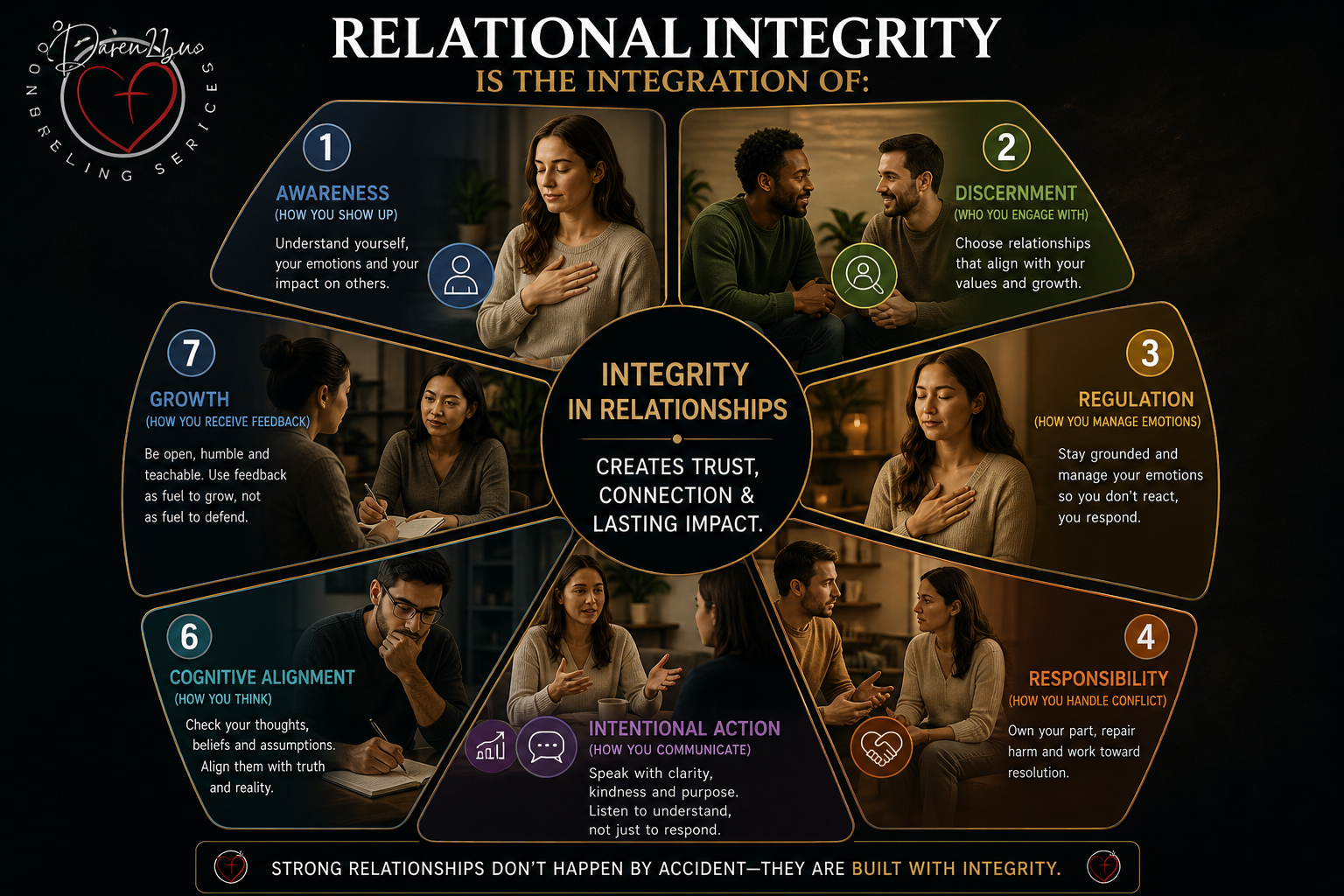
Every GraceRoot course and counseling program is built on a single, integrated framework — the Relational Integrity Principles. Developed by GraceRoot Institute under the academic direction of Dr. Donetta Quinones, PhD, LPC, LMHC, this framework brings together trauma-informed clinical science and Christ-centered truth to address how we heal, how we relate, and who we become through the process.
Six commitments that form the foundation of every course, every workbook, and every clinical resource GraceRoot produces.
Each principle is both a clinical target and a spiritual commitment — inseparable in GraceRoot's approach to healing.
Healing begins with truth. GraceRoot's courses create structured environments where students can be honest — with themselves, with God, and in their relationships — without shame. Every workbook module is designed to surface buried truths gently, using attachment science and Scripture as dual guides. Honesty is not confrontation; it is the precondition for change.
Accountability in the GraceRoot framework is not punishment — it is the practice of owning one's impact without self-condemnation. Drawing on forensic psychology and biblical models of confession and restoration, our curriculum equips students to recognize patterns, acknowledge harm, and take responsibility in ways that move toward healing rather than shame spirals. It is a necessary stop on the road from injury to integrity.
Trauma consistently erodes boundary clarity — either through enmeshment, avoidance, or the belief that limits are unloving. GraceRoot teaches boundaries as a form of love: loving yourself enough to say what is and isn't acceptable, and loving others enough to hold them to the dignity they deserve. Every course builds the clinical and relational language students need to identify, name, and hold healthy limits.
Forgiveness is perhaps the most misunderstood principle in relational healing. GraceRoot does not rush students toward it, nor does it weaponize it. Forgiveness is modeled as a process — one grounded in grief, honest reckoning with harm, and a distinctly Christ-centered understanding of what it means to release debt without excusing injury. It is a destination reached through the other principles, not a shortcut past them.
Trust is not rebuilt through promises — it is rebuilt through patterns, witnessed over time. GraceRoot's curriculum treats trust as a clinical and relational skill, not a feeling. Students learn what secure attachment looks like in practice, how to read safety cues accurately after trauma has distorted them, and how to extend trust incrementally and wisely. Faith and psychology meet here: trust in God informs the capacity to trust others.
The destination of the framework is restored relationship — with self, with God, and where possible and wise, with others. This is not naive reconciliation; GraceRoot's clinical approach distinguishes between restoration that is healthy and reunion that repeats harm. The goal is wholeness: a life shaped by integrity, capable of genuine intimacy, and anchored in an identity that isn't defined by what was done to you or what you've done.
GraceRoot's program catalog is organized around these six principles. Each course addresses a specific relational wound — narcissistic abuse, betrayal, emotional dysregulation, attachment injury — but every one maps back to the same framework. Students don't just learn concepts; they move through a structured clinical and theological arc from assessment to restored trust.
The flagship Rooted & Restored program covers all six principles across 12 modules. Shorter programs — like Healing From Narcissistic Abuse and the Speak to These Dry Bones series — focus the framework on specific injury types.
Explore Our Courses →Dr. Quinones' DAREU2BU counseling practice applies these same six principles in individualized therapeutic settings. The courses were built to extend and reinforce what clients work on in session — not to replace therapeutic work, but to deepen it between appointments.
If you're currently working with a therapist, GraceRoot's curriculum is designed to complement your clinical care with structured, evidence-informed content you can engage at your own pace.
Information for Clinicians →The Relational Integrity Principles inform GraceRoot's clinical referral framework. If you're a licensed clinician looking for structured, faith-integrated adjunct resources for clients working through relational trauma, attachment injury, or betrayal — GraceRoot courses are built to work alongside your clinical modality.
See the clinical referral framework →GraceRoot courses are psychoeducational learning programs, not emergency care, legal advice, or a replacement for therapy. Certificates document GraceRoot completion. Court, employer, board, or continuing education acceptance should be confirmed before purchase unless a page states a specific approval.