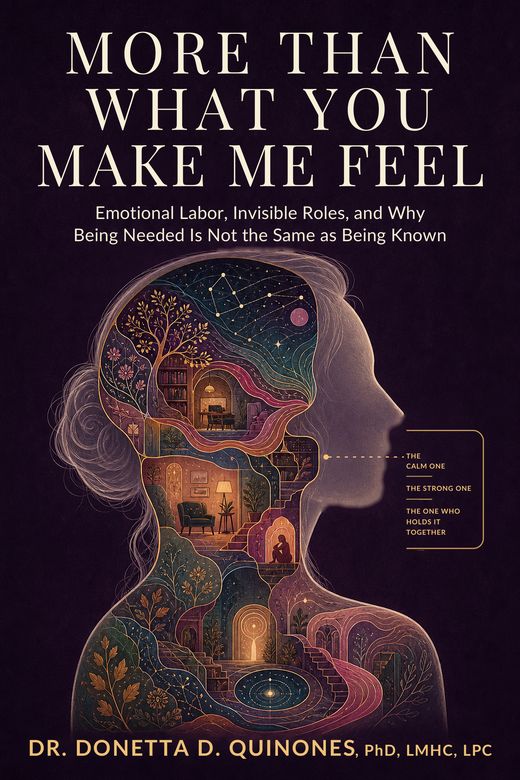
Cover of More Than What You Make Me Feel by Dr. Donetta D. Quinones — the book this course is built from

Self-paced course · Book One of the Objectification Series

Being Known: A Course on Emotional Labor and Invisible Roles

Being needed is not the same as being known.

12modules 10.5 hrsat your own pace 120flashcards 120quiz questions

Dr. Donetta D. Quinones, PhD, LMHC, LPC · GraceRoot Relationship Healing Institute

Who this is for

If you are the calm one, the reliable one, the eldest daughter, the manager everybody likes — the person who reads a room before taking their coat off — this course is for you. It is equally for anyone who suspects they have been on the other side of that arrangement, which is most of us.

No background in psychology is assumed, and you do not have to have read the book to take the course.

The promiseBy the end, you will be able to name the difference between being needed and being known, in ordinary words, using examples you can point at.
  • Name emotional objectification in one plain sentence, so you can talk about it without reaching for jargon or blame.
  • Recognize the six roles people get flattened into — Regulator, Mirror, Anchor, Spark, Witness, Container — so you can see which one you carry and which you hand out.
  • Tell a description of a person from a casting of a person, so you can check the difference instead of arguing about it.
  • Trace how invisible emotional labor becomes invisible, so you can point at the structure rather than at a character flaw.
  • Run the cost test on a real evening, so you can explain your reasoning to somebody else and be understood.

What you will be able to do

  • By the end of this course, you will be able to define emotional objectification in plain words and distinguish it from dependency, ordinary selfishness, and simple neglect.
  • By the end of this course, you will be able to name the six functions a person can be flattened into and describe what each one makes unspeakable.
  • By the end of this course, you will be able to distinguish a description of a person from a casting of a person, and state the test that separates them.
  • By the end of this course, you will be able to trace how invisible emotional labor becomes invisible, naming at least four of its structural causes.
  • By the end of this course, you will be able to apply the difference between being needed and being known to a worked example and explain your reasoning to somebody else.

Why trust it

Dr. Donetta D. Quinones, PhD, LMHC, LPC is a licensed mental health counselor and licensed professional counselor, a certified Human Behavior Consultant, and the founder of GraceRoot Relationship Healing Institute. This course is built from her book More Than What You Make Me Feel: Emotional Labor, Invisible Roles, and Why Being Needed Is Not the Same as Being Known, one module per chapter, in the book's order.

The teaching is trauma-informed and plain-spoken. Every person and scene in the course is a fictional composite. Nothing here is a diagnostic instrument, and no arrangement of answers — none, in any combination — produces a finding about you or about anybody you know.

The twelve modules

One module per chapter of the book. Each takes between thirty-five minutes and an hour, and each is built the same way: a short opening scene, three to five terms defined in ordinary words, the teaching itself, a worked example you watch, a half-finished example you complete, and one small practice you can do alone this week.

01You’re My Calm
Naming the compression at the center
45 min
02Marisol Is Eight, and She Is Working
Where the habit comes from
50 min
03The Woman Who Remembers Every Birthday
Why invisible work stays invisible
50 min
04Your Dot Stopped Moving
Access, refusal, and what a no costs
50 min
05Thank God for You
How families hand out parts
50 min
06Six Rooms on a Sunday Night
The same pattern in ordinary rooms
55 min
07The Tiredness That Sleep Does Not Touch
What it costs the person inside it
55 min
08The Chapter Where It’s You
Turning the lantern the other way
55 min
09The Credential
When insight becomes armor
50 min
10The Label That Loves You Back
When the compression is self-applied
50 min
11What You Do on the Third Day
Repair, refusal, and taking a consequence
55 min
12Ask Something You Cannot Predict
What mutual recognition actually looks like
55 min

Format & what you get

  • Twelve self-paced modules — about 10.5 hrs in total, retakable and revisitable as long as you have access.
  • 120 flashcards and 120 comprehension questions, ten of each per module, with an explanation of why each answer lands where it does.
  • Written reflection built into every module, with Download, Print, Backup and Restore tools in the course toolbar.
  • Everything you type stays in your own browser, on your own device. It is never sent to the author or to any server.
  • Nothing is timed, nothing accumulates against you, and no quiz ever produces a finding about you.

Price

$149

One payment. Self-paced, revisit any time, and questions go to support@graceroot.institute.

Already a member — or thinking about it? This course is included in the Flourishing all-access membership ($99/mo) and the À-la-carte plan (pick any 6 courses, $49/mo), instead of paying $149 for this one. See membership options →

Questions people actually ask

Do I need to have read the book first?

No. The course stands on its own and assumes no background in psychology. It follows the book's twelve chapters in order, so reading alongside it works well, but nothing here depends on it.

Is this going to tell me my relationship is bad?

No. The quizzes check the material, never the learner — they ask whether you can tell a description from a casting, not about your marriage or your family. There is no result at the end, no level, no type, and no finding about you or anybody you know.

What if I recognize myself in this?

Most people do, and the course says so directly in Module 1. Nearly every human being does this in bursts, under load, to people they would drive through the night for. Seeing it is a capacity, not a symptom — and it is the capacity every repair is built out of.

How much time does it take?

About 10.5 hours in total, in modules of 35 to 60 minutes. Nothing is timed and nothing accumulates against you. You can read a module straight through and skip every activity if that is the week you are having.

Where does my writing go?

Into your own browser, on your own device, and nowhere else. Nothing you type is sent to the author or to any server. You can back it up, restore it on another device, or erase it entirely from the course toolbar.

Still in the Next Room

Being needed is not the same as being known.

By the end, you will be able to name the difference between being needed and being known, in ordinary words, using examples you can point at.

Program Clarity

GraceRoot courses are psychoeducational learning programs, not emergency care, legal advice, or a replacement for therapy. Certificates document GraceRoot completion. Court, employer, board, or continuing education acceptance should be confirmed before purchase unless a page states a specific approval.