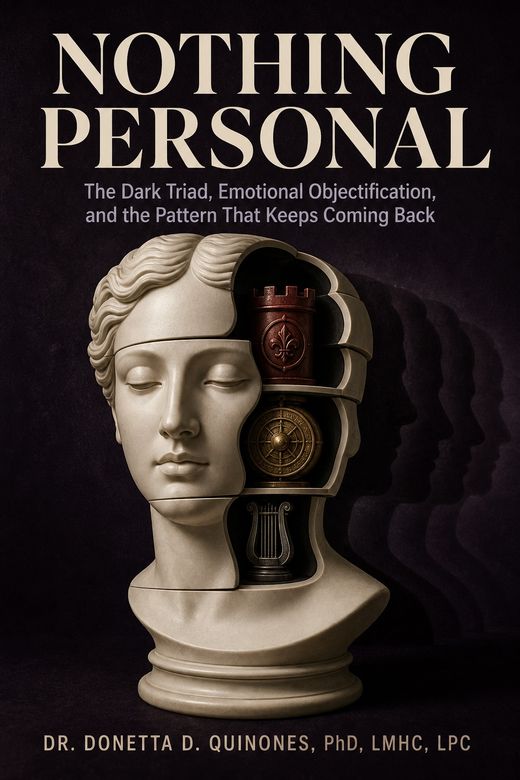
Cover of Nothing Personal by Dr. Donetta D. Quinones — the book this course is built from

Self-paced course · Book Three of the Objectification Series

A Description You Can Check: A Course on Emotional Objectification

Stop asking what they are. Start describing what happened.

12modules 10.5 hrsat your own pace 120flashcards 120quiz questions

Dr. Donetta D. Quinones, PhD, LMHC, LPC · GraceRoot Relationship Healing Institute

Who this is for

If you live or work next to somebody difficult and have run out of language for it — a sibling, a parent, a partner, a manager, an adult child — this course is for you. It is equally for anyone who came away from a paperback with a word instead of a next step, and for anyone who has recognized their own conduct in this material and wants somewhere to go with that.

No background in psychology is assumed, and you do not have to have read the book to take the course.

The promiseBy the end, you will be able to replace the question of what somebody is with an account of what happened, how often, and what followed when it was raised — a description you can check, act on, and say out loud.
  • Replace what somebody is with what happened, how often, and what followed when you raised it — so you can say something you are able to check.
  • Tell a lapse from a method, a trait score from a diagnosis from an epithet, so you can stop borrowing clinical weight your evidence does not carry.
  • Name false coherence, concept creep, and moral disengagement in plain words, so you can spot them in your own account as readily as in theirs.
  • Build a description that survives being repeated, so you can take it to a therapist, an HR meeting, or a family conversation and be taken seriously.
  • Decide what to do with the description once you have it, so you can act on evidence rather than on a label.

What you will be able to do

  • By the end of this course, you will be able to define emotional objectification, compression, false coherence, relational integrity, concept creep, moral disengagement, and dimensional traits in ordinary words.
  • By the end of this course, you will be able to distinguish a lapse from a method, a trait score from a diagnosis from an epithet, and a hard season from a running method.
  • By the end of this course, you will be able to describe a situation in three parts — what happened, how often, and what happened when it was raised — and explain why it survives being read aloud where a label does not.
  • By the end of this course, you will be able to trace what research supports, what it does not, and where nobody has yet done the study, using the specific findings and hedges this course cites.
  • By the end of this course, you will be able to apply the difference between filters and armor to your own conditions, and name the six safeguarding habits without turning any of them into a test of another person.

Why trust it

Dr. Donetta D. Quinones, PhD, LMHC, LPC is a licensed mental health counselor and licensed professional counselor, a certified Human Behavior Consultant, and the founder of GraceRoot Relationship Healing Institute. This course is built from her book Nothing Personal, one module per chapter, in the book's order.

The teaching is trauma-informed and plain-spoken. Every person and scene in the course is a fictional composite. Nothing here is a diagnostic instrument, and no arrangement of answers — none, in any combination — produces a finding about you or about anybody you know.

The twelve modules

One module per chapter of the book. Each takes between thirty-five minutes and an hour, and each is built the same way: a short opening scene, three to five terms defined in ordinary words, the teaching itself, a worked example you watch, a half-finished example you complete, and one small practice you can do alone this week.

01Nothing Personal
When compression stops being an accident
45 min
02Three Words and What They Actually Mean
Where the Dark Triad came from, honestly
55 min
03The Word That Ends the Conversation
Why a label closes inquiry
50 min
04The Account That Never Loses
False coherence, and why insight does not arrive
50 min
05The Charm Was Not a Trick
Speed, durability, and the missing interval
45 min
06Everybody Gets Promoted
Titles, access, and the harm that is informational
50 min
07When There Is Nothing In It
Relational integrity, and the fourth week
55 min
08The Wound That Isn’t There
What the attachment research actually says
55 min
09It Runs in the Family
Four strands, and the study nobody has run
60 min
10The One Strand You Can Reach
Rules, selection, and honest limits
55 min
11The Normal-Looking Version
Media, moral disengagement, and a dispute told honestly
50 min
12Filters, Not Armor
Safeguarding without becoming a person who scans
50 min

Format & what you get

  • Twelve self-paced modules — about 10.5 hrs in total, retakable and revisitable as long as you have access.
  • 120 flashcards and 120 comprehension questions, ten of each per module, with an explanation of why each answer lands where it does.
  • Written reflection built into every module, with Download, Print, Backup and Restore tools in the course toolbar.
  • Everything you type stays in your own browser, on your own device. It is never sent to the author or to any server.
  • Nothing is timed, nothing accumulates against you, and no quiz ever produces a finding about you.

Price

$149

One payment. Self-paced, revisit any time, and questions go to support@graceroot.institute.

Already a member — or thinking about it? This course is included in the Flourishing all-access membership ($99/mo) and the À-la-carte plan (pick any 6 courses, $49/mo), instead of paying $149 for this one. See membership options →

Questions people actually ask

Is this course saying the person I am dealing with is fine?

No. It is saying that a description you can check is stronger than a label you cannot — in a therapist's office, in an HR meeting, and in your own head at three in the morning. A description does not minimize what happened; it makes it usable.

Will it diagnose anybody?

No, and it will not help you diagnose anybody either. That is the point of the course. It teaches description, not diagnosis, and it never produces a finding about you or about anyone you name.

Do I need to have read the book first?

No. The course stands on its own and follows the book's twelve chapters in order.

How much time does it take?

About 10.5 hours in total, in modules of 35 to 60 minutes, entirely at your own pace.

Where does my writing go?

Into your own browser, on your own device, and nowhere else. Nothing you type is sent to the author or to any server — which matters more than usual for this particular course.

What You Are Left Holding

Stop asking what they are. Start describing what happened.

By the end, you will be able to replace the question of what somebody is with an account of what happened, how often, and what followed when it was raised — a description you can check, act on, and say out loud.

Program Clarity

GraceRoot courses are psychoeducational learning programs, not emergency care, legal advice, or a replacement for therapy. Certificates document GraceRoot completion. Court, employer, board, or continuing education acceptance should be confirmed before purchase unless a page states a specific approval.